Mole Snake

Mole Snake

Pseudaspis cana

Silhouette: SeismicShrimp · PhyloPic

LCLeast ConcernNTVUENCR
Daily sighting probability ~30% · Possible
at Cape Town

In 3 days ~60% in a week ~90%

425 Verified sightings at Cape Town
389 In all 3 parks From 2019 to 2026
November Best month
☀️ Diurnal When it's spotted

About the Mole Snake

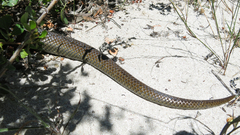
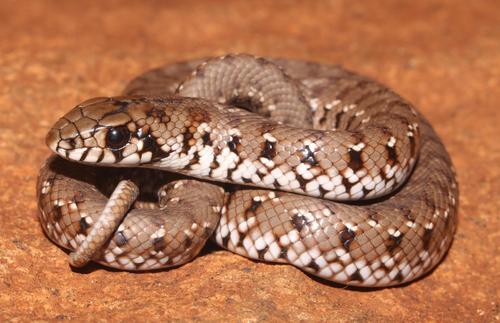
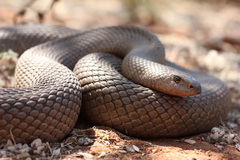
The mole snake (Pseudaspis cana) is a species of snake. It has been placed in the family Lamprophiidae, and more recently in the family Pseudaspididae, along with the genus Pythonodipsas. It is native to much of southern Africa, and is the only member of the genus Pseudaspis. A study showed that P. cana is caught and consumed by the honey badger, among other species. Remains of the mole snake were found in the faeces, and suggest the consumed individuals were larger specimens.

P. cana was originally described by Carl Linnaeus in his landmark 1758 10th edition of Systema Naturae. Its original binomial name was Coluber cana. Since then, it has also been called Coronella cana by André Marie Constant Duméril, Gabriel Bibron and Auguste Duméril in 1854, before being reclassified as Pseudaspis cana by Edward Drinker Cope in 1864. P. cana is the only species in genus Pseudaspis. The genus has been placed in the family Lamprophiidae. More recently it has been placed in the family Pseudaspididae, along with the genera Buhoma and Pythonodipsas, although a 2019 study concluded that the status of Pseudaspididae "deserves to be viewed with caution", and Buhoma may not belong in the... Wikipedia →
Global Distribution

Parks Where Found

# Park Country Daily sighting probability
1 West Coast National Park 🇿🇦 South Africa
~50%
2 Kgalagadi Transfrontier Park 🇿🇦 South Africa
~20%
3 Table Mountain National Park 🇿🇦 South Africa
~20%

Cities Where Found

# City Country Daily sighting probability
1 Cape Town 🇿🇦 South Africa
~30%

Zoos & Centres Where Found

# Zoo / Centre Country
1 Giraffe House 🇿🇦 South Africa In captivity
2 Two Oceans Aquarium 🇿🇦 South Africa In captivity

Before you go

What are the chances of seeing a Mole Snake in Cape Town?

Possible

About 30% of wildlife watchers report a Mole Snake sighting in Cape Town on a given day, based on 425 verified sightings from GBIF citizen-science data. It is the 6th most-seen of the 35 reptiles we can rate there. Over three days the chance rises to about 60%, and over a week to about 90%, if each day is a fresh chance.

When is the best time to see a Mole Snake in Cape Town?

March and November

In those months about 40% of wildlife watchers report a Mole Snake in Cape Town on a given day, against about 20% in January–February and May–August, the lowest months. Those are among Cape Town's driest months, with about 35 mm of rain a month against 140 mm in June.

What time of day is best to see a Mole Snake?

Between 9 am and noon

Across all the parks we cover, that three-hour window holds the most Mole Snake sightings with a recorded time, and about 9 in 10 of them come between 6 am and 6 pm: it is a daytime animal.

Where else can you see a Mole Snake?

Only Cape Town, in our data

Cape Town is the only city on Wallace's Line with enough records to rate Mole Snake sightings: about 30% of wildlife watchers there report one on a given day.

Where does the Mole Snake sighting chance come from?

GBIF citizen-science records

It is estimated from how often the Mole Snake is recorded against all the reptiles logged in Cape Town (425 verified sightings), calibrated against known sighting rates. Figures are rounded to the nearest 10% because citizen-science data supports honest approximations, not decimals, and months with records from fewer than five people show "—". How it works.

← Back to Cape Town