Namaqua Dwarf Chameleon

Namaqua Dwarf Chameleon

Bradypodion occidentale

LCLeast ConcernNTVUENCR
Daily sighting probability ~10% · With luck
at Cape Town

In 3 days ~20% in a week ~40%

37 Verified sightings at Cape Town
13 In 1 park From 2019 to 2026
September Best month
☀️🌙 Day & Night When it's spotted

About the Namaqua Dwarf Chameleon

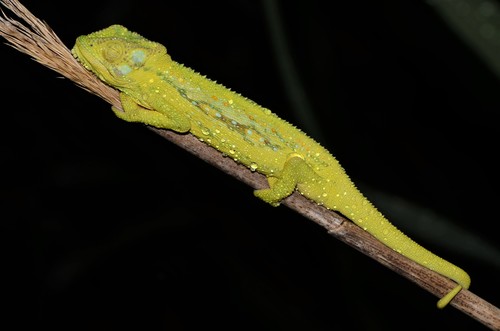
The Namaqua dwarf chameleon or the western dwarf chameleon (Bradypodion occidentale) occurs in beach vegetation, along the west coast of South Africa and Namibia. The Namaqua is relatively large for a Dwarf Chameleon, reaching up to 16 cm in length. It also has a relatively stocky build, and the shortest tail of its genus. It has several distinctive "gular" grooves under its chin, running from its mouth down to the top of its chest. In colour it is a dull, mottled brown-grey.

This species occurs along the coastal regions of the far west of South Africa. It is found in a belt from Melkbosstrand (near Cape Town) in the south, up to Lüderitz, Namibia. In this range, it favours the coastal Strandveld vegetation and is only very rarely found further inland. In the south, near Cape Town, its range slightly overlaps with that of the Cape Dwarf Chameleon, but the two favour different habitats. They can also easily be distinguished as the Cape Dwarf Chameleon has far brighter colouration, with a lighter build, longer tail, and blunter nose and casque.

In the vicinity of human habitation, they have a tendency to fall victim to domestic cats. They are... Wikipedia →

Global Distribution

Parks Where Found

# Park Country Daily sighting probability
1 West Coast National Park 🇿🇦 South Africa
~20%

More parks will be added in future updates.

Cities Where Found

# City Country Daily sighting probability
1 Cape Town 🇿🇦 South Africa
~10%

Before you go

What are the chances of seeing a Namaqua Dwarf Chameleon in Cape Town?

With luck

About 10% of wildlife watchers report a Namaqua Dwarf Chameleon sighting in Cape Town on a given day, based on 37 verified sightings from GBIF citizen-science data. It is the 19th most-seen of the 35 reptiles we can rate there. Over three days the chance rises to about 20%, and over a week to about 40%, if each day is a fresh chance.

When is the best time to see a Namaqua Dwarf Chameleon in Cape Town?

January, April and July–October

In those months about 10% of wildlife watchers report a Namaqua Dwarf Chameleon in Cape Town on a given day, against under 5% in February–March, May–June and November–December, the lowest months.

What time of day is best to see a Namaqua Dwarf Chameleon?

Between 8 and 11 pm

Across all the parks we cover, that three-hour window holds the most Namaqua Dwarf Chameleon sightings with a recorded time, and about half of them come between 6 pm and 6 am: it is seen both by day and at night.

Where else can you see a Namaqua Dwarf Chameleon?

Only Cape Town, in our data

Cape Town is the only city on Wallace's Line with enough records to rate Namaqua Dwarf Chameleon sightings: about 10% of wildlife watchers there report one on a given day.

Where does the Namaqua Dwarf Chameleon sighting chance come from?

GBIF citizen-science records

It is estimated from how often the Namaqua Dwarf Chameleon is recorded against all the reptiles logged in Cape Town (37 verified sightings), calibrated against known sighting rates. Figures are rounded to the nearest 10% because citizen-science data supports honest approximations, not decimals, and months with records from fewer than five people show "—". How it works.

← Back to Cape Town