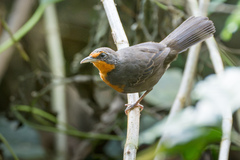
Rosy Thrush-Tanager

Rosy Thrush-Tanager

Rhodinocichla rosea

Silhouette: Sheatherius · PhyloPic

LCLeast ConcernNTVUENCR
Daily sighting probability ~10% · With luck
at Caracas

In 3 days ~20% in a week ~40%

857 Verified sightings at Caracas
1,674 In all 5 parks From 2019 to 2026
April Best month
☀️ Diurnal When it's spotted

About the Rosy Thrush-Tanager

The rosy thrush-tanager (Rhodinocichla rosea) or rose-breasted thrush-tanager is a species of bird in its own family, Rhodinocichlidae. It is found in Colombia, Costa Rica, Mexico, Panama, and Venezuela. The rosy thrush-tanager has a complicated taxonomic history. It was formally described in 1832 with the binomial Furnarius roseus, identifying it as a hornero in the ovenbird family Furnariidae. It was later recognized as an oscine ("songbird") and in 1853 was placed in its own genus Rhodinocichla. Its placement was not settled; nineteenth century authors suggested it belonged to one of several families. In the early twentieth century it settled into the tanager family Thraupidae and remained there into the twenty-first. A 2015 study suggested that it belonged in its own family. This classification was soon adopted by some taxonomic systems but others placed it as incertae sedis pending further evaluation. By 2018 the major systems had assigned it to its own family Rhodinocichlidae and placed it in the linear sequence between the families Calcariidae (longspurs and snow buntings) and emberizidae (Old World buntings).

The rosy thrush-tanager has these five... Wikipedia →

Sounds

Song0:49

Panama · 2025

© Charlie Vogt · XC991691 · CC BY-NC-SA 4.0

Call0:25

Costa Rica · 2024

© Johan Chaves · XC923426 · CC BY-NC-SA 4.0

Song?0:57

Panama · 2009

© Karl Kaufmann · XC29242 · CC BY-NC-ND 2.5

Global Distribution

Parks Where Found

# Park Country Daily sighting probability
1 Parque Natural Metropolitano 🇵🇦 Panama
~10%
2 Volcán Barú National Park 🇵🇦 Panama
~10%
3 Soberanía National Park 🇵🇦 Panama
~10%
4 La Amistad International Park (Panama) 🇵🇦 Panama
~10%
5 Chagres National Park 🇵🇦 Panama
~10%

Cities Where Found

# City Country Daily sighting probability
1 Caracas 🇻🇪 Venezuela
~10%
2 Valencia 🇻🇪 Venezuela
<5%
3 Panama City 🇵🇦 Panama
<5%

Before you go

What are the chances of seeing a Rosy Thrush-Tanager in Caracas?

With luck

About 10% of wildlife watchers report a Rosy Thrush-Tanager sighting in Caracas on a given day, based on 857 verified sightings from GBIF citizen-science data. It is the 74th most-seen of the 295 birds we can rate there. Over three days the chance rises to about 20%, and over a week to about 40%, if each day is a fresh chance.

When is the best time to see a Rosy Thrush-Tanager in Caracas?

April–October and December–February

In those months about 10% of wildlife watchers report a Rosy Thrush-Tanager in Caracas on a given day, against under 5% in March and November, the lowest months.

What time of day is best to see a Rosy Thrush-Tanager?

Between 8 and 11 am

Across all the parks we cover, that three-hour window holds the most Rosy Thrush-Tanager sightings with a recorded time, and about 9 in 10 of them come between 6 am and 6 pm: it is a daytime animal.

Is Caracas the best place to see a Rosy Thrush-Tanager?

Yes

Of the 3 cities where we can rate Rosy Thrush-Tanager sightings, Caracas has the highest daily chance: about 10%. Next come Valencia (Venezuela, under 5%) and Panama City (Panama, under 5%).

Which relatives of the Rosy Thrush-Tanager live in Caracas?

Same order: Passeriformes

The closest relatives of the Rosy Thrush-Tanager that you can see in Caracas (order Passeriformes, Perching Birds) are Blue-gray Tanager (about 90%), Tropical Kingbird (about 80%) and Southern House Wren (about 80%), with each one's daily chance of a sighting.

Where does the Rosy Thrush-Tanager sighting chance come from?

GBIF citizen-science records

It is estimated from how often the Rosy Thrush-Tanager is recorded against all the birds logged in Caracas (857 verified sightings), calibrated against known sighting rates. Figures are rounded to the nearest 10% because citizen-science data supports honest approximations, not decimals, and months with records from fewer than five people show "—". How it works.

← Back to Caracas