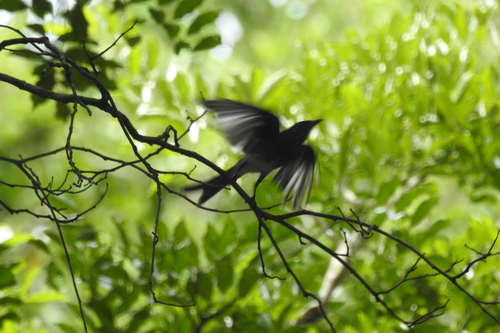
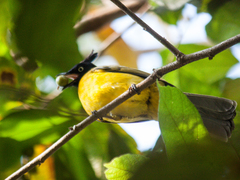
Black-capped Bulbul

Black-capped Bulbul

Pycnonotus melanicterus

Silhouette: Andy Wilson · PhyloPic

Daily sighting probability <5% · Rare
at Colombo [Sri Jayawardenepura Kotte]

In 3 days <5%

8 Verified sightings at Colombo [Sri Jayawardenepura Kotte]
1,303 In all 5 parks From 2019 to 2026
June Best month
🌅 Crepuscular When it's spotted

About the Black-capped Bulbul

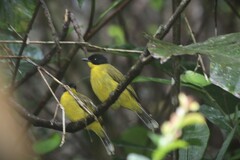
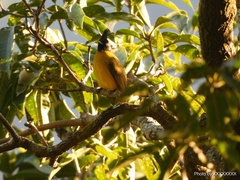
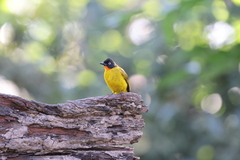
The black-capped bulbul (Rubigula melanictera), or black-headed yellow bulbul, is a member of the bulbul family of passerine birds. It is endemic to Sri Lanka. The black-capped bulbul was formally described in 1789 by the German naturalist Johann Friedrich Gmelin in his revised and expanded edition of Carl Linnaeus's Systema Naturae. He placed it with the flycatchers in the genus Muscicapa and coined the binomial name Muscicapa melanictera. The specific epithet combines the Ancient Greek melas meaning "black" with ikteros meaning "jaundice-yellow". Gmelin based his description on the "yellow-breasted fly-catcher" from Sri Lanka that had been described and illustrated in 1776 by the English naturalist Peter Brown.

The black-capped bulbul was formerly placed in the genus Pycnonotus. A molecular phylogenetic study of the bulbul family published in 2017 found that Pycnonotus was polyphyletic. In the revision to the generic classification the black-capped bulbul and four other species were moved from Pycnonotus to Rubigula.

Until 2008, the black-capped bulbul was considered as conspecific with the black-crested, ruby-throated, flame-throated and Bornean bulbuls. Some authorities... Wikipedia →

Sounds

Recording0:22

Sri Lanka · 2024

© Edmundas Greimas · iNaturalist · CC BY 4.0

Global Distribution

Parks Where Found

# Park Country Daily sighting probability
1 Sinharaja Forest Reserve 🇱🇰 Sri Lanka
~60%
2 Minneriya National Park 🇱🇰 Sri Lanka
~20%
3 Wilpattu National Park 🇱🇰 Sri Lanka
~10%
4 Yala National Park 🇱🇰 Sri Lanka
<5%
5 Udawalawe National Park 🇱🇰 Sri Lanka
<5%

Cities Where Found

# City Country Daily sighting probability
1 Colombo [Sri Jayawardenepura Kotte] 🇱🇰 Sri Lanka
<5%

Zoos & Centres Where Found

# Zoo / Centre Country
1 Hong Kong Zoological and Botanical Gardens 🇨🇳 China In captivity
2 Edward Youde Aviary 🇭🇰 Hong Kong SAR China In captivity

Before you go

What are the chances of seeing a Black-capped Bulbul in Colombo [Sri Jayawardenepura Kotte]?

Rare

Under 5% of wildlife watchers report a Black-capped Bulbul sighting in Colombo [Sri Jayawardenepura Kotte] on a given day, based on 8 verified sightings from GBIF citizen-science data. It is the 183rd most-seen of the 204 birds we can rate there. Over three days the chance rises to under 5%, if each day is a fresh chance.

When is the best time to see a Black-capped Bulbul in Colombo [Sri Jayawardenepura Kotte]?

Any time of year

In every month with enough records, under 5% of wildlife watchers report a Black-capped Bulbul in Colombo [Sri Jayawardenepura Kotte] on a given day, so our monthly data shows no clear season.

What time of day is best to see a Black-capped Bulbul?

Between 3 and 6 am

Across all the parks we cover, that three-hour window holds the most Black-capped Bulbul sightings with a recorded time, and about half of them come between 6 pm and 6 am: it is most active around dawn and dusk.

Where else can you see a Black-capped Bulbul?

Only Colombo [Sri Jayawardenepura Kotte], in our data

Colombo [Sri Jayawardenepura Kotte] is the only city on Wallace's Line with enough records to rate Black-capped Bulbul sightings: under 5% of wildlife watchers there report one on a given day.

Where does the Black-capped Bulbul sighting chance come from?

GBIF citizen-science records

It is estimated from how often the Black-capped Bulbul is recorded against all the birds logged in Colombo [Sri Jayawardenepura Kotte] (8 verified sightings), calibrated against known sighting rates. Figures are rounded to the nearest 10% because citizen-science data supports honest approximations, not decimals, and months with records from fewer than five people show "—". How it works.

← Back to Colombo [Sri Jayawardenepura Kotte]