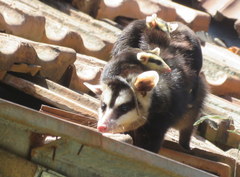
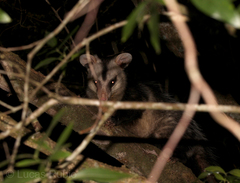
White-eared Opossum

White-eared Opossum

Didelphis albiventris

Silhouette: Sarah Werning · PhyloPic

LCLeast ConcernNTVUENCR
Daily sighting probability ~10% · With luck
at Cordoba

In 3 days ~40% in a week ~60%

11 Verified sightings at Cordoba
14 In all 2 parks From 2019 to 2026
August Best month
☀️🌙 Day & Night When it's spotted

About the White-eared Opossum

The white-eared opossum (Didelphis albiventris), known as the timbu and cassaco in northeast Brazil, saruê and sariguê in Bahia, micurê and mucura in northern Brazil and comadreja overa and zarigüeya in Argentina, is an opossum species found in Argentina, Bolivia, Brazil, Paraguay, and Uruguay. It is a terrestrial and, sometimes, arboreal animal, and a habitat generalist, living in a wide range of different habitats.

For some time, this species was incorrectly known by the name D. azarae, correctly applied to the big-eared opossum. This led to azarae's discontinuation as a species name. From 1993 until 2002, this species also included the Guianan white-eared opossum (D. imperfecta) and the Andean white-eared opossum (D. pernigra) as subspecies.

It is the team mascot of Clube Náutico Capibaribe, a Brazilian football team from Recife, Pernambuco. The white-eared opossum is about one to three pounds in weight and has black and grey fur, with white hair covering their ears and face, and dark hair on their long tails. They are omnivorous, feeding on invertebrates, small vertebrates, and fruits.

White-eared opossums inhabit open areas, mountains... Wikipedia →

Global Distribution

Parks Where Found

# Park Country Daily sighting probability
1 Chapada Diamantina National Park 🇧🇷 Brazil
~20%
2 Iguazú National Park 🇦🇷 Argentina
~10%

Cities Where Found

# City Country Daily sighting probability
1 Natal 🇧🇷 Brazil
~40%
2 João Pessoa 🇧🇷 Brazil
~40%
3 Recife 🇧🇷 Brazil
~30%
4 Brasilia 🇧🇷 Brazil
~30%
5 Campo Grande 🇧🇷 Brazil
~30%
6 Asuncion 🇵🇾 Paraguay
~20%
7 Rosario 🇦🇷 Argentina
~20%
8 Montevideo 🇺🇾 Uruguay
~20%
9 Porto Alegre 🇧🇷 Brazil
~20%
10 Belo Horizonte 🇧🇷 Brazil
~20%

Closest Relatives at Cordoba

No species of the same family or order lives in Cordoba, so these are its closest relatives here: other mammals.

Before you go

What are the chances of seeing a White-eared Opossum in Cordoba?

With luck

About 10% of wildlife watchers report a White-eared Opossum sighting in Cordoba on a given day, based on 11 verified sightings from GBIF citizen-science data. Over three days the chance rises to about 40%, and over a week to about 60%, if each day is a fresh chance.

When is the best time to see a White-eared Opossum in Cordoba?

August

In that month about 30% of wildlife watchers report a White-eared Opossum in Cordoba on a given day, against under 5% in February–March and October–November, the lowest months. That is one of Cordoba's driest months, with about 5 mm of rain against 130 mm in February.

What time of day is best to see a White-eared Opossum?

Between 7 and 10 pm

Across all the parks we cover, that three-hour window holds the most White-eared Opossum sightings with a recorded time, and about 6 in 10 of them come between 6 am and 6 pm: it is seen both by day and at night.

Is Cordoba the best place to see a White-eared Opossum?

13th of 17

Of the 17 cities where we can rate White-eared Opossum sightings, Cordoba ranks 13th at about 10%. The best odds are in Natal (Brazil, about 40%), João Pessoa (Brazil, about 40%) and Recife (Brazil, about 30%).

Where does the White-eared Opossum sighting chance come from?

GBIF citizen-science records

It is estimated from how often the White-eared Opossum is recorded against all the mammals logged in Cordoba (11 verified sightings), calibrated against known sighting rates. Figures are rounded to the nearest 10% because citizen-science data supports honest approximations, not decimals, and months with records from fewer than five people show "—". How it works.

← Back to Cordoba