Plumbeous Rail

Plumbeous Rail

Pardirallus sanguinolentus

Silhouette: Sheatherius · PhyloPic

LCLeast ConcernNTVUENCR
Daily sighting probability ~10% · With luck
at Curitiba

In 3 days ~20% in a week ~40%

95 Verified sightings at Curitiba
63 In all 3 parks From 2019 to 2026
January Best month
☀️ Diurnal When it's spotted

About the Plumbeous Rail

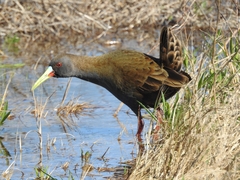
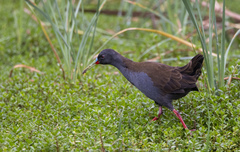
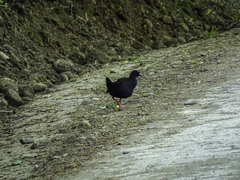
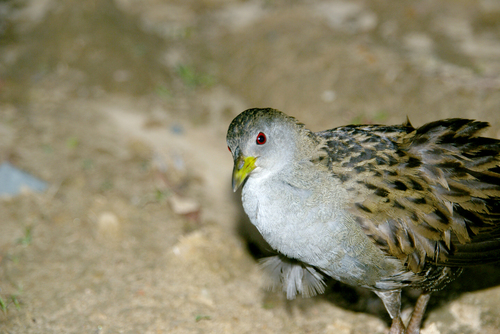
The plumbeous rail (Pardirallus sanguinolentus) is a species of bird in the subfamily Rallinae of the rail, crake, and coot family Rallidae. It is found in Argentina, Bolivia, Brazil, Chile, Ecuador, Paraguay, Peru and Uruguay.

The plumbeous rail has previously been placed in the large genus Rallus, and also in genus Orygonax with the blackish rail (Pardirallus nigricans). Some authors propose that the blackish and plumbeous rails are conspecific, and they do form a superspecies. The plumbeous rail has these six subspecies:

Pardirallus sanguinolentus simonsi Chubb, C., 1918 Pardirallus sanguinolentus tschudii Chubb, C., 1919 Pardirallus sanguinolentus zelebori (Pelzeln, 1865) Pardirallus sanguinolentus sanguinolentus (Swainson, 1838) Pardirallus sanguinolentus landbecki (Hellmayr, 1932)

Pardirallus sanguinolentus luridus (Peale, 1849) The blackish rail is 30 to 38 cm (12 to 15 in) long and weighs 170 to 230 g (6.0 to 8.1 oz). The sexes are alike. They have red eyes and legs. They have a green bill and in all but subspecies P. s. luridus the maxilla has a sky blue base and the mandible a bright red one. Wikipedia →


Sounds

Duet1:27

Uruguay · 2024

© Guillermo Menéndez (gmmv80) · XC923442 · CC BY-NC-SA 4.0

Song0:32

Uruguay · 2018

© Pedro Rinaldi · XC913070 · CC BY-NC-SA 4.0

Call1:18

Chile · 2023

© Barry Edmonston · XC856861 · CC BY-NC-SA 4.0

Global Distribution

Parks Where Found

# Park Country Daily sighting probability
1 El Palmar National Park 🇦🇷 Argentina
<5%
2 Iberá National Park 🇦🇷 Argentina
<5%
3 Torres del Paine National Park 🇨🇱 Chile
<5%

Cities Where Found

# City Country Daily sighting probability
1 Rosario 🇦🇷 Argentina
~20%
2 Buenos Aires 🇦🇷 Argentina
~10%
3 Lima 🇵🇪 Peru
~10%
4 Arequipa 🇵🇪 Peru
~10%
5 Cochabamba 🇧🇴 Bolivia
~10%
6 Curitiba 🇧🇷 Brazil
~10%
7 La Paz 🇧🇴 Bolivia
<5%
8 Santiago 🇨🇱 Chile
<5%
9 Montevideo 🇺🇾 Uruguay
<5%
10 Cordoba 🇦🇷 Argentina
<5%

Zoos & Centres Where Found

# Zoo / Centre Country
1 Bioparque Municipal Vesty Pakos 🇧🇴 Bolivia In captivity

Before you go

What are the chances of seeing a Plumbeous Rail in Curitiba?

With luck

About 10% of wildlife watchers report a Plumbeous Rail sighting in Curitiba on a given day, based on 95 verified sightings from GBIF citizen-science data. It is the 99th most-seen of the 247 birds we can rate there. Over three days the chance rises to about 20%, and over a week to about 40%, if each day is a fresh chance.

When is the best time to see a Plumbeous Rail in Curitiba?

May, July, September–October and December–February

In those months about 10% of wildlife watchers report a Plumbeous Rail in Curitiba on a given day, against under 5% in March–April, June, August and November, the lowest months.

What time of day is best to see a Plumbeous Rail?

Between 3 and 6 pm

Across all the parks we cover, that three-hour window holds the most Plumbeous Rail sightings with a recorded time, and about 9 in 10 of them come between 6 am and 6 pm: it is a daytime animal.

Is Curitiba the best place to see a Plumbeous Rail?

6th of 12

Of the 12 cities where we can rate Plumbeous Rail sightings, Curitiba ranks 6th at about 10%. The best odds are in Rosario (Argentina, about 20%), Buenos Aires (Argentina, about 10%) and Lima (Peru, about 10%).

Where does the Plumbeous Rail sighting chance come from?

GBIF citizen-science records

It is estimated from how often the Plumbeous Rail is recorded against all the birds logged in Curitiba (95 verified sightings), calibrated against known sighting rates. Figures are rounded to the nearest 10% because citizen-science data supports honest approximations, not decimals, and months with records from fewer than five people show "—". How it works.

← Back to Curitiba