Chinese Mantis

Chinese Mantis

Tenodera sinensis

Daily sighting probability ~20% · Possible
at Daejeon

In 3 days ~40% in a week ~70%

7 Verified sightings at Daejeon
125 In all 3 parks From 2019 to 2026
September Best month
☀️ Diurnal When it's spotted

About the Chinese Mantis

The Chinese mantis (Tenodera sinensis), is a species of mantis native to temperate Asia and the nearby islands. In 1896, this species was accidentally introduced by a nursery tender at Mt. Airy, a neighborhood of Philadelphia, United States. T. sinensis often is erroneously referred to as Tenodera aridifolia sinensis because it was at first described as a subspecies of Tenodera aridifolia, but T. sinensis is now established as a full species.

T. sinensis feeds primarily on other large insects, though adult females sometimes catch small vertebrates. For example, they have been observed feeding on hornets, spiders, grasshoppers, katydids, small reptiles, amphibians, and even hummingbirds. Like most mantids, they are known to be cannibalistic. One study found that cannibalism occurs in up to 50% of matings. These mantids have been observed eating the larvae of monarch butterflies, while discarding the entrails.

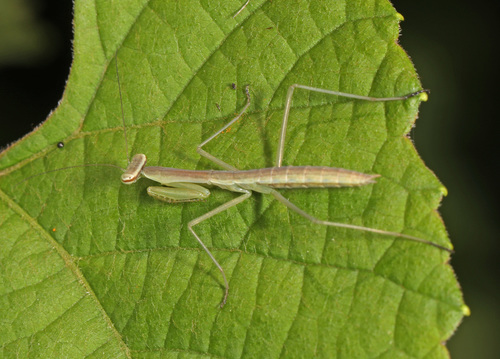
The Chinese mantis is a long, slender, brown and green praying mantis. It is typically longer than other praying mantis species, reaching just over 11 cm (4.3 in), and is the largest mantis species in North America (spread throughout the Northeast United States... Wikipedia →
Global Distribution

Parks Where Found

# Park Country Daily sighting probability
1 Point Pelee National Park 🇨🇦 Canada
~20%
2 Shenandoah National Park 🇺🇸 United States
~10%
3 Great Smoky Mountains National Park 🇺🇸 United States
~10%

Cities Where Found

# City Country Daily sighting probability
1 Nagoya 🇯🇵 Japan
~30%
2 Detroit 🇺🇸 United States
~20%
3 Hefei 🇨🇳 China
~20%
4 Daegu 🇰🇷 South Korea
~20%
5 Salt Lake City 🇺🇸 United States
~20%
6 Tokyo 🇯🇵 Japan
~20%
7 Daejeon 🇰🇷 South Korea
~20%
8 Baltimore 🇺🇸 United States
~10%
9 Osaka 🇯🇵 Japan
~10%
10 Boston 🇺🇸 United States
~10%

Before you go

What are the chances of seeing a Chinese Mantis in Daejeon?

Possible

About 20% of wildlife watchers report a Chinese Mantis sighting in Daejeon on a given day, based on 7 verified sightings from GBIF citizen-science data. It is the 31st most-seen of the 53 insects we can rate there. Over three days the chance rises to about 40%, and over a week to about 70%, if each day is a fresh chance.

When is the best time to see a Chinese Mantis in Daejeon?

September and October

In those months about 30% of wildlife watchers report a Chinese Mantis in Daejeon on a given day, against under 5% in July and November–May, the lowest months.

What time of day is best to see a Chinese Mantis?

Between noon and 3 pm

Across all the parks we cover, that three-hour window holds the most Chinese Mantis sightings with a recorded time, and nearly all of them come between 6 am and 6 pm: it is a daytime animal.

Is Daejeon the best place to see a Chinese Mantis?

7th of 31

Of the 31 cities where we can rate Chinese Mantis sightings, Daejeon ranks 7th at about 20%. The best odds are in Nagoya (Japan, about 30%), Detroit (United States, about 20%) and Hefei (China, about 20%).

Where does the Chinese Mantis sighting chance come from?

GBIF citizen-science records

It is estimated from how often the Chinese Mantis is recorded against all the insects logged in Daejeon (7 verified sightings), calibrated against known sighting rates. Figures are rounded to the nearest 10% because citizen-science data supports honest approximations, not decimals, and months with records from fewer than five people show "—". How it works.

← Back to Daejeon