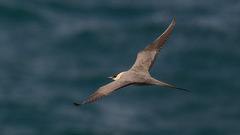
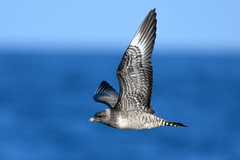
Long-tailed Jaeger

Long-tailed Jaeger

Stercorarius longicaudus

Silhouette: Andy Wilson · PhyloPic

LCLeast ConcernNTVUENCR
Daily sighting probability ~10% · With luck
at Dakar

In 3 days ~40% in a week ~70%

36 Verified sightings at Dakar
282 In all 7 parks From 2019 to 2026
September Best month
☀️ Diurnal When it's spotted

About the Long-tailed Jaeger

The long-tailed jaeger or long-tailed skua (Stercorarius longicaudus) is a seabird in the skua family Stercorariidae. The word "jaeger" is derived from the German word Jäger, meaning "hunter". The English word "skua" comes from the Faroese name skúgvur [ˈskɪkvʊər] for the great skua, with the island of Skúvoy known for its colony of that bird. The general Faroese term for skuas is kjógvi [ˈtʃɛkvə]. The genus name Stercorarius is Latin and means "of dung"; the food disgorged by other birds when pursued by skuas was once thought to be excrement. The specific longicaudus is from Latin longus, "long", and cauda, "tail".

This species is unmistakable as an adult, with grey back, dark primary wing feathers without a white "flash", black cap and very long tail. Adults often hover over their breeding territories. Juveniles are much more problematic, and are difficult to separate from parasitic jaeger over the sea. They are slimmer, longer-winged and more tern-like than that species, but show the same wide range of plumage variation. However, they are usually colder toned than Arctic, with greyer shades, rather than brown.

This is the smallest of the skua family... Wikipedia →

Sounds

Call0:17

Sweden · 2026

© brickegickel · XC1153304 · CC BY-NC-SA 4.0

Alarm call0:30

Sweden · 2024

© Thomas Bergman · XC912774 · CC BY-NC-SA 4.0

Begging call0:54

Sweden · 2014

© Rob van Bemmelen · XC202897 · CC BY-NC-SA 4.0

Global Distribution

Parks Where Found

# Park Country Daily sighting probability
1 Svalbard 🇳🇴 Norway
~10%
2 Denali National Park 🇺🇸 United States
~10%
3 Kenai Fjords National Park 🇺🇸 United States
<5%
4 Cabo Blanco Absolute Nature Reserve 🇨🇷 Costa Rica
<5%
5 Wadden Sea National Park 🇩🇪 Germany
<5%
6 Great Bear Rainforest 🇨🇦 Canada
<5%
7 Point Pelee National Park 🇨🇦 Canada
<5%

Cities Where Found

# City Country Daily sighting probability
1 Dakar 🇸🇳 Senegal
~10%
2 Tel Aviv 🇮🇱 Israel
<5%
3 London 🇬🇧 United Kingdom
<5%
4 Sydney 🇦🇺 Australia
<5%
5 Denver 🇺🇸 United States
<5%

Before you go

What are the chances of seeing a Long-tailed Jaeger in Dakar?

With luck

About 10% of wildlife watchers report a Long-tailed Jaeger sighting in Dakar on a given day, based on 36 verified sightings from GBIF citizen-science data. It is the 72nd most-seen of the 152 birds we can rate there. Over three days the chance rises to about 40%, and over a week to about 70%, if each day is a fresh chance.

When is the best time to see a Long-tailed Jaeger in Dakar?

September

In that month about 40% of wildlife watchers report a Long-tailed Jaeger in Dakar on a given day, against under 5% in January, the lowest month. That is one of Dakar's wettest months, with about 170 mm of rain against almost none in May.

What time of day is best to see a Long-tailed Jaeger?

Between 10 am and 1 pm

Across all the parks we cover, that three-hour window holds the most Long-tailed Jaeger sightings with a recorded time, and about 8 in 10 of them come between 6 am and 6 pm: it is a daytime animal.

Is Dakar the best place to see a Long-tailed Jaeger?

Yes

Of the 5 cities where we can rate Long-tailed Jaeger sightings, Dakar has the highest daily chance: about 10%. Next come Tel Aviv (Israel, under 5%) and London (United Kingdom, under 5%).

Which relatives of the Long-tailed Jaeger live in Dakar?

Same genus: Stercorarius

The closest relatives of the Long-tailed Jaeger that you can see in Dakar (genus Stercorarius, Skuas and Jaegers) are Parasitic Jaeger (about 30%), Pomarine Jaeger (about 20%) and South Polar Skua (about 10%), with each one's daily chance of a sighting.

Where does the Long-tailed Jaeger sighting chance come from?

GBIF citizen-science records

It is estimated from how often the Long-tailed Jaeger is recorded against all the birds logged in Dakar (36 verified sightings), calibrated against known sighting rates. Figures are rounded to the nearest 10% because citizen-science data supports honest approximations, not decimals, and months with records from fewer than five people show "—". How it works.

← Back to Dakar