


Roseate Tern

Roseate Tern

Sterna dougallii

Silhouette: Sharon Wegner-Larsen · PhyloPic

LCLeast ConcernNTVUENCR
Daily sighting probability ~10% · With luck
at Dakar

In 3 days ~30% in a week ~60%

31 Verified sightings at Dakar
111 In all 4 parks From 2019 to 2026
September Best month
☀️ Diurnal When it's spotted

About the Roseate Tern

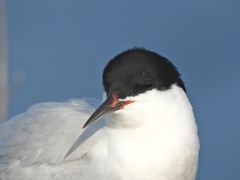
The roseate tern (Sterna dougallii) is a species of tern in the family Laridae. The genus name Sterna is derived from Old English "stearn", "tern", and the specific dougallii refers to Scottish physician and collector Dr Peter McDougall (1777–1814). "Roseate" refers to the bird's pink breast in breeding plumage.

English naturalist George Montagu described the roseate tern in 1813. Genetically, it is most closely related to the white-fronted tern (S. striata), with their common ancestor a sister lineage to the black-naped tern (S. sumatrana).

This species has a number of geographical subspecies, differing mainly in bill colour and minor plumage details. S. d. dougallii breeds on the Atlantic coasts of Europe and North America, and winters south to the Caribbean and west Africa. Both the European and North American populations have been in long-term decline, though active conservation measures have reversed the decline in the last few years at some colonies, most notably at Rockabill Island off the coast of Dublin, Ireland, which now holds most of the European population (about 1200 pairs). Wikipedia →

Sounds

Call0:05

France · 2022

© Tristan Guillebot de Nerville · XC894056 · CC BY-NC-SA 4.0

Nocturnal flight call0:34

Ireland · 2022

© Irish Wildlife Sounds · XC741036 · CC BY-NC-ND 4.0

Flight call0:47

Ireland · 2022

© Paul Kelly · XC737953 · CC BY-NC-SA 4.0

Global Distribution

Parks Where Found

# Park Country Daily sighting probability
1 Rottnest Island 🇦🇺 Australia
~10%
2 Ningaloo Marine Park 🇦🇺 Australia
~10%
3 Arrecifes de Cozumel National Park 🇲🇽 Mexico
<5%
4 Main Ridge Forest Reserve 🇹🇹 Trinidad and Tobago
<5%

Cities Where Found

# City Country Daily sighting probability
1 Dakar 🇸🇳 Senegal
~10%
2 Dublin 🇮🇪 Ireland
<5%
3 Liverpool 🇬🇧 United Kingdom
<5%
4 Kaohsiung 🇹🇼 Taiwan
<5%
5 New York City 🇺🇸 United States
<5%

Before you go

What are the chances of seeing a Roseate Tern in Dakar?

With luck

About 10% of wildlife watchers report a Roseate Tern sighting in Dakar on a given day, based on 31 verified sightings from GBIF citizen-science data. It is the 78th most-seen of the 152 birds we can rate there. Over three days the chance rises to about 30%, and over a week to about 60%, if each day is a fresh chance.

When is the best time to see a Roseate Tern in Dakar?

September

In that month about 40% of wildlife watchers report a Roseate Tern in Dakar on a given day, against under 5% in January and February, the lowest months. That is one of Dakar's wettest months, with about 170 mm of rain against almost none in May.

What time of day is best to see a Roseate Tern?

Between 10 am and 1 pm

Across all the parks we cover, that three-hour window holds the most Roseate Tern sightings with a recorded time, and about 9 in 10 of them come between 6 am and 6 pm: it is a daytime animal.

Is Dakar the best place to see a Roseate Tern?

Yes

Of the 5 cities where we can rate Roseate Tern sightings, Dakar has the highest daily chance: about 10%. Next come Dublin (Ireland, under 5%) and Liverpool (United Kingdom, under 5%).

Which relatives of the Roseate Tern live in Dakar?

Same genus: Sterna

The closest relatives of the Roseate Tern that you can see in Dakar (genus Sterna, Typical Terns) are Common Tern (about 40%) and Arctic Tern (about 20%), with each one's daily chance of a sighting.

Where does the Roseate Tern sighting chance come from?

GBIF citizen-science records

It is estimated from how often the Roseate Tern is recorded against all the birds logged in Dakar (31 verified sightings), calibrated against known sighting rates. Figures are rounded to the nearest 10% because citizen-science data supports honest approximations, not decimals, and months with records from fewer than five people show "—". How it works.

← Back to Dakar