Yellow-Legged Hornet
Daily sighting probability ~10% · With luck
at Dehradun

In 3 days ~30% in a week ~60%

5 Verified sightings at Dehradun
184 In all 6 parks From 2019 to 2026
June Best month
☀️ Diurnal When it's spotted

About the Yellow-Legged Hornet

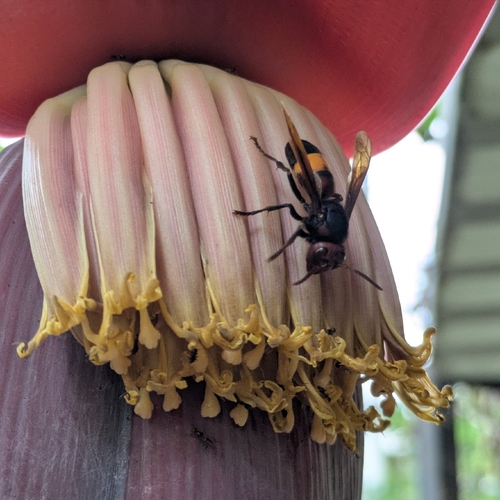
The Asian hornet (Vespa velutina), also known as the yellow-legged hornet or Asian predatory wasp, is a species of hornet indigenous to Southeast Asia. It is of concern as an invasive species in some other countries, including most of Europe.

Vespa velutina is significantly smaller than the European hornet. Typically, queens are 30 mm (1.2 in) long, and males about 24 mm (0.94 in). Workers are about 20 mm (0.79 in) long. The species has distinctive yellow tarsi (legs). The thorax is a velvety brown or black with a brown abdomen. Each abdominal segment has a narrow posterior yellow border, except for the fourth segment, which is orange. The head is black and the face yellow. Regional forms vary sufficiently in colour to cause difficulties in classification, and several subspecies have been variously identified and ultimately rejected; while there is a history of recognising subspecies within many of the Vespa species, including V. velutina, the most recent taxonomic revision of the genus treats all subspecific names in the genus Vespa as synonyms, effectively relegating them to no more than informal names for regional colour forms. The colour form causing concern about... Wikipedia →

Global Distribution

Parks Where Found

# Park Country Daily sighting probability
1 Cuc Phuong National Park 🇻🇳 Vietnam
~20%
2 Taroko National Park 🇹🇼 Taiwan
~20%
3 Cévennes National Park 🇫🇷 France
~10%
4 Pyrénées National Park 🇫🇷 France
~10%
5 Picos de Europa National Park 🇪🇸 Spain
~10%
6 Mercantour National Park 🇫🇷 France
~10%

Cities Where Found

# City Country Daily sighting probability
1 Brussels 🇧🇪 Belgium
~40%
2 Kunming 🇨🇳 China
~40%
3 Hefei 🇨🇳 China
~40%
4 Nanning 🇨🇳 China
~30%
5 Hanoi 🇻🇳 Vietnam
~30%
6 Gwangju 🇰🇷 South Korea
~30%
7 Busan 🇰🇷 South Korea
~30%
8 Guiyang 🇨🇳 China
~30%
9 Xi'an 🇨🇳 China
~30%
10 Chengdu 🇨🇳 China
~30%

Before you go

What are the chances of seeing a Yellow-Legged Hornet in Dehradun?

With luck

About 10% of wildlife watchers report a Yellow-Legged Hornet sighting in Dehradun on a given day, based on 5 verified sightings from GBIF citizen-science data. It is the 53rd most-seen of the 73 insects we can rate there. Over three days the chance rises to about 30%, and over a week to about 60%, if each day is a fresh chance.

When is the best time to see a Yellow-Legged Hornet in Dehradun?

June and September

In those months about 30% of wildlife watchers report a Yellow-Legged Hornet in Dehradun on a given day, against under 5% in July–August and October–May, the lowest months. Those are among Dehradun's wettest months, with about 170 mm of rain a month against 5 mm in November.

What time of day is best to see a Yellow-Legged Hornet?

Between 10 am and 1 pm

Across all the parks we cover, that three-hour window holds the most Yellow-Legged Hornet sightings with a recorded time, and about 9 in 10 of them come between 6 am and 6 pm: it is a daytime animal.

Is Dehradun the best place to see a Yellow-Legged Hornet?

35th of 41

Of the 41 cities where we can rate Yellow-Legged Hornet sightings, Dehradun ranks 35th at about 10%. The best odds are in Brussels (Belgium, about 40%), Kunming (China, about 40%) and Hefei (China, about 40%).

Which relatives of the Yellow-Legged Hornet live in Dehradun?

Same genus: Vespa

The closest relatives of the Yellow-Legged Hornet that you can see in Dehradun (genus Vespa, Hornets) are Black-Bellied Hornet (about 20%) and Greater Banded Hornet (about 10%), with each one's daily chance of a sighting.

Where does the Yellow-Legged Hornet sighting chance come from?

GBIF citizen-science records

It is estimated from how often the Yellow-Legged Hornet is recorded against all the insects logged in Dehradun (5 verified sightings), calibrated against known sighting rates. Figures are rounded to the nearest 10% because citizen-science data supports honest approximations, not decimals, and months with records from fewer than five people show "—". How it works.

← Back to Dehradun