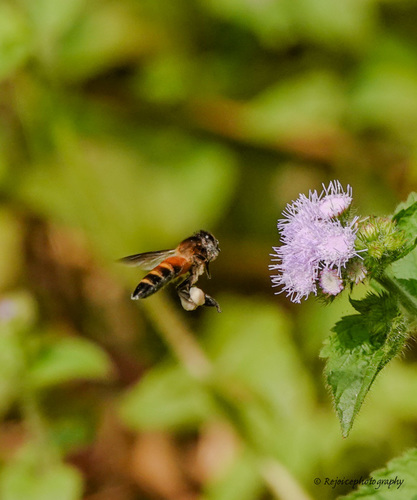
Giant Honey Bee
Daily sighting probability ~30% · Possible
at Dehradun

In 3 days ~60% in a week ~90%

19 Verified sightings at Dehradun
341 In all 28 parks From 2019 to 2026
May Best month
☀️ Diurnal When it's spotted

About the Giant Honey Bee

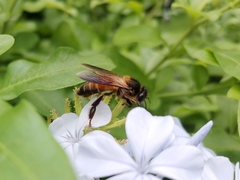
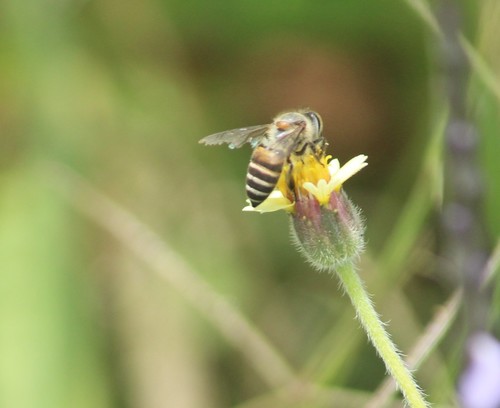
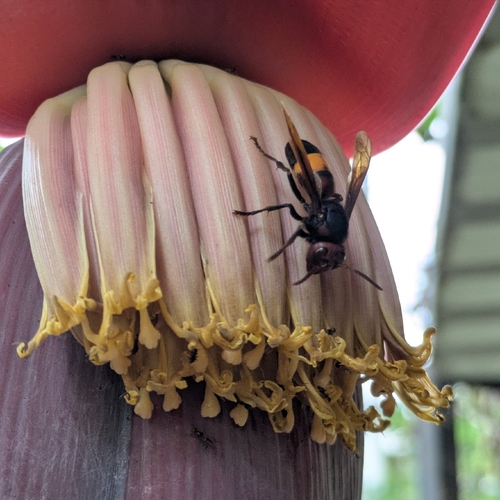
Apis dorsata, the rock bee or giant honey bee, is a honey bee of South and Southeast Asia. They are typically around 17–20 mm (0.7–0.8 in) long and nests are mainly built in exposed places far off the ground, like on tree limbs, under cliff overhangs, and under buildings. These social bees are known for their aggressive defense strategies and vicious behavior when disturbed. Though the species is not domesticated, indigenous peoples have traditionally used it as a source of honey and beeswax, a practice known as honey hunting.

Apis dorsata belongs to the subgenus Megapis in the family Apidae. This honeybee is most closely related to A. mellifera (the western honey bee), A. cerana, and A. florea. There are a few hypotheses as to when A. dorsata diverged from A. florea and A. cerana, as it is unclear which divergence occurred first. Currently, the consensus hypothesis provides a family tree that claims that A. dorsata diverged from both A. cerana and A. florea at the same time. Wikipedia →
Global Distribution

Parks Where Found

# Park Country Daily sighting probability
1 Horton Plains National Park 🇱🇰 Sri Lanka
~40%
2 Sundarbans National Park 🇮🇳 India
~40%
3 Bandhavgarh National Park 🇮🇳 India
~30%
4 Keoladeo National Park 🇮🇳 India
~30%
5 Khao Sok National Park 🇹🇭 Thailand
~30%
6 Royal Bardia National Park 🇳🇵 Nepal
~30%
7 Cuc Phuong National Park 🇻🇳 Vietnam
~30%
8 Kerinci Seblat National Park 🇮🇩 Indonesia
~30%
9 Minneriya National Park 🇱🇰 Sri Lanka
~30%
10 Ranthambore National Park 🇮🇳 India
~30%
11 Taman Negara National Park 🇲🇾 Malaysia
~30%
12 Kanha National Park 🇮🇳 India
~30%
13 Udawalawe National Park 🇱🇰 Sri Lanka
~30%
14 Komodo National Park 🇮🇩 Indonesia
~20%
15 Bandipur National Park 🇮🇳 India
~20%
16 Khao Yai National Park 🇹🇭 Thailand
~20%
17 Danum Valley Conservation Area 🇲🇾 Malaysia
~20%
18 Periyar National Park 🇮🇳 India
~20%
19 Jim Corbett National Park 🇮🇳 India
~20%
20 Chitwan National Park 🇳🇵 Nepal
~20%
21 Sinharaja Forest Reserve 🇱🇰 Sri Lanka
~20%
22 Kaeng Krachan National Park 🇹🇭 Thailand
~20%
23 Cat Tien National Park 🇻🇳 Vietnam
~20%
24 Gunung Leuser National Park 🇮🇩 Indonesia
~10%
25 Doi Inthanon National Park 🇹🇭 Thailand
~10%
26 Sepilok 🇲🇾 Malaysia
~10%
27 Kinabalu Park 🇲🇾 Malaysia
~10%
28 Kinabatangan Wildlife Sanctuary 🇲🇾 Malaysia
~10%

Cities Where Found

# City Country Daily sighting probability
1 Jammu 🇮🇳 India
~50%
2 Prayagraj 🇮🇳 India
~50%
3 Agra 🇮🇳 India
~50%
4 Jodhpur 🇮🇳 India
~40%
5 Karachi 🇵🇰 Pakistan
~30%
6 Lucknow 🇮🇳 India
~30%
7 Tamluk 🇮🇳 India
~30%
8 Varanasi 🇮🇳 India
~30%
9 Tiruppur 🇮🇳 India
~30%
10 Ahmedabad 🇮🇳 India
~30%

Before you go

What are the chances of seeing a Giant Honey Bee in Dehradun?

Possible

About 30% of wildlife watchers report a Giant Honey Bee sighting in Dehradun on a given day, based on 19 verified sightings from GBIF citizen-science data. It is the 8th most-seen of the 73 insects we can rate there. Over three days the chance rises to about 60%, and over a week to about 90%, if each day is a fresh chance.

When is the best time to see a Giant Honey Bee in Dehradun?

May

In that month about 60% of wildlife watchers report a Giant Honey Bee in Dehradun on a given day, against under 5% in July and October–March, the lowest months. That is one of Dehradun's driest months, with about 45 mm of rain against 370 mm in July.

What time of day is best to see a Giant Honey Bee?

Between 8 and 11 am

Across all the parks we cover, that three-hour window holds the most Giant Honey Bee sightings with a recorded time, and about 8 in 10 of them come between 6 am and 6 pm: it is a daytime animal.

Is Dehradun the best place to see a Giant Honey Bee?

17th of 45

Of the 45 cities where we can rate Giant Honey Bee sightings, Dehradun ranks 17th at about 30%. The best odds are in Jammu (India, about 50%), Prayagraj (India, about 50%) and Agra (India, about 50%).

Where does the Giant Honey Bee sighting chance come from?

GBIF citizen-science records

It is estimated from how often the Giant Honey Bee is recorded against all the insects logged in Dehradun (19 verified sightings), calibrated against known sighting rates. Figures are rounded to the nearest 10% because citizen-science data supports honest approximations, not decimals, and months with records from fewer than five people show "—". How it works.

← Back to Dehradun