Pygmy Nuthatch

Pygmy Nuthatch

Sitta pygmaea

Silhouette: Alan and Elaine Wilson (Modified) · PhyloPic

LCLeast ConcernNTVUENCR
Daily sighting probability <5% · Rare
at Denver

In 3 days <5%

171 Verified sightings at Denver
8,983 In all 7 parks From 2019 to 2026
February Best month
☀️ Diurnal When it's spotted

About the Pygmy Nuthatch

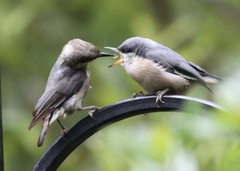
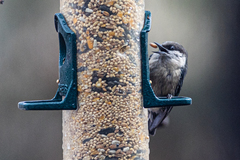
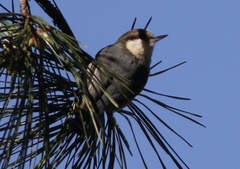
The pygmy nuthatch (Sitta pygmaea) is a tiny songbird, native to western North America. The pygmy nuthatch is 9–11 cm (3.5–4.3 in) long and with a wingspan of 19.7 cm (7.8 in), and weighs 9.3–11.4 g (0.33–0.40 oz). It ranges from southern British Columbia south through various discontinuous parts of the western U.S. (northwest U.S., Sierra Nevada range, southern Rockies, etc.), to central Mexico. It is usually found in pines (especially ponderosa pine), douglas-fir, and other conifers. Pygmy nuthatches clamber acrobatically in the foliage of these trees, feeding on insects and seeds; less often they creep along limbs or the trunk like bigger nuthatches.

Pygmy nuthatches nest in cavities in dead stubs of conifers, lining the bottom of the cavity with pine cone scales, plant fibers, and other soft plant and animal materials. They may fill cracks or crevices around the entrance with fur; the function of this behavior is unknown. The female lays 4–9 eggs, which are white with fine reddish-brown spotting. She does most of the incubation, which lasts about 16 days. The young leave the nest about 22 days after hatching.

This species is highly gregarious. A nesting pair may... Wikipedia →

Sounds

Call0:25

Mexico · 2023

© Matthew L. Brady · XC977839 · CC BY-NC-SA 4.0

Recording0:08

United States · 2022

© Gary Mele · XC712266 · CC BY-NC-SA 4.0

Begging call1:22

United States · 2020

© Paul Marvin · XC571070 · CC BY-NC-SA 4.0

Global Distribution

Parks Where Found

# Park Country Daily sighting probability
1 Rocky Mountain National Park 🇺🇸 United States
~60%
2 Grand Canyon National Park 🇺🇸 United States
~30%
3 Yosemite National Park 🇺🇸 United States
~10%
4 Zion National Park 🇺🇸 United States
<5%
5 Guadalupe Mountains National Park 🇺🇸 United States
<5%
6 Sequoia and Kings Canyon National Parks 🇺🇸 United States
<5%
7 Glacier National Park 🇺🇸 United States
<5%

Cities Where Found

# City Country Daily sighting probability
1 San Francisco 🇺🇸 United States
~20%
2 Minneapolis [Saint Paul] 🇺🇸 United States
~10%
3 Denver 🇺🇸 United States
<5%
4 Portland 🇺🇸 United States
<5%
5 Mexico City 🇲🇽 México
<5%
6 Seattle 🇺🇸 United States
<5%

Before you go

What are the chances of seeing a Pygmy Nuthatch in Denver?

Rare

Under 5% of wildlife watchers report a Pygmy Nuthatch sighting in Denver on a given day, based on 171 verified sightings from GBIF citizen-science data. It is the 197th most-seen of the 299 birds we can rate there. Over three days the chance rises to under 5%, if each day is a fresh chance.

When is the best time to see a Pygmy Nuthatch in Denver?

Any time of year

In every month with enough records, under 5% of wildlife watchers report a Pygmy Nuthatch in Denver on a given day, so our monthly data shows no clear season.

What time of day is best to see a Pygmy Nuthatch?

Between 8 and 11 am

Across all the parks we cover, that three-hour window holds the most Pygmy Nuthatch sightings with a recorded time, and about 8 in 10 of them come between 6 am and 6 pm: it is a daytime animal.

Is Denver the best place to see a Pygmy Nuthatch?

3rd of 6

Of the 6 cities where we can rate Pygmy Nuthatch sightings, Denver ranks 3rd at under 5%. The best odds are in San Francisco (United States, about 20%) and Minneapolis [Saint Paul] (United States, about 10%).

Which relatives of the Pygmy Nuthatch live in Denver?

Same genus: Sitta

The closest relatives of the Pygmy Nuthatch that you can see in Denver (genus Sitta, Nuthatches) are White-breasted Nuthatch (about 30%) and Red-breasted Nuthatch (about 20%), with each one's daily chance of a sighting.

Where does the Pygmy Nuthatch sighting chance come from?

GBIF citizen-science records

It is estimated from how often the Pygmy Nuthatch is recorded against all the birds logged in Denver (171 verified sightings), calibrated against known sighting rates. Figures are rounded to the nearest 10% because citizen-science data supports honest approximations, not decimals, and months with records from fewer than five people show "—". How it works.

← Back to Denver