Cape Rockthrush

Cape Rockthrush

Monticola rupestris

Silhouette: Martin Bulla, based on François Desbordes' illustration · PhyloPic

LCLeast ConcernNTVUENCR
Daily sighting probability ~10% · With luck
at Durban

In 3 days ~20% in a week ~50%

27 Verified sightings at Durban
277 In all 5 parks From 2019 to 2026
June Best month
☀️ Diurnal When it's spotted

About the Cape Rockthrush

The Cape Rock-Thrush (Monticola rupestris) is a member of the bird family Muscicapidae. This rock-thrush breeds in eastern and southern South Africa, Lesotho and Eswatini. It is a common endemic resident, non-migratory apart from seasonal altitudinal movements in some areas.

The Cape Rock-Thrush belongs to the Kingdom Animalia, Phylum Chordata, Class Aves, Order Passeriformes, Family Muscicapidae, Genus Monticola, and Species rupestris. The bird was named for its geographic location in the Cape region of southern Africa and its preference for rocky habitats, where it lives among rocks and cliffs. The scientific name Monticola rupestris reinforces this, with "Monticola" meaning "mountain-dweller" and "rupestris" meaning "living among rocks."

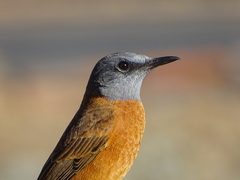
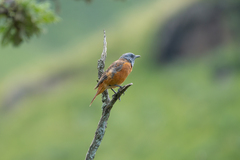
This bird is large and stocky for a rock thrush, measuring 21-22 cm (8.26in) in length. The adult male during the summer features a blue-grey head, orange underparts and outer tail feathers, and brown wings and back. Females have a brown head and richer orange underparts compared to other female rock thrushes.

Vocalizations are an important aspect of this species’ behavior. The male produces a whistled song described... Wikipedia →

Sounds

Song0:39

South Africa · 2022

© Tim Cockcroft · XC728740 · CC BY-NC-SA 4.0

Begging call1:02

South Africa · 2019

© Frank Lambert · XC523697 · CC BY-NC-ND 4.0

Call0:11

Swaziland · 2015

© Joshua Weiss · XC425557 · CC BY-NC-SA 4.0

Global Distribution

Parks Where Found

# Park Country Daily sighting probability
1 Golden Gate Highlands National Park 🇿🇦 South Africa
~40%
2 De Hoop Nature Reserve 🇿🇦 South Africa
<5%
3 Pilanesberg National Park 🇿🇦 South Africa
<5%
4 Addo Elephant National Park 🇿🇦 South Africa
<5%
5 Table Mountain National Park 🇿🇦 South Africa
<5%

Cities Where Found

# City Country Daily sighting probability
1 Durban 🇿🇦 South Africa
~10%
2 Johannesburg 🇿🇦 South Africa
<5%

Before you go

What are the chances of seeing a Cape Rockthrush in Durban?

With luck

About 10% of wildlife watchers report a Cape Rockthrush sighting in Durban on a given day, based on 27 verified sightings from GBIF citizen-science data. It is the 72nd most-seen of the 219 birds we can rate there. Over three days the chance rises to about 20%, and over a week to about 50%, if each day is a fresh chance.

When is the best time to see a Cape Rockthrush in Durban?

March and June

In those months about 20% of wildlife watchers report a Cape Rockthrush in Durban on a given day, against under 5% in August–October and December, the lowest months.

What time of day is best to see a Cape Rockthrush?

Between noon and 3 pm

Across all the parks we cover, that three-hour window holds the most Cape Rockthrush sightings with a recorded time, and nearly all of them come between 6 am and 6 pm: it is a daytime animal.

Is Durban the best place to see a Cape Rockthrush?

Yes

Of the 2 cities where we can rate Cape Rockthrush sightings, Durban has the highest daily chance: about 10%. Next come Johannesburg (South Africa, under 5%).

Where does the Cape Rockthrush sighting chance come from?

GBIF citizen-science records

It is estimated from how often the Cape Rockthrush is recorded against all the birds logged in Durban (27 verified sightings), calibrated against known sighting rates. Figures are rounded to the nearest 10% because citizen-science data supports honest approximations, not decimals, and months with records from fewer than five people show "—". How it works.

← Back to Durban