Fiscal Flycatcher

Fiscal Flycatcher

Sigelus silens

Silhouette: Martin Bulla, based on François Desbordes' illustration · PhyloPic

LCLeast ConcernNTVUENCR
Daily sighting probability <5% · Rare
at Durban

In 3 days <5% in a week ~10%

12 Verified sightings at Durban
2,438 In all 11 parks From 2019 to 2026
April Best month
☀️ Diurnal When it's spotted

About the Fiscal Flycatcher

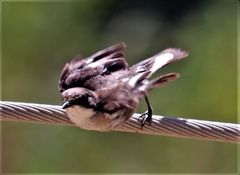
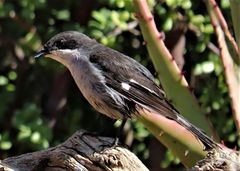
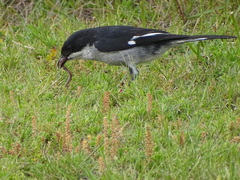
The fiscal flycatcher (Sigelus silens) is a small passerine bird in the Old World flycatcher family. It is the only species placed in the genus Sigelus. It is a resident breeder in Botswana, South Africa, Lesotho, Mozambique and Swaziland, and a vagrant to Namibia.

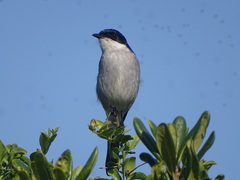
This species is found in subtropical open woodland, dry savanna, shrubland and suburban gardens. The fiscal flycatcher was previously the only member of the genus Sigelus but was moved to Melaenornis based on the results of a molecular phylogenetic study published in 2010. This black and white bird gets its name from its resemblance to the northern and southern fiscal shrikes (previously considered one species, common fiscal), shrikes that in turn get the name from their black and white suit-and-tie appearance reminiscent of the taxman ('fiscal'). The male may be confused with the fiscal shrikes, but the shrikes have heavy, hooked bills, white patches on the shoulder rather than the lower wing, and no white on their longer tails. The resemblance is assumed to be an example of Batesian mimicry.

The fiscal flycatcher is 17–20 cm in length. The adult male is black above and white below with... Wikipedia →

Sounds

Recording0:11

South Africa · 2022

© Marion Maclean · iNaturalist · CC BY-NC 4.0

Recording0:10

South Africa · 2026

© vfdeh · iNaturalist · CC BY-NC 4.0

Recording0:19

South Africa · 2024

© Gareth Bain · iNaturalist · CC BY-NC 4.0

Global Distribution

Parks Where Found

# Park Country Daily sighting probability
1 De Hoop Nature Reserve 🇿🇦 South Africa
~50%
2 Addo Elephant National Park 🇿🇦 South Africa
~40%
3 Garden Route National Park 🇿🇦 South Africa
~20%
4 uMkhuze Game Reserve 🇿🇦 South Africa
~10%
5 Hluhluwe-Imfolozi Park 🇿🇦 South Africa
~10%
6 Table Mountain National Park 🇿🇦 South Africa
~10%
7 Pilanesberg National Park 🇿🇦 South Africa
~10%
8 West Coast National Park 🇿🇦 South Africa
~10%
9 iSimangaliso Wetland Park 🇿🇦 South Africa
<5%
10 Kgalagadi Transfrontier Park 🇿🇦 South Africa
<5%
11 Kruger National Park 🇿🇦 South Africa
<5%

Cities Where Found

# City Country Daily sighting probability
1 Johannesburg 🇿🇦 South Africa
~30%
2 Pretoria 🇿🇦 South Africa
~10%
3 Cape Town 🇿🇦 South Africa
~10%
4 Durban 🇿🇦 South Africa
<5%

Before you go

What are the chances of seeing a Fiscal Flycatcher in Durban?

Rare

Under 5% of wildlife watchers report a Fiscal Flycatcher sighting in Durban on a given day, based on 12 verified sightings from GBIF citizen-science data. It is the 168th most-seen of the 219 birds we can rate there. Over three days the chance rises to under 5%, and over a week to about 10%, if each day is a fresh chance.

When is the best time to see a Fiscal Flycatcher in Durban?

Any time of year

In every month with enough records, under 5% of wildlife watchers report a Fiscal Flycatcher in Durban on a given day, so our monthly data shows no clear season.

What time of day is best to see a Fiscal Flycatcher?

Between 8 and 11 am

Across all the parks we cover, that three-hour window holds the most Fiscal Flycatcher sightings with a recorded time, and nearly all of them come between 6 am and 6 pm: it is a daytime animal.

Is Durban the best place to see a Fiscal Flycatcher?

4th of 4

Of the 4 cities where we can rate Fiscal Flycatcher sightings, Durban ranks 4th at under 5%. The best odds are in Johannesburg (South Africa, about 30%), Pretoria (South Africa, about 10%) and Cape Town (South Africa, about 10%).

Where does the Fiscal Flycatcher sighting chance come from?

GBIF citizen-science records

It is estimated from how often the Fiscal Flycatcher is recorded against all the birds logged in Durban (12 verified sightings), calibrated against known sighting rates. Figures are rounded to the nearest 10% because citizen-science data supports honest approximations, not decimals, and months with records from fewer than five people show "—". How it works.

← Back to Durban