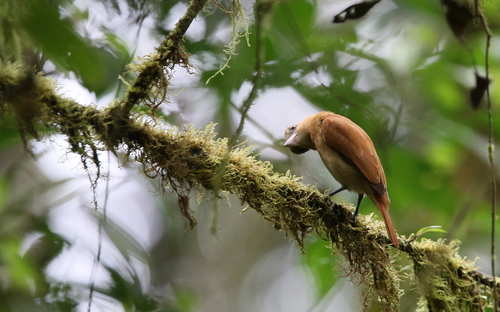
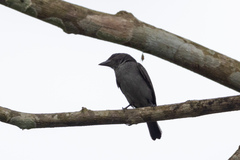

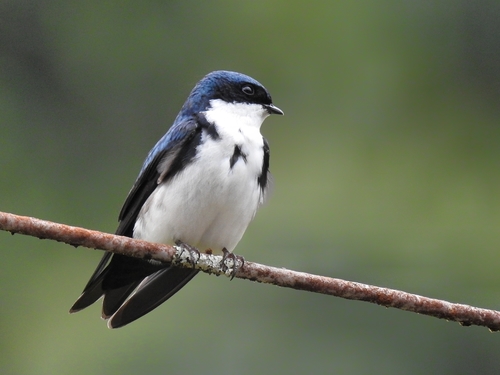
One-colored Becard

One-colored Becard

Pachyramphus homochrous

Silhouette: Sheatherius · PhyloPic

LCLeast ConcernNTVUENCR
Daily sighting probability ~10% · With luck
at Guayaquil

In 3 days ~30% in a week ~60%

107 Verified sightings at Guayaquil
220 In all 2 parks From 2019 to 2026
September Best month
☀️ Diurnal When it's spotted

About the One-colored Becard

The one-colored becard (Pachyramphus homochrous) is a species of bird in the family Tityridae, the tityras, becards, and allies. It is found in Colombia, Ecuador, Panama, Peru, and Venezuela. The one-colored becard was originally described in 1859 as Pachyramphus homochrous, its current binomial. For a time it and several other becards were placed in genus Platypsaris which was merged by most taxonomists into Pachyramphus in 1973. It is now one of 18 becards in genus Pachyramphus that had been introduced in 1839 by George Gray. The genus Pachyramphus has variously been assigned to the tyrant flycatcher family Tyrannidae and the cotinga family Cotingidae. Several early twenty-first century studies confirmed the placement of Pachyramphus in Tityridae and taxonomic systems made the reassignment. In 1998 the American Ornithological Society was unsure where to place the genus and listed its members as incertae sedis but in 2011 moved them to Tityridae.

The one-colored... Wikipedia →

Sounds

Call0:14

Ecuador · 2021

© Manuel Sánchez-Nivicela · XC1149469 · CC BY-NC-ND 4.0

Song0:19

Ecuador · 2020

© José María Loaiza B. · XC582980 · CC BY-NC-SA 4.0

Song0:31

Ecuador · 2018

© Hans Matheve · XC512810 · CC BY-NC-ND 4.0

Global Distribution

Parks Where Found

# Park Country Daily sighting probability
1 Tayrona National Natural Park 🇨🇴 Colombia
~20%
2 Machalilla National Park 🇪🇨 Ecuador
<5%

Cities Where Found

# City Country Daily sighting probability
1 Guayaquil 🇪🇨 Ecuador
~10%
2 Quito 🇪🇨 Ecuador
<5%

Before you go

What are the chances of seeing a One-colored Becard in Guayaquil?

With luck

About 10% of wildlife watchers report a One-colored Becard sighting in Guayaquil on a given day, based on 107 verified sightings from GBIF citizen-science data. It is the 53rd most-seen of the 167 birds we can rate there. Over three days the chance rises to about 30%, and over a week to about 60%, if each day is a fresh chance.

When is the best time to see a One-colored Becard in Guayaquil?

September and November–December

In those months about 20% of wildlife watchers report a One-colored Becard in Guayaquil on a given day, against under 5% in April, the lowest month. Those are among Guayaquil's driest months, with about 10 mm of rain a month against 220 mm in February.

What time of day is best to see a One-colored Becard?

Between 8 and 11 am

Across all the parks we cover, that three-hour window holds the most One-colored Becard sightings with a recorded time, and about 8 in 10 of them come between 6 am and 6 pm: it is a daytime animal.

Is Guayaquil the best place to see a One-colored Becard?

Yes

Of the 2 cities where we can rate One-colored Becard sightings, Guayaquil has the highest daily chance: about 10%. Next come Quito (Ecuador, under 5%).

Which relatives of the One-colored Becard live in Guayaquil?

Same order: Passeriformes

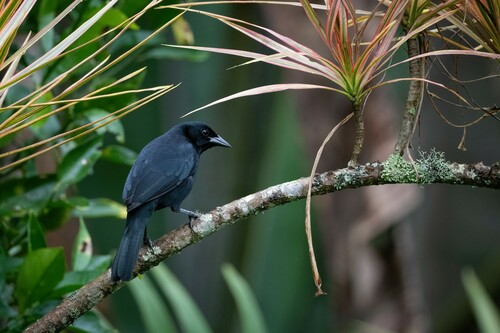
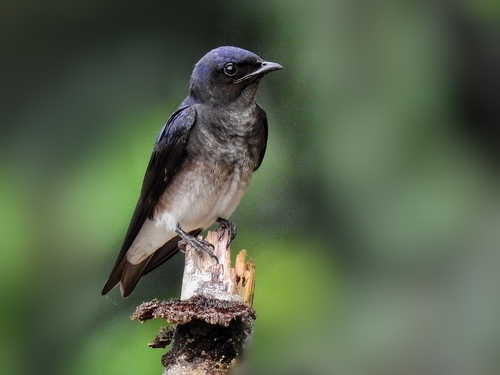
The closest relatives of the One-colored Becard that you can see in Guayaquil (order Passeriformes, Perching Birds) are Blue-gray Tanager (about 90%), Tropical Kingbird (about 80%) and Scrub Blackbird (about 70%), with each one's daily chance of a sighting.

Where does the One-colored Becard sighting chance come from?

GBIF citizen-science records

It is estimated from how often the One-colored Becard is recorded against all the birds logged in Guayaquil (107 verified sightings), calibrated against known sighting rates. Figures are rounded to the nearest 10% because citizen-science data supports honest approximations, not decimals, and months with records from fewer than five people show "—". How it works.

← Back to Guayaquil