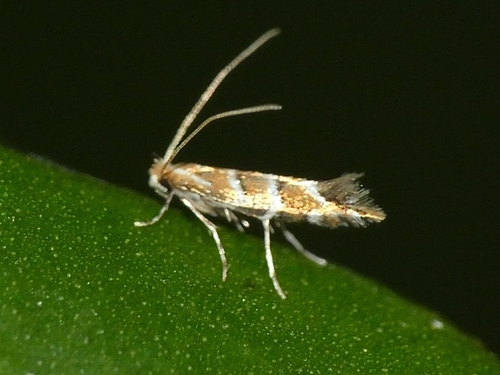
Horse-Chestnut Leafminer

Horse-Chestnut Leafminer

Cameraria ohridella

Daily sighting probability ~10% · With luck
at Hamburg

In 3 days ~20% in a week ~30%

13 Verified sightings at Hamburg
31 In all 4 parks From 2019 to 2026
September Best month
☀️ Diurnal When it's spotted

About the Horse-Chestnut Leafminer

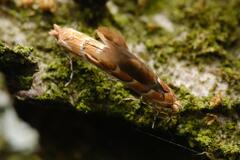
The horse-chestnut leaf miner (Cameraria ohridella) is a leaf-mining moth of the family Gracillariidae. The horse-chestnut leaf miner was first observed in North Macedonia in 1984, and was described as a new species in 1986. Its larvae are leaf miners on the common horse-chestnut (Aesculus hippocastanum). The horse-chestnut leafminer was first collected and inadvertently pressed in herbarium sheets by the botanist Theodor von Heldreich in central Greece in 1879.

Cameraria ohridella causes significant damage, mainly late summer browning, to the appearance of horse-chestnut trees. Despite the poor appearance of these infested trees, there is no evidence that damage by the moth leads to tree death. Seed weight, photosynthetic storage and reproductive capacity may however be reduced. Trees survive repeated infestations and re-flush normally in the following year. It appears that most of the damage caused by the moth occurs too late in the growing season to greatly affect tree performance. Consequently, there is no reason to fell and remove trees just because they are attacked by C. ohridella.

The larva feeds in a mine in the leaves of the tree, damaging the leaves and stunting... Wikipedia →

Global Distribution

Parks Where Found

# Park Country Daily sighting probability
1 Triglav National Park 🇸🇮 Slovenia
~10%
2 Snowdonia National Park 🇬🇧 United Kingdom
~10%
3 Bavarian Forest National Park 🇩🇪 Germany
~10%
4 Wadden Sea National Park 🇩🇪 Germany
<5%

Cities Where Found

# City Country Daily sighting probability
1 Liverpool 🇬🇧 United Kingdom
~30%
2 Kyiv 🇺🇦 Ukraine
~30%
3 Kharkiv 🇺🇦 Ukraine
~20%
4 London 🇬🇧 United Kingdom
~20%
5 Minsk 🇧🇾 Belarus
~20%
6 Sofia 🇧🇬 Bulgaria
~20%
7 Berlin 🇩🇪 Germany
~10%
8 Manchester 🇬🇧 United Kingdom
~10%
9 Warsaw 🇵🇱 Poland
~10%
10 Birmingham 🇬🇧 United Kingdom
~10%

Before you go

What are the chances of seeing a Horse-Chestnut Leafminer in Hamburg?

With luck

About 10% of wildlife watchers report a Horse-Chestnut Leafminer sighting in Hamburg on a given day, based on 13 verified sightings from GBIF citizen-science data. It is the 188th most-seen of the 423 insects we can rate there. Over three days the chance rises to about 20%, and over a week to about 30%, if each day is a fresh chance.

When is the best time to see a Horse-Chestnut Leafminer in Hamburg?

April and June–September

In those months about 10% of wildlife watchers report a Horse-Chestnut Leafminer in Hamburg on a given day, against under 5% in May and October–March, the lowest months.

What time of day is best to see a Horse-Chestnut Leafminer?

Between 10 am and 1 pm

Across all the parks we cover, that three-hour window holds the most Horse-Chestnut Leafminer sightings with a recorded time, and about 8 in 10 of them come between 6 am and 6 pm: it is a daytime animal.

Is Hamburg the best place to see a Horse-Chestnut Leafminer?

25th of 33

Of the 33 cities where we can rate Horse-Chestnut Leafminer sightings, Hamburg ranks 25th at about 10%. The best odds are in Liverpool (United Kingdom, about 30%), Kyiv (Ukraine, about 30%) and Kharkiv (Ukraine, about 20%).

Which relatives of the Horse-Chestnut Leafminer live in Hamburg?

Same order: Lepidoptera

The closest relatives of the Horse-Chestnut Leafminer that you can see in Hamburg (order Lepidoptera, Butterflies and Moths) are European Peacock Butterfly (about 20%), Red Admiral (about 20%) and Green-Veined White (about 20%), with each one's daily chance of a sighting.

Where does the Horse-Chestnut Leafminer sighting chance come from?

GBIF citizen-science records

It is estimated from how often the Horse-Chestnut Leafminer is recorded against all the insects logged in Hamburg (13 verified sightings), calibrated against known sighting rates. Figures are rounded to the nearest 10% because citizen-science data supports honest approximations, not decimals, and months with records from fewer than five people show "—". How it works.
← Back to Hamburg