Dhaman

Dhaman

Ptyas mucosa

Silhouette: Alex Slavenko · PhyloPic

LCLeast ConcernNTVUENCR
Daily sighting probability ~40% · Likely
at Jabalpur

In 3 days ~70% in a week >90%

7 Verified sightings at Jabalpur
39 In all 4 parks From 2019 to 2026
July Best month
☀️ Diurnal When it's spotted

About the Dhaman

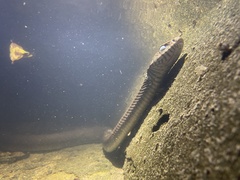
Ptyas mucosa, commonly known as the Oriental rat snake, or Indian rat snake, is a common non-venomous species of colubrid snake found in parts of South and Southeast Asia. These are large snakes. Typical mature total length is around 1.5 to 1.95 m (4 ft 11 in to 6 ft 5 in) though some exceed 2 m (6 ft 7 in). The record length for this species was 3.7 m (12 ft 2 in), second only to their cousin Ptyas carinata among living colubrid snakes. Despite their large size, oriental ratsnakes are usually quite slender with even a specimen of 2 m (6 ft 7 in) commonly measuring 4 to 6 cm (1.6 to 2.4 in) only around in diameter. Furthermore, the average weight of ratsnakes caught in Java was around 877 to 940 g (1.933 to 2.072 lb), though larger males of over 2.3 m (7 ft 7 in) (which average mildly larger of the two sexes in the species) may easily weigh over 2.5 kg (5.5 lb). Their color varies from pale browns in dry regions to nearly black in moist forest areas. Rat snakes are diurnal, semi-arboreal, non-venomous, and fast-moving. Rat snakes eat a variety of prey and are frequently found in urban areas where rodents thrive.

The International Code for Zoological Nomenclature (ICZN... Wikipedia →

Sounds

Recording0:08

India · 2026

© Ajay Malik. · iNaturalist · CC BY-NC 4.0

Global Distribution

Parks Where Found

# Park Country Daily sighting probability
1 Satpura National Park 🇮🇳 India
~20%
2 Sinharaja Forest Reserve 🇱🇰 Sri Lanka
~20%
3 Minneriya National Park 🇱🇰 Sri Lanka
~20%
4 Yala National Park 🇱🇰 Sri Lanka
~20%

Cities Where Found

# City Country Daily sighting probability
1 Lucknow 🇮🇳 India
~40%
2 Thrissur 🇮🇳 India
~40%
3 Jabalpur 🇮🇳 India
~40%
4 Pune 🇮🇳 India
~30%
5 Kalyan-Dombivli 🇮🇳 India
~30%
6 Thiruvananthapuram 🇮🇳 India
~30%
7 Colombo [Sri Jayawardenepura Kotte] 🇱🇰 Sri Lanka
~30%
8 Coimbatore 🇮🇳 India
~30%
9 Chandigarh 🇮🇳 India
~30%
10 Dehradun 🇮🇳 India
~30%

Zoos & Centres Where Found

# Zoo / Centre Country
1 Bondla Zoo 🇮🇳 India In captivity
2 Nehru Zoological Park 🇮🇳 India In captivity
3 National Zoological Park Delhi 🇮🇳 India In captivity
4 Sanjay Gandhi Biological Park 🇮🇳 India In captivity
5 Fort Worth Zoo 🇺🇸 United States In captivity
6 Thiruvananthapuram Zoo 🇮🇳 India In captivity
7 Children's Park, Guindy 🇮🇳 India In captivity
8 Siam Serpentarium 🇹🇭 Thailand In captivity
9 Snake Farm of Queen Saovabha Memorial Institute 🇹🇭 Thailand In captivity
10 Exotarium Sosnowiec 🇵🇱 Poland In captivity
11 Thrissur Zoo 🇮🇳 India In captivity
12 Zoológico La Era de las aves 🇪🇸 Spain In captivity

Before you go

What are the chances of seeing a Dhaman in Jabalpur?

Likely

About 40% of wildlife watchers report a Dhaman sighting in Jabalpur on a given day, based on 7 verified sightings from GBIF citizen-science data. It is the 3rd most-seen of the 7 reptiles we can rate there. Over three days the chance rises to about 70%, and over a week to over 90%, if each day is a fresh chance.

When is the best time to see a Dhaman in Jabalpur?

April, June–July and November

In those months about 50% of wildlife watchers report a Dhaman in Jabalpur on a given day, against under 5% in September, the lowest month.

What time of day is best to see a Dhaman?

Between 10 am and 1 pm

Across all the parks we cover, that three-hour window holds the most Dhaman sightings with a recorded time, and about 8 in 10 of them come between 6 am and 6 pm: it is a daytime animal.

Is Jabalpur the best place to see a Dhaman?

Among the best

Of the 28 cities where we can rate Dhaman sightings, Jabalpur ranks 3rd at about 40%, level with the leaders once rounded. The best odds are in Lucknow (India, about 40%) and Thrissur (India, about 40%).

Which relatives of the Dhaman live in Jabalpur?

Same family: Colubridae

The closest relatives of the Dhaman that you can see in Jabalpur (family Colubridae, Colubrid Snakes) are Common Bronzeback Tree Snake (about 40%) and Chequered Keelback (about 30%), with each one's daily chance of a sighting.

Where does the Dhaman sighting chance come from?

GBIF citizen-science records

It is estimated from how often the Dhaman is recorded against all the reptiles logged in Jabalpur (7 verified sightings), calibrated against known sighting rates. Figures are rounded to the nearest 10% because citizen-science data supports honest approximations, not decimals, and months with records from fewer than five people show "—". How it works.

← Back to Jabalpur

