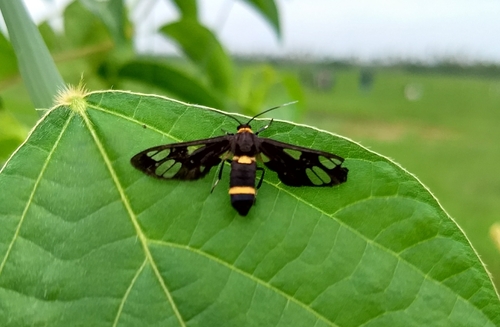
Handmaiden Moth

Handmaiden Moth

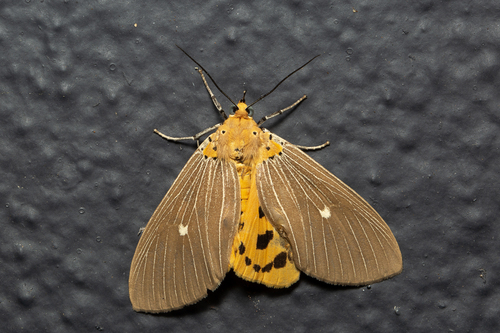
Syntomoides imaon

Daily sighting probability ~20% · Possible
at Jabalpur

In 3 days ~50% in a week ~80%

7 Verified sightings at Jabalpur
117 In all 7 parks From 2019 to 2026
January Best month
☀️🌙 Day & Night When it's spotted

About the Handmaiden Moth

Syntomoides imaon, the handmaiden moth, is a moth of subfamily Arctiinae, subtribe Ctenuchina. The systematics of the subfamily has been revised. It was described by Pieter Cramer in 1780. It is found in Pakistan (Sindh), India (Sikkim, Khasi hills, Tamil Nadu, Kerala), Sri Lanka, Myanmar, Bangladesh, Nepal, China (Hong Kong), Thailand and Vietnam.

The moth has a wingspan of 34 mm. The frons and collar are yellow with the metathorax having a yellow streak. The first abdominal segment has a yellow band which is sometimes obsolescent. The forewing has large hyaline patches, one filling the cell, another filling nearly the whole interno-median interspace, one at junction of veins 2 and 3, two subapical, and two submarginal. In the form S. i. sargania, there is a long streak between veins 5 and 6. In others it is reduced to a spot or may be lacking entirely. The hindwing has a postbasal hyaline patch extending hardly (or not at all) beyond the cell. The tips of the antennae and proximal joints of the tarsi are white. The spots of the forewing vary considerably in size. The male individual is slender and long abdomen than female. Wikipedia →
Global Distribution

Parks Where Found

# Park Country Daily sighting probability
1 Kanha National Park 🇮🇳 India
~50%
2 Mudumalai National Park 🇮🇳 India
~30%
3 Eravikulam National Park 🇮🇳 India
~20%
4 Sinharaja Forest Reserve 🇱🇰 Sri Lanka
~10%
5 Doi Inthanon National Park 🇹🇭 Thailand
~10%
6 Taroko National Park 🇹🇼 Taiwan
~10%
7 Khao Yai National Park 🇹🇭 Thailand
~10%

Cities Where Found

# City Country Daily sighting probability
1 Naha 🇯🇵 Japan
~30%
2 Dehradun 🇮🇳 India
~30%
3 Berhampore 🇮🇳 India
~30%
4 Tuen Mun 🇨🇳 China
~20%
5 Chandigarh 🇮🇳 India
~20%
6 Jabalpur 🇮🇳 India
~20%
7 Bengaluru 🇮🇳 India
~20%
8 Thiruvananthapuram 🇮🇳 India
~20%
9 Ponnani 🇮🇳 India
~20%
10 Kochi 🇮🇳 India
~20%

Before you go

What are the chances of seeing a Handmaiden Moth in Jabalpur?

Possible

About 20% of wildlife watchers report a Handmaiden Moth sighting in Jabalpur on a given day, based on 7 verified sightings from GBIF citizen-science data. It is the 60th most-seen of the 88 insects we can rate there. Over three days the chance rises to about 50%, and over a week to about 80%, if each day is a fresh chance.

When is the best time to see a Handmaiden Moth in Jabalpur?

January

In that month about 50% of wildlife watchers report a Handmaiden Moth in Jabalpur on a given day, against under 5% in February–March and May–September, the lowest months. That is one of Jabalpur's driest months, with about 20 mm of rain against 410 mm in July.

What time of day is best to see a Handmaiden Moth?

Between 9 pm and midnight

Across all the parks we cover, that three-hour window holds the most Handmaiden Moth sightings with a recorded time, and about 7 in 10 of them come between 6 pm and 6 am: it is seen both by day and at night.

Is Jabalpur the best place to see a Handmaiden Moth?

6th of 25

Of the 25 cities where we can rate Handmaiden Moth sightings, Jabalpur ranks 6th at about 20%. The best odds are in Naha (Japan, about 30%), Dehradun (India, about 30%) and Berhampore (India, about 30%).

Which relatives of the Handmaiden Moth live in Jabalpur?

Same family: Erebidae

The closest relatives of the Handmaiden Moth that you can see in Jabalpur (family Erebidae, Underwing, Tiger, Tussock, and Allied Moths) are Common Fruit-Piercing Moth (about 30%) and Tropical Tiger Moth (about 20%), with each one's daily chance of a sighting.

Where does the Handmaiden Moth sighting chance come from?

GBIF citizen-science records

It is estimated from how often the Handmaiden Moth is recorded against all the insects logged in Jabalpur (7 verified sightings), calibrated against known sighting rates. Figures are rounded to the nearest 10% because citizen-science data supports honest approximations, not decimals, and months with records from fewer than five people show "—". How it works.

← Back to Jabalpur