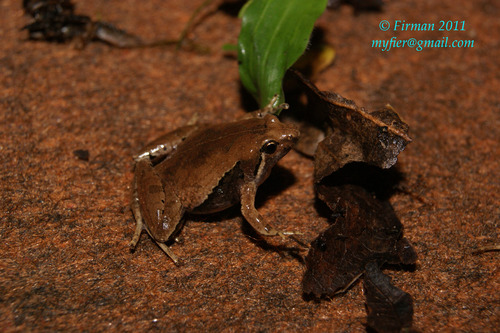
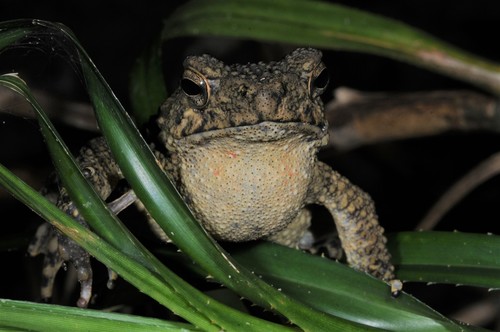
Asian Painted Frog

Asian Painted Frog

Kaloula pulchra

Silhouette: Dmitry Bogdanov (vectorized by T. Michael Keesey) · PhyloPic

LCLeast ConcernNTVUENCR
Daily sighting probability ~20% · Possible
at Jakarta

In 3 days ~40% in a week ~70%

17 Verified sightings at Jakarta
166 In all 6 parks From 2019 to 2026
June Best month
🌙 Nocturnal When it's spotted

About the Asian Painted Frog

The banded bullfrog (Kaloula pulchra) is a species of frog in the narrow-mouthed frog family Microhylidae. Native to Southeast Asia, it is also known as the Asian painted frog, digging frog, Malaysian bullfrog, common Asian frog, and painted balloon frog. In the pet trade, it is sometimes called the chubby frog. Adults measure 5.4 to 7.5 cm (2.1 to 3.0 in) and have a dark brown back with stripes that vary from copper-brown to salmon pink.

The banded bullfrog lives at low altitudes and is found in both urban and rural settings, as well as in forest habitats. They bury themselves underground during dry periods and emerge after heavy rainfall to emit calls and breed. They feed primarily on ants and termites; predators of adults and tadpoles include snakes, dragonfly larvae, and snails. When threatened, they inflate their lungs and secrete a noxious white substance. The species is prevalent in the pet trade and is a potential invasive species being introduced in Taiwan, the Philippines, Guam, Singapore, Borneo, and Sulawesi.

The banded bullfrog was first described in 1831 by the British zoologist John Edward Gray, as Kaloula pulchra (pulchra meaning "beautiful... Wikipedia →

Sounds

Advertisement call0:58

Singapore · 2025

© Ding Li Yong · XC1045307 · CC BY-NC-ND 4.0

Advertisement call0:57

India · 2003

© Olivier SWIFT · XC980812 · CC BY-NC-SA 4.0

Advertisement call1:00

Singapore · 2026

© Joan Theng · XC1142793 · CC BY-NC-SA 4.0

Global Distribution

Parks Where Found

# Park Country Daily sighting probability
1 Way Kambas National Park 🇮🇩 Indonesia
~60%
2 Cat Tien National Park 🇻🇳 Vietnam
~40%
3 Khao Sok National Park 🇹🇭 Thailand
~40%
4 Taman Negara National Park 🇲🇾 Malaysia
~30%
5 Kaeng Krachan National Park 🇹🇭 Thailand
~20%
6 Khao Yai National Park 🇹🇭 Thailand
~10%

Cities Where Found

# City Country Daily sighting probability
1 Angeles 🇵🇭 Philippines
~80%
2 Kuching 🇲🇾 Malaysia
~60%
3 Davao City 🇵🇭 Philippines
~50%
4 Phnom Penh 🇰🇭 Cambodia
~50%
5 Chattogram 🇧🇩 Bangladesh
~50%
6 Bandar Lampung 🇮🇩 Indonesia
~40%
7 Ho Chi Minh City 🇻🇳 Vietnam
~40%
8 Tainan 🇹🇼 Taiwan
~40%
9 Manila 🇵🇭 Philippines
~30%
10 Nanning 🇨🇳 China
~30%

Before you go

What are the chances of seeing an Asian Painted Frog in Jakarta?

Possible

About 20% of wildlife watchers report an Asian Painted Frog sighting in Jakarta on a given day, based on 17 verified sightings from GBIF citizen-science data. It is the 13th most-seen of the 18 amphibians we can rate there. Over three days the chance rises to about 40%, and over a week to about 70%, if each day is a fresh chance.

When is the best time to see an Asian Painted Frog in Jakarta?

June, August and November

In those months about 20% of wildlife watchers report an Asian Painted Frog in Jakarta on a given day, against under 5% in February, the lowest month.

What time of day is best to see an Asian Painted Frog?

Between 7 and 10 pm

Across all the parks we cover, that three-hour window holds the most Asian Painted Frog sightings with a recorded time, and about 8 in 10 of them come between 6 pm and 6 am: it is mostly seen at night.

Is Jakarta the best place to see an Asian Painted Frog?

19th of 20

Of the 20 cities where we can rate Asian Painted Frog sightings, Jakarta ranks 19th at about 20%. The best odds are in Angeles (Philippines, about 80%), Kuching (Malaysia, about 60%) and Davao City (Philippines, about 50%).

Where does the Asian Painted Frog sighting chance come from?

GBIF citizen-science records

It is estimated from how often the Asian Painted Frog is recorded against all the amphibians logged in Jakarta (17 verified sightings), calibrated against known sighting rates. Figures are rounded to the nearest 10% because citizen-science data supports honest approximations, not decimals, and months with records from fewer than five people show "—". How it works.

← Back to Jakarta