Smooth-Fingered Narrow-mouthed Frog

Smooth-Fingered Narrow-mouthed Frog

Kaloula baleata

Silhouette: Dmitry Bogdanov (vectorized by T. Michael Keesey) · PhyloPic

LCLeast ConcernNTVUENCR
Daily sighting probability ~20% · Possible
at Jakarta

In 3 days ~60% in a week ~90%

37 Verified sightings at Jakarta
31 In 1 park From 2019 to 2026
November Best month
🌙 Nocturnal When it's spotted

About the Smooth-Fingered Narrow-mouthed Frog

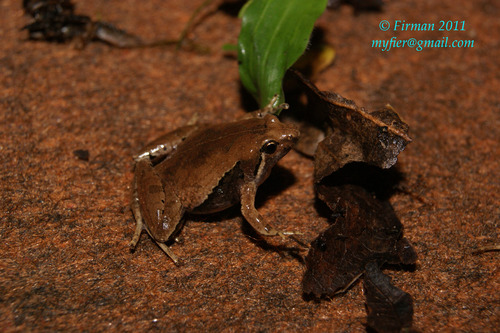
Kaloula baleata, the flower pot toad or sometimes the smooth-fingered narrow-mouthed frog, is a species of narrow-mouthed toad. It is native to India, Borneo, Indochinese Peninsula, Java, Malay Peninsula and Philippines where it lives in lowland rainforests and is tolerant of disturbed sites. The IUCN lists it as being of "Least Concern".

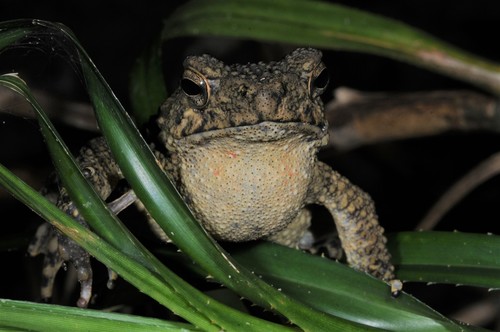
The smooth-fingered narrow-mouthed frog is a stout animal with a rounded body. Females average a snout-to-vent length of 65 millimetres (2.6 in) and males are a little smaller. The hind limbs are short and the digits of the hands have spoon-shaped tips while the toes are webbed. The colour is dark brown but many white-tipped tubercles give it a rough, speckled appearance. In individuals from Java, there is a brick red spot in the groin region whereas other populations have a yellow spot in this location.

This frog is native to the mainland of Malaysia, Borneo, Sumatra, Nusa Tenggara, Sulawesi, southern Thailand, and the Philippines. Its habitat is primary and secondary rainforest up to an altitude of about 800 metres (2,600 ft) and it can tolerate some disturbance of its environment. It also occurs on... Wikipedia →

Sounds

Recording0:19

Indonesia · 2022

© Ganjar Cahyadi · iNaturalist · CC BY-NC 4.0

Recording0:16

Indonesia · 2023

© Maria Bernadeth Tukan (Ona Tukan) · iNaturalist · CC BY-NC 4.0

Recording0:20

Indonesia · 2021

© Ulfi Faizah · iNaturalist · CC BY-NC 4.0

Global Distribution

Parks Where Found

# Park Country Daily sighting probability
1 Kinabatangan Wildlife Sanctuary 🇲🇾 Malaysia
~30%

More parks will be added in future updates.

Cities Where Found

# City Country Daily sighting probability
1 Yogyakarta 🇮🇩 Indonesia
~40%
2 Malang 🇮🇩 Indonesia
~30%
3 Surakarta 🇮🇩 Indonesia
~30%
4 Semarang 🇮🇩 Indonesia
~30%
5 Denpasar 🇮🇩 Indonesia
~30%
6 Surabaya 🇮🇩 Indonesia
~30%
7 Jakarta 🇮🇩 Indonesia
~20%
8 Bandung 🇮🇩 Indonesia
~10%

Zoos & Centres Where Found

# Zoo / Centre Country
1 Parque Municipal Summit 🇵🇦 Panama In captivity

Before you go

What are the chances of seeing a Smooth-Fingered Narrow-mouthed Frog in Jakarta?

Possible

About 20% of wildlife watchers report a Smooth-Fingered Narrow-mouthed Frog sighting in Jakarta on a given day, based on 37 verified sightings from GBIF citizen-science data. It is the 10th most-seen of the 18 amphibians we can rate there. Over three days the chance rises to about 60%, and over a week to about 90%, if each day is a fresh chance.

When is the best time to see a Smooth-Fingered Narrow-mouthed Frog in Jakarta?

November

In that month about 40% of wildlife watchers report a Smooth-Fingered Narrow-mouthed Frog in Jakarta on a given day, against under 5% in July and December, the lowest months.

What time of day is best to see a Smooth-Fingered Narrow-mouthed Frog?

Between 7 and 10 pm

Across all the parks we cover, that three-hour window holds the most Smooth-Fingered Narrow-mouthed Frog sightings with a recorded time, and about 8 in 10 of them come between 6 pm and 6 am: it is mostly seen at night.

Is Jakarta the best place to see a Smooth-Fingered Narrow-mouthed Frog?

7th of 8

Of the 8 cities where we can rate Smooth-Fingered Narrow-mouthed Frog sightings, Jakarta ranks 7th at about 20%. The best odds are in Yogyakarta (Indonesia, about 40%), Malang (Indonesia, about 30%) and Surakarta (Indonesia, about 30%).

Where does the Smooth-Fingered Narrow-mouthed Frog sighting chance come from?

GBIF citizen-science records

It is estimated from how often the Smooth-Fingered Narrow-mouthed Frog is recorded against all the amphibians logged in Jakarta (37 verified sightings), calibrated against known sighting rates. Figures are rounded to the nearest 10% because citizen-science data supports honest approximations, not decimals, and months with records from fewer than five people show "—". How it works.

← Back to Jakarta