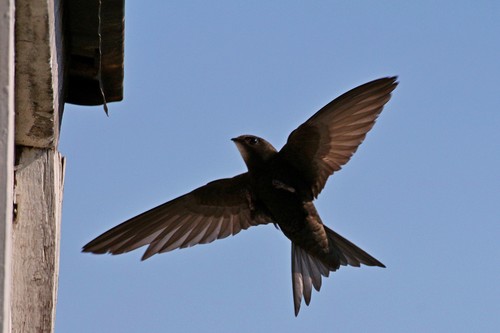
Pallid Swift

Pallid Swift

Apus pallidus

Silhouette: PhyloPic

LCLeast ConcernNTVUENCR
Daily sighting probability ~10% · With luck
at Jeddah

In 3 days ~40% in a week ~70%

22 Verified sightings at Jeddah
1,099 In all 5 parks From 2019 to 2026
March Best month
☀️ Diurnal When it's spotted

About the Pallid Swift

The pallid swift (Apus pallidus) is a swift (order Apodiformes). Swifts have very short legs which they use only for clinging to vertical surfaces. The genus name Apus is Latin for a swift, thought by the ancients to be a type of swallow with no feet (from Ancient Greek α, a, "without", and πούς, pous, "foot"), and pallidus is Latin for "pale". Like other swifts they never settle voluntarily on the ground, but spend most of their lives in the air, living on the insects they catch in their beaks. They drink on the wing.

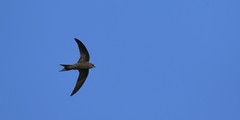
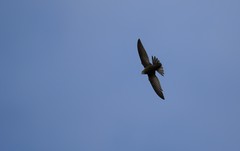
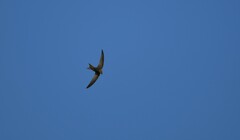
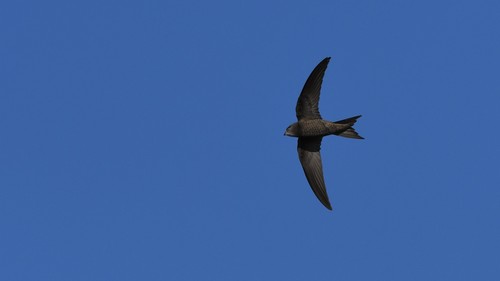
The pallid swift was first described by English naturalist George Ernest Shelley in 1870. This 16–17 cm (6.3–6.7 in) long species is very similar to the common swift, and separation is only possible with good views. Like its relative, it has a short forked tail and very long swept-back wings that resemble a crescent or a boomerang.

It is entirely dark except for a large white throat patch which is frequently visible from a distance. It is chunkier and browner than common swift, and the slightly paler flight feathers, underparts and rump give more contrast than that species. It also has a scalier looking belly and subtly different flight... Wikipedia →
Sounds

Call0:24

Italy · 2026

© Gianluca Congi · XC1177745 · CC BY-NC-SA 4.0

Flight call0:21

Portugal · 2026

© Jorge Leitão · XC1152323 · CC BY-NC-SA 4.0

Alarm call0:18

Algeria · 2023

© Karim Haddad · XC800986 · CC BY-NC-SA 4.0

Global Distribution

Parks Where Found

# Park Country Daily sighting probability
1 Sierra Nevada National Park 🇪🇸 Spain
~10%
2 Doñana National Park 🇪🇸 Spain
~10%
3 Monfragüe National Park 🇪🇸 Spain
~10%
4 Sierra de Guadarrama National Park 🇪🇸 Spain
<5%
5 Wadden Sea National Park 🇩🇪 Germany
<5%

Cities Where Found

# City Country Daily sighting probability
1 Marrakesh 🇲🇦 Morocco
~60%
2 Kuwait City 🇰🇼 Kuwait
~40%
3 Dubai 🇦🇪 United Arab Emirates
~40%
4 Riyadh 🇸🇦 Saudi Arabia
~40%
5 Abu Dhabi 🇦🇪 United Arab Emirates
~40%
6 Luxor 🇪🇬 Egypt
~40%
7 Amman 🇯🇴 Jordan
~30%
8 Casablanca 🇲🇦 Morocco
~30%
9 Fez 🇲🇦 Morocco
~30%
10 Tangier 🇲🇦 Morocco
~30%

Before you go

What are the chances of seeing a Pallid Swift in Jeddah?

With luck

About 10% of wildlife watchers report a Pallid Swift sighting in Jeddah on a given day, based on 22 verified sightings from GBIF citizen-science data. It is the 12th most-seen of the 40 birds we can rate there. Over three days the chance rises to about 40%, and over a week to about 70%, if each day is a fresh chance.

When is the best time to see a Pallid Swift in Jeddah?

March

In that month about 30% of wildlife watchers report a Pallid Swift in Jeddah on a given day, against about 10% in April, September and November–February, the lowest months. June–August and October have too few records to rate.

What time of day is best to see a Pallid Swift?

Between 8 and 11 am

Across all the parks we cover, that three-hour window holds the most Pallid Swift sightings with a recorded time, and nearly all of them come between 6 am and 6 pm: it is a daytime animal.

Is Jeddah the best place to see a Pallid Swift?

18th of 36

Of the 36 cities where we can rate Pallid Swift sightings, Jeddah ranks 18th at about 10%. The best odds are in Marrakesh (Morocco, about 60%), Kuwait City (Kuwait, about 40%) and Dubai (United Arab Emirates, about 40%).

Which relatives of the Pallid Swift live in Jeddah?

Same genus: Apus

The closest relatives of the Pallid Swift that you can see in Jeddah (genus Apus, Typical Swifts) are Common Swift (about 10%) and Little Swift (about 10%), with each one's daily chance of a sighting.

Where does the Pallid Swift sighting chance come from?

GBIF citizen-science records

It is estimated from how often the Pallid Swift is recorded against all the birds logged in Jeddah (22 verified sightings), calibrated against known sighting rates. Figures are rounded to the nearest 10% because citizen-science data supports honest approximations, not decimals, and months with records from fewer than five people show "—". How it works.

← Back to Jeddah