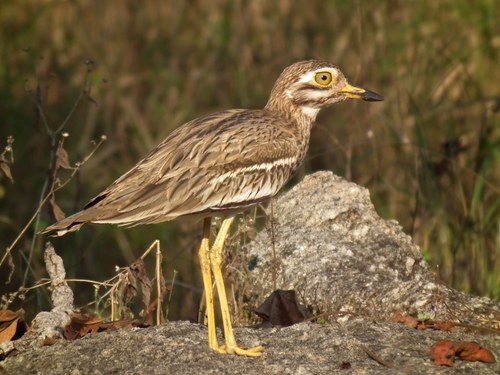
River Tern

River Tern

Sterna aurantia

Silhouette: Sharon Wegner-Larsen · PhyloPic

LCNTVUVulnerableENCR
Daily sighting probability ~10% · With luck
at Jodhpur

In 3 days ~20% in a week ~40%

19 Verified sightings at Jodhpur
3,482 In all 10 parks From 2019 to 2026
February Best month
🌅 Crepuscular When it's spotted

About the River Tern

The river tern or Indian river tern (Sterna aurantia) is a tern in the family Laridae, the largest species currently included in the genus Sterna of typical terns. It is a resident breeder along inland rivers from Pakistan east through the Indian subcontinent, to Myanmar, Thailand, and Cambodia, where it is uncommon. Unlike most Sterna terns, it is almost exclusively found on freshwater, rarely venturing even to tidal creeks.

It is a medium-large tern, 38–46 cm long with an 80–85 cm wingspan, distinctly larger than any other species in Sterna and more comparable in size to a Sandwich tern (Thalasseus sandvicensis) or a lesser crested tern (T. bengalensis). It has dark grey upperparts, white or very pale grey underparts, a forked tail with long flexible streamers, and long pointed wings with pale grey primaries. The bill is stout for a tern, bright yellow in summer and duller yellow with a dusky tip in winter, and the legs bright red. It has a black cap in breeding plumage, which is more extensive than in other Sterna terns, extending well below the eye instead of barely or not below the eye. In winter the cap is greyish white, flecked and streaked with black, with... Wikipedia →

Sounds

Call0:33

India · 2018

© Peter Boesman · XC427001 · CC BY-NC-ND 4.0

Alarm call0:09

India · 2013

© vir joshi · XC122995 · CC BY-NC-SA 3.0

Flight call0:06

India · 2020

© Sreekumar Chirukandoth · XC541668 · CC BY-NC-SA 4.0

Global Distribution

Parks Where Found

# Park Country Daily sighting probability
1 Ranthambore National Park 🇮🇳 India
~40%
2 Satpura National Park 🇮🇳 India
~30%
3 Kaziranga National Park 🇮🇳 India
~30%
4 Gir National Park 🇮🇳 India
~30%
5 Keoladeo National Park 🇮🇳 India
~20%
6 Nagarhole National Park 🇮🇳 India
~20%
7 Jim Corbett National Park 🇮🇳 India
~20%
8 Periyar National Park 🇮🇳 India
~10%
9 Bandipur National Park 🇮🇳 India
<5%
10 Bandhavgarh National Park 🇮🇳 India
<5%

Cities Where Found

# City Country Daily sighting probability
1 Rajkot 🇮🇳 India
~40%
2 Kota 🇮🇳 India
~20%
3 Bhopal 🇮🇳 India
~20%
4 Hyderabad 🇮🇳 India
~20%
5 Chhatrapati Sambhajinagar 🇮🇳 India
~10%
6 Vasai-Virar 🇮🇳 India
~10%
7 Nagpur 🇮🇳 India
~10%
8 Agra 🇮🇳 India
~10%
9 Surat 🇮🇳 India
~10%
10 Vadodara 🇮🇳 India
~10%

Before you go

What are the chances of seeing a River Tern in Jodhpur?

With luck

About 10% of wildlife watchers report a River Tern sighting in Jodhpur on a given day, based on 19 verified sightings from GBIF citizen-science data. It is the 70th most-seen of the 127 birds we can rate there. Over three days the chance rises to about 20%, and over a week to about 40%, if each day is a fresh chance.

When is the best time to see a River Tern in Jodhpur?

July–August and October–February

In those months about 10% of wildlife watchers report a River Tern in Jodhpur on a given day, against under 5% in March–June and September, the lowest months.

What time of day is best to see a River Tern?

Between 3 and 6 am

Across all the parks we cover, that three-hour window holds the most River Tern sightings with a recorded time, and about half of them come between 6 am and 6 pm: it is most active around dawn and dusk.

Is Jodhpur the best place to see a River Tern?

12th of 32

Of the 32 cities where we can rate River Tern sightings, Jodhpur ranks 12th at about 10%. The best odds are in Rajkot (India, about 40%), Kota (India, about 20%) and Bhopal (India, about 20%).

Where does the River Tern sighting chance come from?

GBIF citizen-science records

It is estimated from how often the River Tern is recorded against all the birds logged in Jodhpur (19 verified sightings), calibrated against known sighting rates. Figures are rounded to the nearest 10% because citizen-science data supports honest approximations, not decimals, and months with records from fewer than five people show "—". How it works.

← Back to Jodhpur