Grey-necked Bunting

Grey-necked Bunting

Emberiza buchanani

Silhouette: L. Shyamal · PhyloPic

LCLeast ConcernNTVUENCR
Daily sighting probability <5% · Rare
at Kalyan-Dombivli

In 3 days ~10% in a week ~30%

55 Verified sightings at Kalyan-Dombivli
29 In all 4 parks From 2019 to 2026
October Best month
☀️ Diurnal When it's spotted

About the Grey-necked Bunting

The grey-necked bunting (Emberiza buchanani), sometimes referred to as grey-hooded bunting (a name also in use for chestnut-eared bunting) is a species of bird in the family Emberizidae. It breeds along a wide distribution range from the Caspian Sea to the Altai Mountains in Central Asia and winters in parts of Southern Asia. Like other buntings it is found in small flocks.

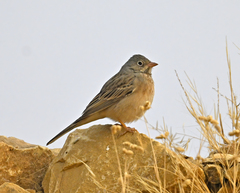
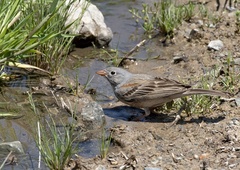
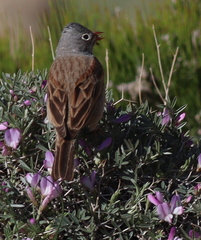
This bunting has a long pink bill and is greyish above. The male has a distinctive white eye-ring that stands out in contrast to the grey hood. The chin and throat are whitish pink and are bordered by grey malar stripes. The underparts are pinkish brown. The female is duller but the moustachial stripe can appear more noticeable. The outer tail feathers are whitish.

The species was described by Edward Blyth based on a drawing by Francis Buchanan-Hamilton after whom the species is named. It has been suggested that the actual date of the description was 1845 due to delays in the publication of the journal of The Asiatic Society. A supposed type specimen in the Indian Museum was never located.

In winter it makes a short subdued click note but the song is a metalling jingle made of swee-swee notes ending... Wikipedia →

Sounds

Call1:11

Mongolia · 2025

© Richard E. Webster · XC1024142 · CC BY-NC-SA 4.0

Song0:08

Armenia · 2024

© Teet Sirotkin · XC920042 · CC BY-NC-SA 4.0

Song0:30

Kazakhstan · 2023

© Peter Boesman · XC813369 · CC BY-NC-ND 4.0

Global Distribution

Parks Where Found

# Park Country Daily sighting probability
1 Gobi Gurvansaikhan National Park 🇲🇳 Mongolia
<5%
2 Satpura National Park 🇮🇳 India
<5%
3 Ranthambore National Park 🇮🇳 India
<5%
4 Kanha National Park 🇮🇳 India
<5%

Cities Where Found

# City Country Daily sighting probability
1 Kalyan-Dombivli 🇮🇳 India
<5%
2 Jodhpur 🇮🇳 India
<5%
3 Pune 🇮🇳 India
<5%
4 Vasai-Virar 🇮🇳 India
<5%
5 Jaipur 🇮🇳 India
<5%
6 Kochi 🇮🇳 India
<5%
7 Colombo [Sri Jayawardenepura Kotte] 🇱🇰 Sri Lanka
<5%
8 Mumbai 🇮🇳 India
<5%

Before you go

What are the chances of seeing a Grey-necked Bunting in Kalyan-Dombivli?

Rare

Under 5% of wildlife watchers report a Grey-necked Bunting sighting in Kalyan-Dombivli on a given day, based on 55 verified sightings from GBIF citizen-science data. It is the 93rd most-seen of the 179 birds we can rate there. Over three days the chance rises to about 10%, and over a week to about 30%, if each day is a fresh chance.

When is the best time to see a Grey-necked Bunting in Kalyan-Dombivli?

October

In that month about 30% of wildlife watchers report a Grey-necked Bunting in Kalyan-Dombivli on a given day, against under 5% in December to August, the lowest months. That is one of Kalyan-Dombivli's driest months, with about 100 mm of rain against 830 mm in July.

What time of day is best to see a Grey-necked Bunting?

Between 8 and 11 am

Across all the parks we cover, that three-hour window holds the most Grey-necked Bunting sightings with a recorded time, and about 9 in 10 of them come between 6 am and 6 pm: it is a daytime animal.

Is Kalyan-Dombivli the best place to see a Grey-necked Bunting?

Yes

Of the 8 cities where we can rate Grey-necked Bunting sightings, Kalyan-Dombivli has the highest daily chance: under 5%. Next come Jodhpur (India, under 5%) and Pune (India, under 5%).

Where does the Grey-necked Bunting sighting chance come from?

GBIF citizen-science records

It is estimated from how often the Grey-necked Bunting is recorded against all the birds logged in Kalyan-Dombivli (55 verified sightings), calibrated against known sighting rates. Figures are rounded to the nearest 10% because citizen-science data supports honest approximations, not decimals, and months with records from fewer than five people show "—". How it works.
← Back to Kalyan-Dombivli