
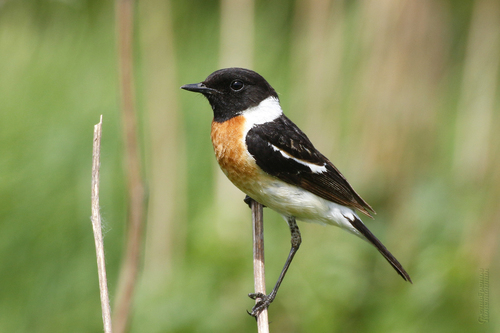
Chestnut-bellied Rock-Thrush

Chestnut-bellied Rock-Thrush

Monticola rufiventris

Silhouette: Martin Bulla, based on François Desbordes' illustration · PhyloPic

LCLeast ConcernNTVUENCR
Daily sighting probability <5% · Rare
at Kathmandu

In 3 days <5%

30 Verified sightings at Kathmandu
437 In all 6 parks From 2019 to 2026
December Best month
☀️ Diurnal When it's spotted

About the Chestnut-bellied Rock-Thrush

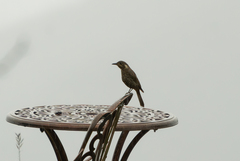
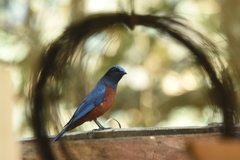
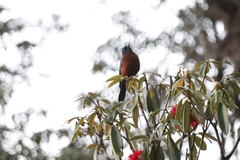
The chestnut-bellied rock thrush (Monticola rufiventris) is a species of passerine bird in the Old World flycatcher family Muscicapidae. The chestnut-bellied rock thrush is 21–23 cm (8.3–9.1 in) in overall length and weighs 48–61 g (1.7–2.2 oz). The male has a blue-grey crown and upperparts with darker lores and throat. The undersides are deep chestnut. The female has dull grey-brown upperparts and scalloped slate-grey with buffy-white underparts. The eyering and the post-auricular patch are whitish-buff.

Its natural habitat is temperate forests. It is an altitudanal migrant and experiences Zugunruhe strongly the night before migration. It is native to the Himalayas, Purvanchal Range and southern China; some birds winter to northern Indochina.

The chestnut-bellied rock thrush was formally described in 1832 by the Irish zoologist Nicholas Vigors under the binomial name Turdus erythogaster. The identical name had been used for a different species by the Dutch naturalist Pieter Boddaert in 1783. The chestnut-bellied rock thrush was described again in 1833 by the English naturalists William Jardine and Prideaux John Selby under... Wikipedia →

Sounds

Call0:42

China · 2002

© Geoff Carey · XC741397 · CC BY-NC-SA 4.0

Song1:17

Nepal · 2012

© Marc Anderson · XC134598 · CC BY-NC-SA 3.0

Call0:12

Laos · 2024

© Bram Piot · XC895476 · CC BY-NC-SA 4.0

Global Distribution

Parks Where Found

# Park Country Daily sighting probability
1 Langtang National Park 🇳🇵 Nepal
~10%
2 Royal Manas National Park 🇧🇹 Bhutan
~10%
3 Doi Inthanon National Park 🇹🇭 Thailand
~10%
4 Manas National Park 🇮🇳 India
<5%
5 Namdapha National Park 🇮🇳 India
<5%
6 Jim Corbett National Park 🇮🇳 India
<5%

Cities Where Found

# City Country Daily sighting probability
1 Chengdu 🇨🇳 China
<5%
2 Kathmandu 🇳🇵 Nepal
<5%

Before you go

What are the chances of seeing a Chestnut-bellied Rock-Thrush in Kathmandu?

Rare

Under 5% of wildlife watchers report a Chestnut-bellied Rock-Thrush sighting in Kathmandu on a given day, based on 30 verified sightings from GBIF citizen-science data. It is the 221st most-seen of the 312 birds we can rate there. Over three days the chance rises to under 5%, if each day is a fresh chance.

When is the best time to see a Chestnut-bellied Rock-Thrush in Kathmandu?

Any time of year

In every month with enough records, under 5% of wildlife watchers report a Chestnut-bellied Rock-Thrush in Kathmandu on a given day, so our monthly data shows no clear season.

What time of day is best to see a Chestnut-bellied Rock-Thrush?

Between 8 and 11 am

Across all the parks we cover, that three-hour window holds the most Chestnut-bellied Rock-Thrush sightings with a recorded time, and about 9 in 10 of them come between 6 am and 6 pm: it is a daytime animal.

Is Kathmandu the best place to see a Chestnut-bellied Rock-Thrush?

Among the best

Of the 2 cities where we can rate Chestnut-bellied Rock-Thrush sightings, Kathmandu ranks 2nd at under 5%, level with the leaders once rounded. The best odds are in Chengdu (China, under 5%).

Where does the Chestnut-bellied Rock-Thrush sighting chance come from?

GBIF citizen-science records

It is estimated from how often the Chestnut-bellied Rock-Thrush is recorded against all the birds logged in Kathmandu (30 verified sightings), calibrated against known sighting rates. Figures are rounded to the nearest 10% because citizen-science data supports honest approximations, not decimals, and months with records from fewer than five people show "—". How it works.

← Back to Kathmandu