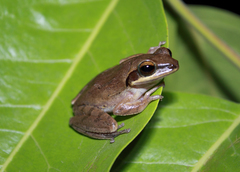
About the Chunam Tree Frog
Polypedates maculatus, the Indian tree frog, or Chunam tree frog, is a common species of tree frog found in South Asia. It was described by John Edward Gray in 1830. Although now considered as a separate species again, for a time, the Himalayan tree frog was considered as a subspecies of the Indian tree frog (as P. m. himalayensis). Polypedates leucomystax, a very similar species, was formerly included in P. maculatus.
These frogs measure about 7–8 cm in body length. They are mostly brownish, yellowish, greyish, or whitish above, with darker spots or markings, rarely with an hourglass-shaped figure on the back of the head and the front of the back. The loreal and temporal regions are dark; there is a light line on the upper lip. The hind side of the thighs has round, yellow spots, which are usually separated by a dark-brown or purplish network. The skin is smooth above, and granulated on the belly and under the thighs; a fold extends from the eye to the shoulder. Males have internal vocal sacs.
The vomerine teeth are arranged in two more or less oblique series between the choanae or commencing close to the inner front edge of the latter. The skin of head is free;... Wikipedia →