Indian Black Turtle

Indian Black Turtle

Melanochelys trijuga

Silhouette: SeismicShrimp · PhyloPic

LCLeast ConcernNTVUENCR
Daily sighting probability ~20% · Possible
at Kozhikode

In 3 days ~50% in a week ~80%

9 Verified sightings at Kozhikode
87 In all 6 parks From 2019 to 2026
May Best month
🌅 Crepuscular When it's spotted

About the Indian Black Turtle

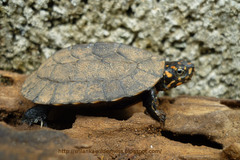
The Indian black turtle (Melanochelys trijuga) or Indian pond terrapin is a species of medium-sized freshwater turtle found in South Asia. Their shell is a typically made up of shades of dark brown, green, or grey, not just black. Their heads feature even more variation in color, as different subspecies may have pink or yellow spots. The average shell is about 6 inches long, while the entire body is usually about one foot.

The species occurs in India, Bangladesh, Myanmar, Sri Lanka, the Maldives, Nepal, and the Chagos Archipelago, where it may have been introduced. There are five recognized subspecies with overlapping distributions: M. t. trijuga: peninsula black turtle, India

M. t. indopeninsularis: Bangladesh black turtle, India, Nepal M. t. thermalis: Sri Lanka black turtle, India, Maldives, Sri Lanka The Indian black turtle inhabits a variety of water bodies including ponds, marshes streams, rivers and artificial water bodies like... Wikipedia →

Global Distribution

Parks Where Found

# Park Country Daily sighting probability
1 Wilpattu National Park 🇱🇰 Sri Lanka
~50%
2 Nagarhole National Park 🇮🇳 India
~50%
3 Bandipur National Park 🇮🇳 India
~30%
4 Periyar National Park 🇮🇳 India
~30%
5 Minneriya National Park 🇱🇰 Sri Lanka
~20%
6 Udawalawe National Park 🇱🇰 Sri Lanka
~20%

Cities Where Found

# City Country Daily sighting probability
1 Kochi 🇮🇳 India
~50%
2 Ponnani 🇮🇳 India
~30%
3 Kozhikode 🇮🇳 India
~20%
4 Dehradun 🇮🇳 India
~20%
5 Kollam 🇮🇳 India
~20%
6 Colombo [Sri Jayawardenepura Kotte] 🇱🇰 Sri Lanka
~20%
7 Hyderabad 🇮🇳 India
~10%
8 Bengaluru 🇮🇳 India
~10%
9 Chennai 🇮🇳 India
~10%

Zoos & Centres Where Found

# Zoo / Centre Country
1 Prague Zoo 🇨🇿 Czechia In captivity
2 Sri Venkateswara Zoological Park 🇮🇳 India In captivity
3 Nehru Zoological Park 🇮🇳 India In captivity
4 Mysore Zoo 🇮🇳 India In captivity
5 Bioparque Municipal Vesty Pakos 🇧🇴 Bolivia In captivity
6 Jijamata Udyaan 🇮🇳 India In captivity
7 Bird Paradise 🇸🇬 Singapore In captivity
8 Thiruvananthapuram Zoo 🇮🇳 India In captivity
9 Rainforest Wild Asia 🇸🇬 Singapore In captivity
10 Children's Park, Guindy 🇮🇳 India In captivity
11 Rákosův pavilon 🇨🇿 Czechia In captivity
12 Velemlokárium 🇨🇿 Czechia In captivity

Before you go

What are the chances of seeing an Indian Black Turtle in Kozhikode?

Possible

About 20% of wildlife watchers report an Indian Black Turtle sighting in Kozhikode on a given day, based on 9 verified sightings from GBIF citizen-science data. It is the 5th most-seen of the 9 reptiles we can rate there. Over three days the chance rises to about 50%, and over a week to about 80%, if each day is a fresh chance.

When is the best time to see an Indian Black Turtle in Kozhikode?

January and May

In those months about 40% of wildlife watchers report an Indian Black Turtle in Kozhikode on a given day, against under 5% in March and June–November, the lowest months. Those are among Kozhikode's driest months, with about 95 mm of rain a month against 390 mm in June.

What time of day is best to see an Indian Black Turtle?

Between 5 and 8 am

Across all the parks we cover, that three-hour window holds the most Indian Black Turtle sightings with a recorded time, and about 6 in 10 of them come between 6 am and 6 pm: it is most active around dawn and dusk.

Is Kozhikode the best place to see an Indian Black Turtle?

3rd of 9

Of the 9 cities where we can rate Indian Black Turtle sightings, Kozhikode ranks 3rd at about 20%. The best odds are in Kochi (India, about 50%) and Ponnani (India, about 30%).

Where does the Indian Black Turtle sighting chance come from?

GBIF citizen-science records

It is estimated from how often the Indian Black Turtle is recorded against all the reptiles logged in Kozhikode (9 verified sightings), calibrated against known sighting rates. Figures are rounded to the nearest 10% because citizen-science data supports honest approximations, not decimals, and months with records from fewer than five people show "—". How it works.

← Back to Kozhikode