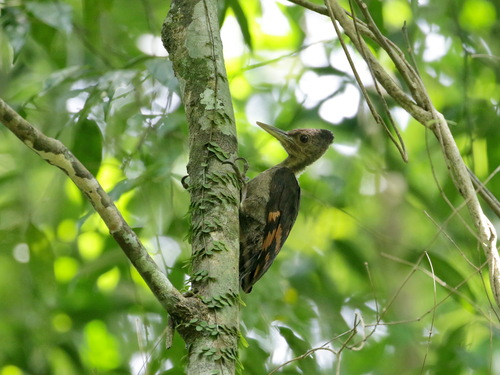
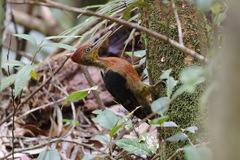
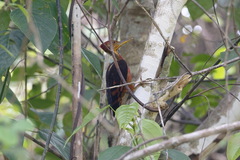
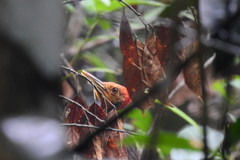

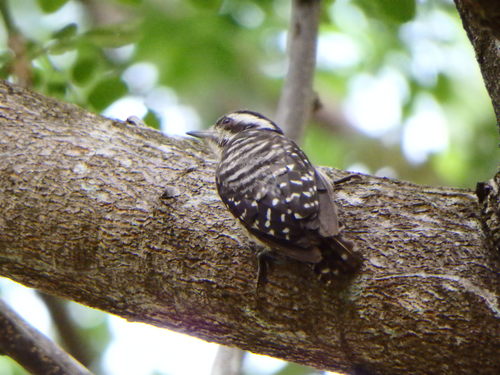
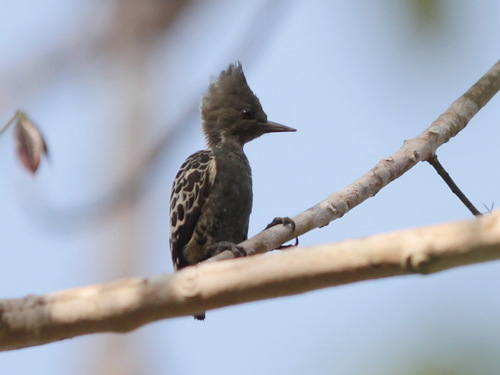
Orange-Backed Woodpecker

Orange-Backed Woodpecker

Reinwardtipicus validus

Silhouette: Pepe Reigada · PhyloPic

Daily sighting probability <5% · Rare
at Kuala Lumpur

In 3 days <5% in a week ~10%

24 Verified sightings at Kuala Lumpur
682 In all 8 parks From 2019 to 2026
December Best month
☀️ Diurnal When it's spotted

About the Orange-Backed Woodpecker

The orange-backed woodpecker (Chrysocolaptes validus) is a bird in the woodpecker family Picidae, found in southern Thailand, Malaya, Sarawak and Sabah in Malaysia, Brunei, Sumatra, and Java. It is a forest specialist that is found primarily in the canopy.

The orange-backed woodpecker was described and illustrated in 1825 by Dutch zoologist Coenraad Jacob Temminck in his Nouveau recueil de planches coloriées d'oiseaux from specimens that had been collected on the Indonesian island of Java. He coined the binomial name Pic validus. This species was previously placed in its own genus Reinwardtipicus. It is now one of ten species placed in the genus Chrysocolaptes that was introduced in 1843 by the English zoologist Edward Blyth.

Two subspecies are recognised: BirdLife species factsheet for Chrysocolaptes validus "Reinwardtipicus validus". Avibase. "Orange-backed woodpecker media". Internet Bird Collection. Interactive range map of Chrysocolaptes validus at IUCN Red List

Audio recordings of Orange-backed... Wikipedia →

Sounds

Call0:11

Malaysia · 2026

© Ding Li Yong · XC1145397 · CC BY-NC-ND 4.0

Song1:05

Malaysia · 2020

© Jani Sleutel · XC534781 · CC BY-NC-SA 4.0

Call0:30

Indonesia · 2018

© Panji Gusti Akbar · XC434124 · CC BY-NC-SA 4.0

Global Distribution

Parks Where Found

# Park Country Daily sighting probability
1 Way Kambas National Park 🇮🇩 Indonesia
~10%
2 Taman Negara National Park 🇲🇾 Malaysia
~10%
3 Sepilok 🇲🇾 Malaysia
~10%
4 Kinabalu Park 🇲🇾 Malaysia
<5%
5 Kerinci Seblat National Park 🇮🇩 Indonesia
<5%
6 Danum Valley Conservation Area 🇲🇾 Malaysia
<5%
7 Kinabatangan Wildlife Sanctuary 🇲🇾 Malaysia
<5%
8 Gunung Leuser National Park 🇮🇩 Indonesia
<5%

Cities Where Found

# City Country Daily sighting probability
1 Kuala Lumpur 🇲🇾 Malaysia
<5%

Before you go

What are the chances of seeing an Orange-Backed Woodpecker in Kuala Lumpur?

Rare

Under 5% of wildlife watchers report an Orange-Backed Woodpecker sighting in Kuala Lumpur on a given day, based on 24 verified sightings from GBIF citizen-science data. It is the 177th most-seen of the 228 birds we can rate there. Over three days the chance rises to under 5%, and over a week to about 10%, if each day is a fresh chance.

When is the best time to see an Orange-Backed Woodpecker in Kuala Lumpur?

Any time of year

In every month with enough records, under 5% of wildlife watchers report an Orange-Backed Woodpecker in Kuala Lumpur on a given day, so our monthly data shows no clear season.

What time of day is best to see an Orange-Backed Woodpecker?

Between 8 and 11 am

Across all the parks we cover, that three-hour window holds the most Orange-Backed Woodpecker sightings with a recorded time, and about 9 in 10 of them come between 6 am and 6 pm: it is a daytime animal.

Where else can you see an Orange-Backed Woodpecker?

Only Kuala Lumpur, in our data

Kuala Lumpur is the only city on Wallace's Line with enough records to rate Orange-Backed Woodpecker sightings: under 5% of wildlife watchers there report one on a given day.

Which relatives of the Orange-Backed Woodpecker live in Kuala Lumpur?

Same family: Picidae

The closest relatives of the Orange-Backed Woodpecker that you can see in Kuala Lumpur (family Picidae, Woodpeckers) are Common Flameback (about 30%), Banded Woodpecker (about 30%) and Crimson-winged Woodpecker (about 10%), with each one's daily chance of a sighting.

Where does the Orange-Backed Woodpecker sighting chance come from?

GBIF citizen-science records

It is estimated from how often the Orange-Backed Woodpecker is recorded against all the birds logged in Kuala Lumpur (24 verified sightings), calibrated against known sighting rates. Figures are rounded to the nearest 10% because citizen-science data supports honest approximations, not decimals, and months with records from fewer than five people show "—". How it works.

← Back to Kuala Lumpur