Desert Nightsnake

Desert Nightsnake

Hypsiglena chlorophaea

Silhouette: Jose Carlos Arenas-Monroy · PhyloPic

LCLeast ConcernNTVUENCR
Daily sighting probability ~10% · With luck
at Las Vegas

In 3 days ~20% in a week ~40%

10 Verified sightings at Las Vegas
100 In all 5 parks From 2019 to 2026
July Best month
🌙 Nocturnal When it's spotted

About the Desert Nightsnake

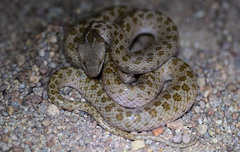
Hypsiglena chlorophaea, commonly known as the desert nightsnake, is a species of rear-fanged colubrid snake native to North America. It is found throughout regions of Mexico, the United States, and in a small, isolated population in British Columbia, Canada. Known for its highly secretive, nocturnal nature, it is a mildly venomous species that poses no danger to humans.

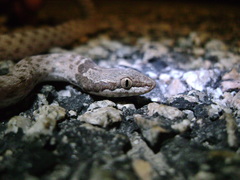
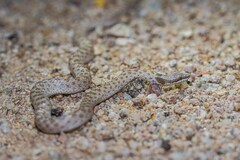
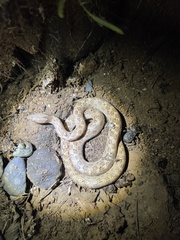
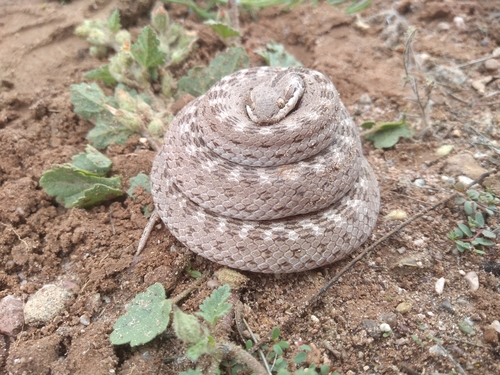
The desert nightsnake is a small, slender snake, typically measuring between 30 and 66 cm (12 to 26 inches) in total length. Females are generally longer and heavier than males. Its base coloration ranges from beige or yellowish to grey, overlaid with dark grey-brown blotches that usually form offset pairs down its back. It has three distinct, elongated dark blotches on its neck and behind each eye.

Because of its triangular-shaped head, vertical pupils, and blotched patterning, it is frequently mistaken for a juvenile rattlesnake. However, the desert nightsnake lacks a rattle and possesses smooth dorsal scales. It is an opisthoglyphous (rear-fanged) snake, meaning its enlarged, grooved teeth are located at the back of the upper jaw to help subdue prey.

The desert nightsnake has three... Wikipedia →
Global Distribution

Parks Where Found

# Park Country Daily sighting probability
1 Saguaro National Park 🇺🇸 United States
~10%
2 Death Valley National Park 🇺🇸 United States
~10%
3 Zion National Park 🇺🇸 United States
~10%
4 Grand Canyon National Park 🇺🇸 United States
~10%
5 Joshua Tree National Park 🇺🇸 United States
~10%

Cities Where Found

# City Country Daily sighting probability
1 Las Vegas 🇺🇸 United States
~10%
2 Phoenix 🇺🇸 United States
<5%
3 Mesa 🇺🇸 United States
<5%

Before you go

What are the chances of seeing a Desert Nightsnake in Las Vegas?

With luck

About 10% of wildlife watchers report a Desert Nightsnake sighting in Las Vegas on a given day, based on 10 verified sightings from GBIF citizen-science data. It is the 10th most-seen of the 15 reptiles we can rate there. Over three days the chance rises to about 20%, and over a week to about 40%, if each day is a fresh chance.

When is the best time to see a Desert Nightsnake in Las Vegas?

March and May–August

In those months about 10% of wildlife watchers report a Desert Nightsnake in Las Vegas on a given day, against under 5% in April and September–February, the lowest months.

What time of day is best to see a Desert Nightsnake?

Between 8 and 11 pm

Across all the parks we cover, that three-hour window holds the most Desert Nightsnake sightings with a recorded time, and about 8 in 10 of them come between 6 pm and 6 am: it is mostly seen at night.

Is Las Vegas the best place to see a Desert Nightsnake?

Yes

Of the 3 cities where we can rate Desert Nightsnake sightings, Las Vegas has the highest daily chance: about 10%. Next come Phoenix (United States, under 5%) and Mesa (United States, under 5%).

Which relatives of the Desert Nightsnake live in Las Vegas?

Same family: Colubridae

The closest relatives of the Desert Nightsnake that you can see in Las Vegas (family Colubridae, Colubrid Snakes) are Coachwhip (about 10%), Gopher Snake (about 10%) and Ground Snake (about 10%), with each one's daily chance of a sighting.

Where does the Desert Nightsnake sighting chance come from?

GBIF citizen-science records

It is estimated from how often the Desert Nightsnake is recorded against all the reptiles logged in Las Vegas (10 verified sightings), calibrated against known sighting rates. Figures are rounded to the nearest 10% because citizen-science data supports honest approximations, not decimals, and months with records from fewer than five people show "—". How it works.

← Back to Las Vegas