Common Swift Moth

Common Swift Moth

Korscheltellus lupulina

Daily sighting probability <5% · Rare
at Leeds

In 3 days ~10% in a week ~30%

9 Verified sightings at Leeds
42 In all 4 parks From 2019 to 2026
May Best month
☀️🌙 Day & Night When it's spotted

About the Common Swift Moth

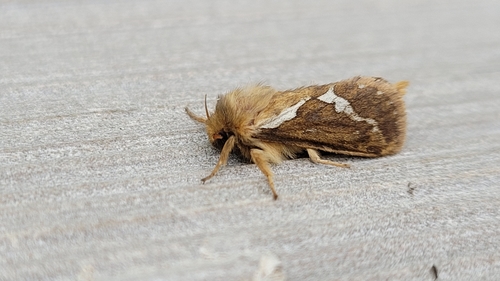
The common swift (Korscheltellus lupulina) is a moth of the family Hepialidae. It was previously placed in the genus Hepialus. It is a common, often abundant European species. The species was described by Carl Linnaeus in his 1758 10th edition of Systema Naturae.

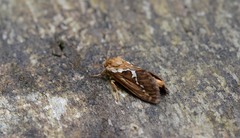
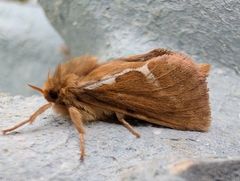
The male has a wingspan of about 30 mm with dark brown forewings with white apical and basal streaks meeting to make a "V" shape with another spot close to the costa. The hindwings are plain brown. The female is larger (wingspan about 40 mm) with similar patterning to the male but generally paler and less distinct. Patterns on the moths are highly variable, ranging from whitish to grey to pale brown with the females slightly larger and less strongly marked. Some individuals of both sexes are plain buff or brown with no pattern. The moths do not have a proboscis, are unable to feed, and therefore, are not usually found at flowers.

The adults fly at dusk in May and June[1] and the females broadcast the eggs, in a hovering flight, just above the vegetation. Males have a hovering flight. The species overwinters as a larva. The orange swift (Triodia sylvina) and gold swift (Phymatopus hecta) look similar, although... Wikipedia →
Global Distribution

Parks Where Found

# Park Country Daily sighting probability
1 Mercantour National Park 🇫🇷 France
~10%
2 Cévennes National Park 🇫🇷 France
~10%
3 Wadden Sea National Park 🇩🇪 Germany
<5%
4 Pyrénées National Park 🇫🇷 France
<5%

Cities Where Found

# City Country Daily sighting probability
1 Prague 🇨🇿 Czechia
~10%
2 Liverpool 🇬🇧 United Kingdom
~10%
3 Copenhagen 🇩🇰 Denmark
~10%
4 Stockholm 🇸🇪 Sweden
~10%
5 Birmingham 🇬🇧 United Kingdom
~10%
6 Manchester 🇬🇧 United Kingdom
~10%
7 London 🇬🇧 United Kingdom
~10%
8 Paris 🇫🇷 France
~10%
9 Lyon 🇫🇷 France
~10%
10 Leeds 🇬🇧 United Kingdom
<5%

Before you go

What are the chances of seeing a Common Swift Moth in Leeds?

Rare

Under 5% of wildlife watchers report a Common Swift Moth sighting in Leeds on a given day, based on 9 verified sightings from GBIF citizen-science data. It is the 215th most-seen of the 284 insects we can rate there. Over three days the chance rises to about 10%, and over a week to about 30%, if each day is a fresh chance.

When is the best time to see a Common Swift Moth in Leeds?

May and June

In those months about 10% of wildlife watchers report a Common Swift Moth in Leeds on a given day, against under 5% in July to April, the lowest months.

What time of day is best to see a Common Swift Moth?

Between 8 and 11 pm

Across all the parks we cover, that three-hour window holds the most Common Swift Moth sightings with a recorded time, and about half of them come between 6 pm and 6 am: it is seen both by day and at night.

Is Leeds the best place to see a Common Swift Moth?

10th of 15

Of the 15 cities where we can rate Common Swift Moth sightings, Leeds ranks 10th at under 5%. The best odds are in Prague (Czechia, about 10%), Liverpool (United Kingdom, about 10%) and Copenhagen (Denmark, about 10%).

Where does the Common Swift Moth sighting chance come from?

GBIF citizen-science records

It is estimated from how often the Common Swift Moth is recorded against all the insects logged in Leeds (9 verified sightings), calibrated against known sighting rates. Figures are rounded to the nearest 10% because citizen-science data supports honest approximations, not decimals, and months with records from fewer than five people show "—". How it works.

← Back to Leeds