Purple Sandpiper

Purple Sandpiper

Calidris maritima

Silhouette: Edwin Price · PhyloPic

LCLeast ConcernNTVUENCR
Daily sighting probability <5% · Rare
at Liverpool

In 3 days <5% in a week ~10%

36 Verified sightings at Liverpool
2,737 In all 6 parks From 2019 to 2026
January Best month
☀️ Diurnal When it's spotted

About the Purple Sandpiper

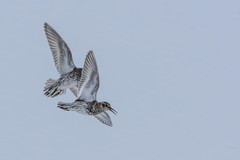
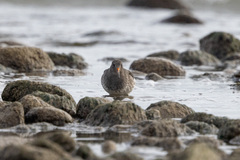
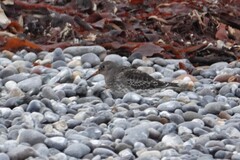
The purple sandpiper (Calidris maritima) is a small shorebird in the sandpiper family Scolopacidae. This is a hardy sandpiper that breeds in the arctic and subarctic regions of Eurasia and North America and winters further south on the Atlantic coast.

The purple sandpiper was formally described in 1764 by the Danish zoologist Morten Thrane Brünnich and given the binomial name Tringa maratina. This species was formerly placed in the genus Erolia, but is now placed with 23 other sandpipers in the genus Calidris that was introduced in 1804 by the German naturalist Blasius Merrem. The genus name is from Ancient Greek kalidris or skalidris, a term used by Aristotle for some grey-coloured waterside birds. Within the genus Calidris the purple sandpiper is sister to the rock sandpiper (Calidris ptilocnemis) and is closely related to the sanderling... Wikipedia →

Sounds

Call1:17

Norway · 2021

© Stein Ø. Nilsen · XC623303 · CC BY-NC-SA 4.0

Flight call0:09

France · 2020

© Stanislas Wroza · XC588531 · CC BY-NC-SA 4.0

Song0:07

Sweden · 2020

© Lars Edenius · XC567570 · CC BY-NC-SA 4.0

Global Distribution

Parks Where Found

# Park Country Daily sighting probability
1 Svalbard 🇳🇴 Norway
~70%
2 Wadden Sea National Park 🇩🇪 Germany
~10%
3 Vatnajokull National Park 🇮🇸 Iceland
~10%
4 Merritt Island National Wildlife Refuge 🇺🇸 United States
<5%
5 Acadia National Park 🇺🇸 United States
<5%
6 Cape Breton Highlands National Park 🇨🇦 Canada
<5%

Cities Where Found

# City Country Daily sighting probability
1 Dublin 🇮🇪 Ireland
<5%
2 Rotterdam [The Hague] 🇳🇱 Netherlands
<5%
3 Porto 🇵🇹 Portugal
<5%
4 Liverpool 🇬🇧 United Kingdom
<5%
5 New York City 🇺🇸 United States
<5%
6 Boston 🇺🇸 United States
<5%
7 Miami 🇺🇸 United States
<5%
8 Lisbon 🇵🇹 Portugal
<5%
9 Barcelona 🇪🇸 Spain
<5%
10 Toronto 🇨🇦 Canada
<5%

Zoos & Centres Where Found

# Zoo / Centre Country
1 National Zoological Park 🇺🇸 United States In captivity
2 Zoo Pilsen 🇨🇿 Czechia In captivity

Before you go

What are the chances of seeing a Purple Sandpiper in Liverpool?

Rare

Under 5% of wildlife watchers report a Purple Sandpiper sighting in Liverpool on a given day, based on 36 verified sightings from GBIF citizen-science data. It is the 130th most-seen of the 168 birds we can rate there. Over three days the chance rises to under 5%, and over a week to about 10%, if each day is a fresh chance.

When is the best time to see a Purple Sandpiper in Liverpool?

Any time of year

In every month with enough records, under 5% of wildlife watchers report a Purple Sandpiper in Liverpool on a given day, so our monthly data shows no clear season.

What time of day is best to see a Purple Sandpiper?

Between 9 am and noon

Across all the parks we cover, that three-hour window holds the most Purple Sandpiper sightings with a recorded time, and about 9 in 10 of them come between 6 am and 6 pm: it is a daytime animal.

Is Liverpool the best place to see a Purple Sandpiper?

Among the best

Of the 10 cities where we can rate Purple Sandpiper sightings, Liverpool ranks 4th at under 5%, level with the leaders once rounded. The best odds are in Dublin (Ireland, under 5%), Rotterdam [The Hague] (Netherlands, under 5%) and Porto (Portugal, under 5%).

Which relatives of the Purple Sandpiper live in Liverpool?

Same genus: Calidris

The closest relatives of the Purple Sandpiper that you can see in Liverpool (genus Calidris, Calidris Sandpipers) are Dunlin (about 40%) and Red Knot (about 40%), with each one's daily chance of a sighting.

Where does the Purple Sandpiper sighting chance come from?

GBIF citizen-science records

It is estimated from how often the Purple Sandpiper is recorded against all the birds logged in Liverpool (36 verified sightings), calibrated against known sighting rates. Figures are rounded to the nearest 10% because citizen-science data supports honest approximations, not decimals, and months with records from fewer than five people show "—". How it works.

← Back to Liverpool