Birch Shield Bug

Birch Shield Bug

Elasmostethus interstinctus

Daily sighting probability ~10% · With luck
at London

In 3 days ~20% in a week ~30%

51 Verified sightings at London
62 In all 4 parks From 2019 to 2026
November Best month
☀️ Diurnal When it's spotted

About the Birch Shield Bug

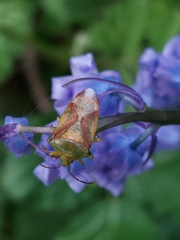
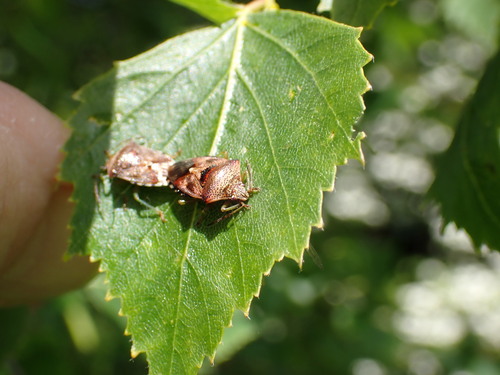
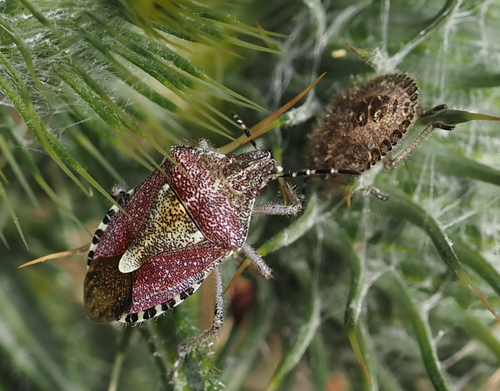
Elasmostethus interstinctus, the birch shield bug, is species of shield bug in the Acanthosomatidae family. Shield bugs are often called "stink bugs" because they excrete a foul smelling liquid that is used to deter predators.

This rather common species has an holarctic range. It is widely distributed across Europe, Northern Asia (excluding China) and in North America. These shield bugs mainly inhabit sunny areas with mixed birch woodlands, deciduous trees and shrubs.

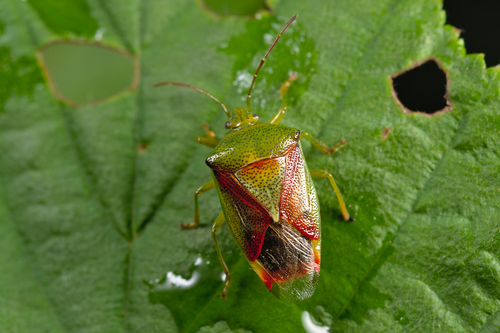
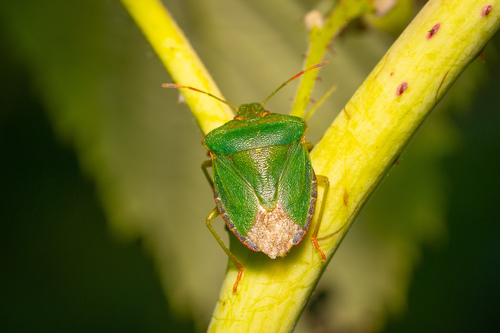
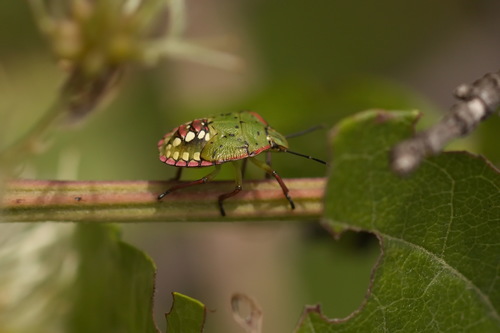
Elasmostethus interstinctus can reach a length of 8–11.5 millimetres (0.31–0.45 in). These shield bugs have a relatively flat body with the entire upper surface covered with mostly black punctures. The dorsal side is a bright yellow-green, with various red markings. In particular, pronotum is yellow-green, scutellum is green with a red center, clavus and corium are intensely red and the apex of the elytra are also bright red. The ventral side and the abdominal margins are yellow. Legs are yellow-green.

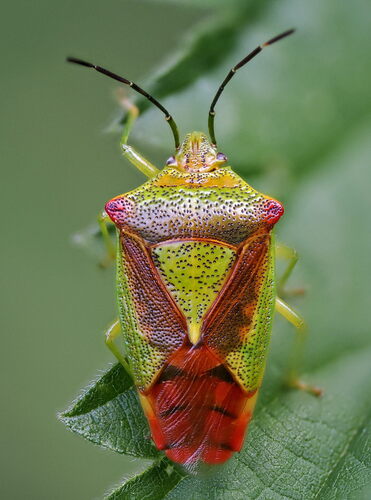
This species of shield bug can be confused with the Hawthorn Shield Bug (Acanthosoma haemorrhoidale), which is larger and more elongate and has a smaller lateral extensions... Wikipedia →

Global Distribution

Parks Where Found

# Park Country Daily sighting probability
1 Cairngorms National Park 🇬🇧 United Kingdom
~20%
2 Snowdonia National Park 🇬🇧 United Kingdom
~10%
3 Pyrénées National Park 🇫🇷 France
<5%
4 Wadden Sea National Park 🇩🇪 Germany
<5%

Cities Where Found

# City Country Daily sighting probability
1 Anchorage 🇺🇸 United States
~20%
2 Liverpool 🇬🇧 United Kingdom
~20%
3 Birmingham 🇬🇧 United Kingdom
~20%
4 Manchester 🇬🇧 United Kingdom
~10%
5 Leeds 🇬🇧 United Kingdom
~10%
6 Dublin 🇮🇪 Ireland
~10%
7 Helsinki 🇫🇮 Finland
~10%
8 Yekaterinburg 🇷🇺 Russia
~10%
9 London 🇬🇧 United Kingdom
~10%
10 Copenhagen 🇩🇰 Denmark
~10%

Before you go

What are the chances of seeing a Birch Shield Bug in London?

With luck

About 10% of wildlife watchers report a Birch Shield Bug sighting in London on a given day, based on 51 verified sightings from GBIF citizen-science data. It is the 471st most-seen of the 1504 insects we can rate there. Over three days the chance rises to about 20%, and over a week to about 30%, if each day is a fresh chance.

When is the best time to see a Birch Shield Bug in London?

April and September–February

In those months about 10% of wildlife watchers report a Birch Shield Bug in London on a given day, against under 5% in March and May–August, the lowest months.

What time of day is best to see a Birch Shield Bug?

Between 1 and 4 pm

Across all the parks we cover, that three-hour window holds the most Birch Shield Bug sightings with a recorded time, and about 9 in 10 of them come between 6 am and 6 pm: it is a daytime animal.

Is London the best place to see a Birch Shield Bug?

9th of 15

Of the 15 cities where we can rate Birch Shield Bug sightings, London ranks 9th at about 10%. The best odds are in Anchorage (United States, about 20%), Liverpool (United Kingdom, about 20%) and Birmingham (United Kingdom, about 20%).

Which relatives of the Birch Shield Bug live in London?

Same family: Acanthosomatidae

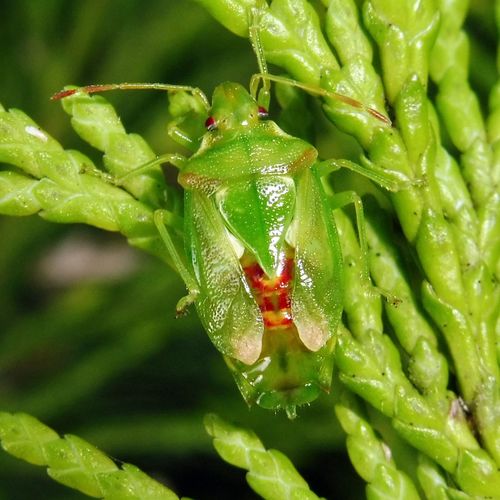
The closest relatives of the Birch Shield Bug that you can see in London (family Acanthosomatidae, Shield Bugs) are Parent Bug (about 10%), Hawthorn Shield Bug (about 10%) and Juniper Shield Bug (about 10%), with each one's daily chance of a sighting.

Where does the Birch Shield Bug sighting chance come from?

GBIF citizen-science records

It is estimated from how often the Birch Shield Bug is recorded against all the insects logged in London (51 verified sightings), calibrated against known sighting rates. Figures are rounded to the nearest 10% because citizen-science data supports honest approximations, not decimals, and months with records from fewer than five people show "—". How it works.

← Back to London