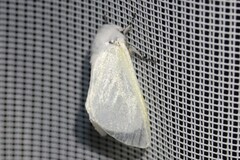
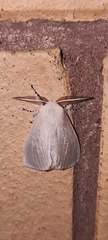
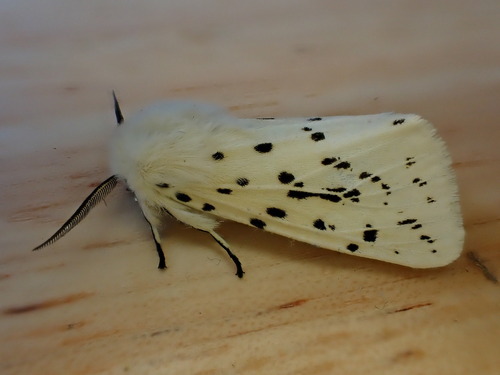
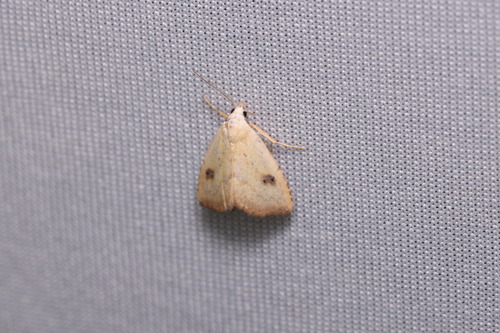
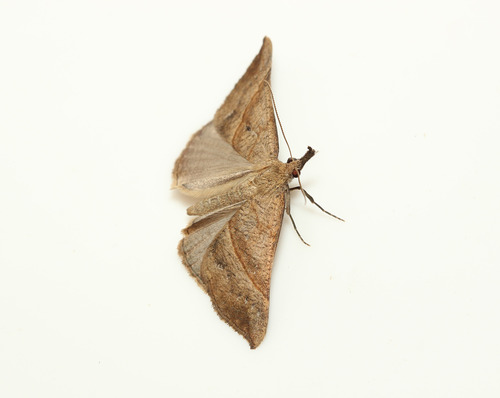
White Satin Moth

White Satin Moth

Leucoma salicis

Daily sighting probability <5% · Rare
at London

In 3 days ~10% in a week ~20%

7 Verified sightings at London
139 In all 8 parks From 2019 to 2026
June Best month
☀️🌙 Day & Night When it's spotted

About the White Satin Moth

Leucoma salicis, also known as the white satin moth or satin moth, is a moth of the family Erebidae. The species was first described by Carl Linnaeus in his 10th edition of Systema Naturae from 1758. It is found in Europe including the British Isles excluding the far north. In the east it is found across the Palearctic to Japan. The species was introduced to North America in the 1920s.

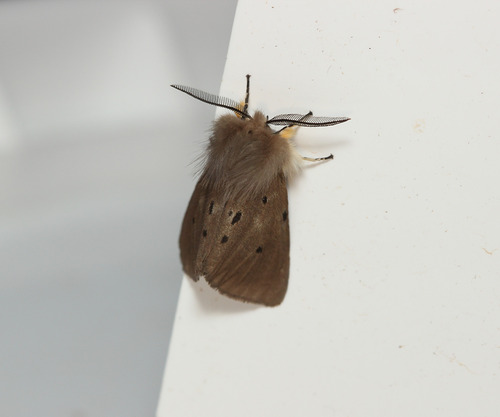
Leucoma salicis has a wingspan of 37–50 mm. White, sometimes with black spots. The head and collar as well as the pectinations of the antennae are black. Tibiae and tarsi with broad black rings. The East-Asiatic species Leucoma candida (Staudinger, 1892) with different male genitalia structure, has much purer glossy white and entirely opaque, more thickly scaled, wings and is on the whole smaller, with narrower wings. From central and eastern Siberia, Mongolia, Amurland, Korea, China and Japan. Yellowish-grey specimens are ab. sohesti Capr. Specimens from Tian-shan with black pectinations of the antennae of the male are nigripennata Staudinger. ab. nigrociliata Fuchs has sharp black third of the costal margin and glossy black fringes; Germany, ab. rubicunda Strand... Wikipedia →

Global Distribution

Parks Where Found

# Park Country Daily sighting probability
1 Isle Royale National Park 🇺🇸 United States
~40%
2 Gros Morne National Park 🇨🇦 Canada
~20%
3 Ecrins National Park 🇫🇷 France
~10%
4 Vanoise National Park 🇫🇷 France
~10%
5 Mercantour National Park 🇫🇷 France
~10%
6 Grand Teton National Park 🇺🇸 United States
~10%
7 Yellowstone National Park 🇺🇸 United States
~10%
8 Wadden Sea National Park 🇩🇪 Germany
~10%

Cities Where Found

# City Country Daily sighting probability
1 Liverpool 🇬🇧 United Kingdom
~20%
2 Calgary 🇨🇦 Canada
~10%
3 Manchester 🇬🇧 United Kingdom
<5%
4 Birmingham 🇬🇧 United Kingdom
<5%
5 Edmonton 🇨🇦 Canada
<5%
6 London 🇬🇧 United Kingdom
<5%
7 Seattle 🇺🇸 United States
<5%
8 Vancouver 🇨🇦 Canada
<5%

Before you go

What are the chances of seeing a White Satin Moth in London?

Rare

Under 5% of wildlife watchers report a White Satin Moth sighting in London on a given day, based on 7 verified sightings from GBIF citizen-science data. It is the 1300th most-seen of the 1504 insects we can rate there. Over three days the chance rises to about 10%, and over a week to about 20%, if each day is a fresh chance.

When is the best time to see a White Satin Moth in London?

Any time of year

In every month with enough records, under 5% of wildlife watchers report a White Satin Moth in London on a given day, so our monthly data shows no clear season.

What time of day is best to see a White Satin Moth?

Between 9 am and noon

Across all the parks we cover, that three-hour window holds the most White Satin Moth sightings with a recorded time, and about 7 in 10 of them come between 6 am and 6 pm: it is seen both by day and at night.

Is London the best place to see a White Satin Moth?

6th of 8

Of the 8 cities where we can rate White Satin Moth sightings, London ranks 6th at under 5%. The best odds are in Liverpool (United Kingdom, about 20%), Calgary (Canada, about 10%) and Manchester (United Kingdom, under 5%).

Which relatives of the White Satin Moth live in London?

Same family: Erebidae

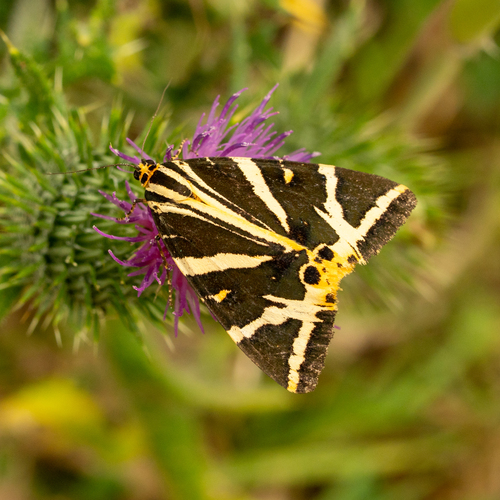
The closest relatives of the White Satin Moth that you can see in London (family Erebidae, Underwing, Tiger, Tussock, and Allied Moths) are Jersey Tiger (about 40%), Cinnabar Moth (about 30%) and Spongy Moth (about 20%), with each one's daily chance of a sighting.

Where does the White Satin Moth sighting chance come from?

GBIF citizen-science records

It is estimated from how often the White Satin Moth is recorded against all the insects logged in London (7 verified sightings), calibrated against known sighting rates. Figures are rounded to the nearest 10% because citizen-science data supports honest approximations, not decimals, and months with records from fewer than five people show "—". How it works.


← Back to London