Ashy-crowned Sparrow-Lark

Ashy-crowned Sparrow-Lark

Eremopterix griseus

Silhouette: Gossipguy and T. Michael Keesey · PhyloPic

LCLeast ConcernNTVUENCR
Daily sighting probability <5% · Rare
at Lucknow

In 3 days ~10% in a week ~20%

30 Verified sightings at Lucknow
848 In all 10 parks From 2019 to 2026
February Best month
🌅 Crepuscular When it's spotted

About the Ashy-crowned Sparrow-Lark

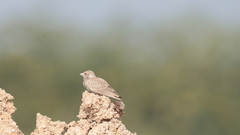
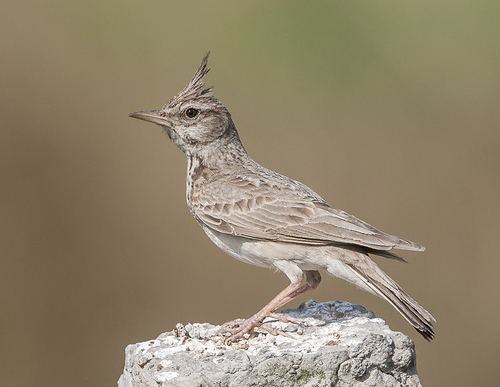
The ashy-crowned sparrow-lark (Eremopterix griseus) is a small sparrow-sized member of the lark family. It is found in the plains in open land with bare ground, grass and scrub across South Asia. The males are well marked with a contrasting black-and-white face pattern, while females are sandy brown, looking similar to a female sparrow. Males are easily detected during the breeding season by the long descending whistle that accompanies their undulating and dive-bombing flight displays.

The ashy-crowned sparrow-lark was originally placed in the genus Alauda. This species is also known by the following alternate names: ash-crowned sparrow-lark, ashy-crowned finch-lark, black-bellied finch-lark, and black-bellied sparrow-lark.

Although some subspecies ceylonensis (from Sri Lanka) and siccata (from Gujarat) have been named, variations are considered to be clinal and they are treated as a monotypic species. Sparrow sized with a finch-like bill and short legs, these birds are usually seen sitting on the ground, and although they will sometimes perch on wires they do not perch in trees or bushes. The male is sandy brown overall with a black... Wikipedia →

Sounds

Song0:16

India · 2019

© Peter Boesman · XC460265 · CC BY-NC-ND 4.0

Call1:25

India · 2020

© Sreekumar Chirukandoth · XC586883 · CC BY-NC-SA 4.0

Flight call0:04

India · 2014

© Frank Lambert · XC166154 · CC BY-NC-ND 4.0

Global Distribution

Parks Where Found

# Park Country Daily sighting probability
1 Yala National Park 🇱🇰 Sri Lanka
~20%
2 Ranthambore National Park 🇮🇳 India
~10%
3 Udawalawe National Park 🇱🇰 Sri Lanka
~10%
4 Satpura National Park 🇮🇳 India
~10%
5 Bandipur National Park 🇮🇳 India
<5%
6 Gir National Park 🇮🇳 India
<5%
7 Keoladeo National Park 🇮🇳 India
<5%
8 Nagarhole National Park 🇮🇳 India
<5%
9 Kanha National Park 🇮🇳 India
<5%
10 Bandhavgarh National Park 🇮🇳 India
<5%

Cities Where Found

# City Country Daily sighting probability
1 Rajkot 🇮🇳 India
~20%
2 Indore 🇮🇳 India
~20%
3 Nashik 🇮🇳 India
~20%
4 Vasai-Virar 🇮🇳 India
~20%
5 Kota 🇮🇳 India
~20%
6 Durg 🇮🇳 India
~10%
7 Chhatrapati Sambhajinagar 🇮🇳 India
~10%
8 Chandigarh 🇮🇳 India
~10%
9 Pune 🇮🇳 India
~10%
10 Bhopal 🇮🇳 India
~10%

Before you go

What are the chances of seeing an Ashy-crowned Sparrow-Lark in Lucknow?

Rare

Under 5% of wildlife watchers report an Ashy-crowned Sparrow-Lark sighting in Lucknow on a given day, based on 30 verified sightings from GBIF citizen-science data. It is the 125th most-seen of the 200 birds we can rate there. Over three days the chance rises to about 10%, and over a week to about 20%, if each day is a fresh chance.

When is the best time to see an Ashy-crowned Sparrow-Lark in Lucknow?

February and September

In those months about 10% of wildlife watchers report an Ashy-crowned Sparrow-Lark in Lucknow on a given day, against under 5% in March–August and October–January, the lowest months.

What time of day is best to see an Ashy-crowned Sparrow-Lark?

Between 3 and 6 am

Across all the parks we cover, that three-hour window holds the most Ashy-crowned Sparrow-Lark sightings with a recorded time, and about 6 in 10 of them come between 6 pm and 6 am: it is most active around dawn and dusk.

Is Lucknow the best place to see an Ashy-crowned Sparrow-Lark?

15th of 32

Of the 32 cities where we can rate Ashy-crowned Sparrow-Lark sightings, Lucknow ranks 15th at under 5%. The best odds are in Rajkot (India, about 20%), Indore (India, about 20%) and Nashik (India, about 20%).

Where does the Ashy-crowned Sparrow-Lark sighting chance come from?

GBIF citizen-science records

It is estimated from how often the Ashy-crowned Sparrow-Lark is recorded against all the birds logged in Lucknow (30 verified sightings), calibrated against known sighting rates. Figures are rounded to the nearest 10% because citizen-science data supports honest approximations, not decimals, and months with records from fewer than five people show "—". How it works.

← Back to Lucknow