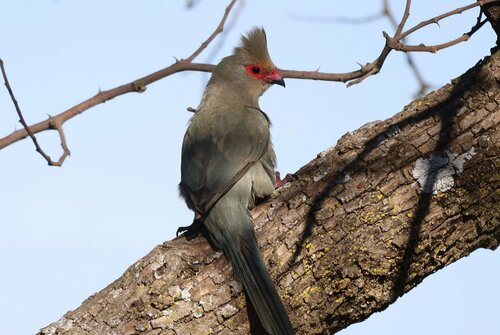
Swainson's Francolin

Swainson's Francolin

Pternistis swainsonii

Silhouette: Amanda Kuhlman · PhyloPic

LCLeast ConcernNTVUENCR
Daily sighting probability ~10% · With luck
at Lusaka

In 3 days ~30% in a week ~50%

16 Verified sightings at Lusaka
6,697 In all 13 parks From 2019 to 2026
July Best month
☀️ Diurnal When it's spotted

About the Swainson's Francolin

Swainson's spurfowl or Swainson's francolin (Pternistis swainsonii) is a species of bird in the family Phasianidae which is native to southern Africa. In the Shona language in Zimbabwe, this bird is called the chikwari or horwe and is considered a delicacy by outdoor and hunting enthusiasts. Swainson's spurfowl was named after William Swainson, an English ornithologist.

It is found in grasslands and woodlands of Angola, Botswana, Lesotho, Malawi, Mozambique, Namibia, South Africa, Eswatini, Zambia, and Zimbabwe. Swainson's spurfowl was described in 1836 by the Scottish zoologist Andrew Smith and given the binomial name Perdix swainsonii. Smith noted that the spurfowl inhabited the banks of the rivers beyond Kurrichaine (Kaditshwene), the modern province of Limpopo in South Africa. The specific epithet swainsonii was chosen to honour the English naturalist William Swainson. The species is now placed in the genus Pternistis that was introduced by the German naturalist Johann Georg Wagler in 1832. Swainson's spurfowl is treated as monotypic: the proposed subspecies lundazi is not recognised.

One syntype specimen of Perdix Swainsonii Smith (Rep.... Wikipedia →

Sounds

Call0:09

South Africa · 2025

© Ehren Eksteen · XC1028089 · CC BY-NC-SA 4.0

Song0:08

South Africa · 1994

© Rick Nuttall · XC662980 · CC BY-NC-SA 4.0

Alarm call0:37

South Africa · 2019

© Tony Archer · XC506979 · CC BY-NC-SA 4.0

Global Distribution

Parks Where Found

# Park Country Daily sighting probability
1 Gonarezhou National Park 🇿🇼 Zimbabwe
~50%
2 Hwange National Park 🇿🇼 Zimbabwe
~50%
3 Kruger National Park 🇿🇦 South Africa
~40%
4 Mana Pools National Park 🇿🇼 Zimbabwe
~40%
5 Moremi Game Reserve 🇧🇼 Botswana
~40%
6 South Luangwa National Park 🇿🇲 Zambia
~40%
7 Lower Zambezi National Park 🇿🇲 Zambia
~40%
8 Pilanesberg National Park 🇿🇦 South Africa
~30%
9 Chobe National Park 🇧🇼 Botswana
~30%
10 Kafue National Park 🇿🇲 Zambia
~10%
11 Golden Gate Highlands National Park 🇿🇦 South Africa
~10%
12 Waterberg Plateau Park 🇳🇦 Namibia
<5%
13 Etosha National Park 🇳🇦 Namibia
<5%

Cities Where Found

# City Country Daily sighting probability
1 Lusaka 🇿🇲 Zambia
~10%
2 Harare 🇿🇼 Zimbabwe
~10%
3 Johannesburg 🇿🇦 South Africa
~10%
4 Pretoria 🇿🇦 South Africa
<5%

Before you go

What are the chances of seeing a Swainson's Francolin in Lusaka?

With luck

About 10% of wildlife watchers report a Swainson's Francolin sighting in Lusaka on a given day, based on 16 verified sightings from GBIF citizen-science data. It is the 41st most-seen of the 87 birds we can rate there. Over three days the chance rises to about 30%, and over a week to about 50%, if each day is a fresh chance.

When is the best time to see a Swainson's Francolin in Lusaka?

July

In that month about 20% of wildlife watchers report a Swainson's Francolin in Lusaka on a given day, against under 5% in March, May, September and November, the lowest months. That is one of Lusaka's driest months, with almost no rain against 210 mm in January.

What time of day is best to see a Swainson's Francolin?

Between 3 and 6 pm

Across all the parks we cover, that three-hour window holds the most Swainson's Francolin sightings with a recorded time, and about 9 in 10 of them come between 6 am and 6 pm: it is a daytime animal.

Is Lusaka the best place to see a Swainson's Francolin?

Yes

Of the 4 cities where we can rate Swainson's Francolin sightings, Lusaka has the highest daily chance: about 10%. Next come Harare (Zimbabwe, about 10%) and Johannesburg (South Africa, about 10%).

Where does the Swainson's Francolin sighting chance come from?

GBIF citizen-science records

It is estimated from how often the Swainson's Francolin is recorded against all the birds logged in Lusaka (16 verified sightings), calibrated against known sighting rates. Figures are rounded to the nearest 10% because citizen-science data supports honest approximations, not decimals, and months with records from fewer than five people show "—". How it works.

← Back to Lusaka