Oriental Pratincole

Oriental Pratincole

Glareola maldivarum

Silhouette: Cristian Gutierrez-Ibanez · PhyloPic

LCLeast ConcernNTVUENCR
Daily sighting probability <5% · Rare
at Manila

In 3 days <5% in a week ~10%

50 Verified sightings at Manila
153 In all 6 parks From 2019 to 2026
June Best month
☀️ Diurnal When it's spotted

About the Oriental Pratincole

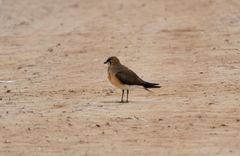
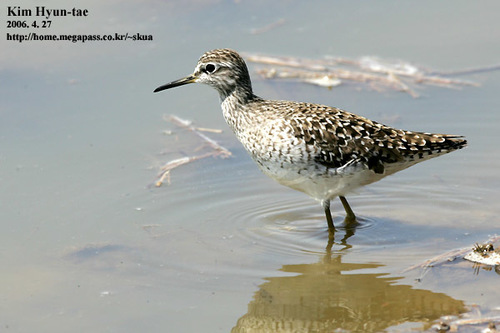
The oriental pratincole (Glareola maldivarum), also known as the grasshopper-bird or swallow-plover, is a wader in the pratincole family, Glareolidae. The genus name is a diminutive of Latin glarea, "gravel", referring to a typical nesting habitat for pratincoles. The species name, maldivarum, refers to the type locality, the ocean near the Maldive Islands. The type specimen, caught alive at sea, survived for a month on flies.

The Oriental pratincole has short legs, long pointed wings and long forked tails. It has a short bill, which is an adaptation to aerial feeding. The back and head are brown, and the wings are brown with black flight feathers. The belly is white and the underwings are chestnut.

Very good views are needed to distinguish the species from other pratincoles, particularly the very similar collared pratincole, which also has a chestnut underwing. The black-winged pratincole shares the black upperwing flight feathers, and lacks a white trailing edge to the wing. Those features are not always readily seen in the field, especially because the chestnut underwing appears black unless excellent views are obtained.

An unusual feature... Wikipedia →

Sounds

Flight call0:05

China · 2025

© 王自堃 · XC1015741 · CC BY-NC-SA 4.0

Call0:49

Laos · 2023

© Bram Piot · XC802406 · CC BY-NC-SA 4.0

Alarm call0:43

Malaysia · 2023

© Lim Ying Hien · XC798271 · CC BY-NC-ND 4.0

Global Distribution

Parks Where Found

# Park Country Daily sighting probability
1 Yala National Park 🇱🇰 Sri Lanka
~10%
2 Wadden Sea National Park 🇩🇪 Germany
<5%
3 Cat Tien National Park 🇻🇳 Vietnam
<5%
4 Kaeng Krachan National Park 🇹🇭 Thailand
<5%
5 Keoladeo National Park 🇮🇳 India
<5%
6 Kinabatangan Wildlife Sanctuary 🇲🇾 Malaysia
<5%

Cities Where Found

# City Country Daily sighting probability
1 Phnom Penh 🇰🇭 Cambodia
~10%
2 Bangkok 🇹🇭 Thailand
<5%
3 Tainan 🇹🇼 Taiwan
<5%
4 Thiruvananthapuram 🇮🇳 India
<5%
5 Singapore 🇸🇬 Singapore
<5%
6 Manila 🇵🇭 Philippines
<5%
7 Kaohsiung 🇹🇼 Taiwan
<5%
8 Kolkata 🇮🇳 India
<5%
9 Taichung 🇹🇼 Taiwan
<5%
10 Thrissur 🇮🇳 India
<5%

Before you go

What are the chances of seeing an Oriental Pratincole in Manila?

Rare

Under 5% of wildlife watchers report an Oriental Pratincole sighting in Manila on a given day, based on 50 verified sightings from GBIF citizen-science data. It is the 125th most-seen of the 191 birds we can rate there. Over three days the chance rises to under 5%, and over a week to about 10%, if each day is a fresh chance.

When is the best time to see an Oriental Pratincole in Manila?

Any time of year

In every month with enough records, under 5% of wildlife watchers report an Oriental Pratincole in Manila on a given day, so our monthly data shows no clear season.

What time of day is best to see an Oriental Pratincole?

Between 1 and 4 pm

Across all the parks we cover, that three-hour window holds the most Oriental Pratincole sightings with a recorded time, and nearly all of them come between 6 am and 6 pm: it is a daytime animal.

Is Manila the best place to see an Oriental Pratincole?

6th of 13

Of the 13 cities where we can rate Oriental Pratincole sightings, Manila ranks 6th at under 5%. The best odds are in Phnom Penh (Cambodia, about 10%), Bangkok (Thailand, under 5%) and Tainan (Taiwan, under 5%).

Which relatives of the Oriental Pratincole live in Manila?

Same order: Charadriiformes

The closest relatives of the Oriental Pratincole that you can see in Manila (order Charadriiformes, Shorebirds and Allies) are Whiskered Tern (about 30%), Common Sandpiper (about 10%) and Black-winged Stilt (about 10%), with each one's daily chance of a sighting.

Where does the Oriental Pratincole sighting chance come from?

GBIF citizen-science records

It is estimated from how often the Oriental Pratincole is recorded against all the birds logged in Manila (50 verified sightings), calibrated against known sighting rates. Figures are rounded to the nearest 10% because citizen-science data supports honest approximations, not decimals, and months with records from fewer than five people show "—". How it works.

← Back to Manila