Peacock Pansy
Daily sighting probability ~10% · With luck
at Manila

In 3 days ~20% in a week ~40%

7 Verified sightings at Manila
125 In all 10 parks From 2019 to 2026
July Best month
☀️ Diurnal When it's spotted

About the Peacock Pansy

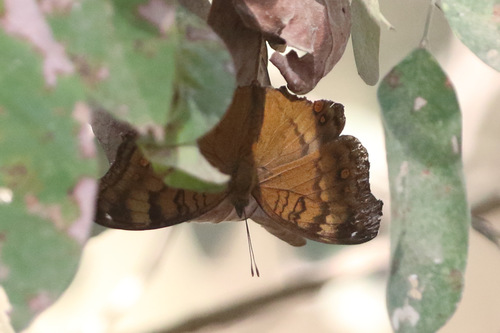
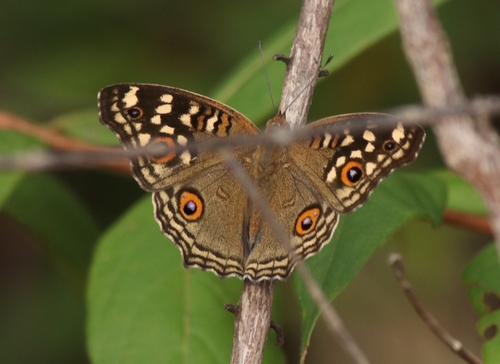
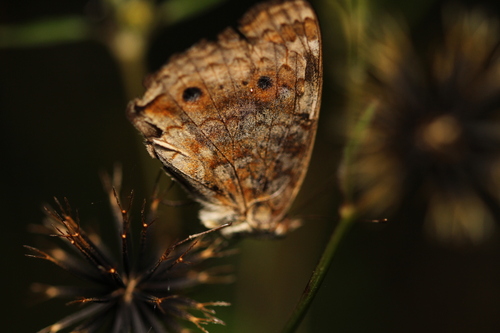
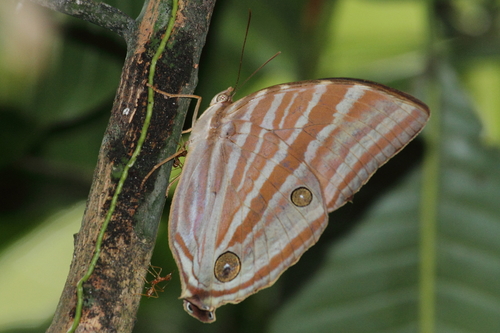
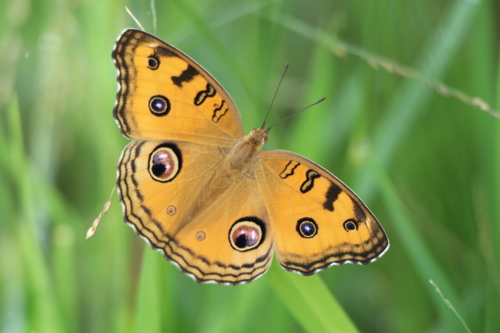
Junonia almana, the peacock pansy, is a species of nymphalid butterfly found in Cambodia and South Asia. It exists in two distinct adult forms, which differ chiefly in the patterns on the underside of the wings; the dry-season form has few markings, while the wet-season form has additional eyespots and lines. It is listed as Least Concern in the IUCN Red List.

The adult butterfly has a wingspan of 54–62 mm (2.1–2.4 in), and exhibits seasonal polyphenism. "Upperside rich orange-yellow. Fore wing with a pale dusky and a much darker short transverse bar with lateral jet-black marginal lines across cell, another somewhat similar bar defining the discocellulars; costal margin, an inner and an outer subterminal line, and a terminal line dusky black; a large minutely white-centred ocellus with an inner slender and outer black ring on disc in interspace 2; two similar but smaller geminate subapical ocelli with an obscure pale spot above them and a short oblique bar connecting them to the black on the costa. Hind wing: a small minutely white-centred and very slenderly black-ringed discal ocellus in interspace 2, with a very much larger pale yellow and... Wikipedia →

Global Distribution

Parks Where Found

# Park Country Daily sighting probability
1 Keoladeo National Park 🇮🇳 India
~30%
2 Royal Bardia National Park 🇳🇵 Nepal
~30%
3 Chitwan National Park 🇳🇵 Nepal
~30%
4 Cuc Phuong National Park 🇻🇳 Vietnam
~30%
5 Gunung Leuser National Park 🇮🇩 Indonesia
~30%
6 Kanha National Park 🇮🇳 India
~10%
7 Minneriya National Park 🇱🇰 Sri Lanka
~10%
8 Khao Sok National Park 🇹🇭 Thailand
~10%
9 Khao Yai National Park 🇹🇭 Thailand
~10%
10 Kaeng Krachan National Park 🇹🇭 Thailand
~10%

Cities Where Found

# City Country Daily sighting probability
1 Prayagraj 🇮🇳 India
~50%
2 Raipur 🇮🇳 India
~40%
3 Yogyakarta 🇮🇩 Indonesia
~40%
4 Dhaka 🇧🇩 Bangladesh
~40%
5 Jamshedpur 🇮🇳 India
~40%
6 Phnom Penh 🇰🇭 Cambodia
~30%
7 Guwahati 🇮🇳 India
~30%
8 Salem 🇮🇳 India
~30%
9 Kuala Lumpur 🇲🇾 Malaysia
~30%
10 Yangon 🇲🇲 Myanmar
~30%

Before you go

What are the chances of seeing a Peacock Pansy in Manila?

With luck

About 10% of wildlife watchers report a Peacock Pansy sighting in Manila on a given day, based on 7 verified sightings from GBIF citizen-science data. It is the 91st most-seen of the 122 insects we can rate there. Over three days the chance rises to about 20%, and over a week to about 40%, if each day is a fresh chance.

When is the best time to see a Peacock Pansy in Manila?

March and May–September

In those months about 10% of wildlife watchers report a Peacock Pansy in Manila on a given day, against under 5% in April and October–February, the lowest months.

What time of day is best to see a Peacock Pansy?

Between 11 am and 2 pm

Across all the parks we cover, that three-hour window holds the most Peacock Pansy sightings with a recorded time, and about 8 in 10 of them come between 6 am and 6 pm: it is a daytime animal.

Is Manila the best place to see a Peacock Pansy?

49th of 55

Of the 55 cities where we can rate Peacock Pansy sightings, Manila ranks 49th at about 10%. The best odds are in Prayagraj (India, about 50%), Raipur (India, about 40%) and Yogyakarta (Indonesia, about 40%).

Which relatives of the Peacock Pansy live in Manila?

Same genus: Junonia

The closest relatives of the Peacock Pansy that you can see in Manila (genus Junonia, Buckeyes & Pansies) are Brown Pansy (about 40%), Lemon Pansy (about 20%) and Blue Pansy (about 10%), with each one's daily chance of a sighting.

Where does the Peacock Pansy sighting chance come from?

GBIF citizen-science records

It is estimated from how often the Peacock Pansy is recorded against all the insects logged in Manila (7 verified sightings), calibrated against known sighting rates. Figures are rounded to the nearest 10% because citizen-science data supports honest approximations, not decimals, and months with records from fewer than five people show "—". How it works.
← Back to Manila