Black-tailed Nativehen

Black-tailed Nativehen

Gallinula ventralis

Silhouette: Andy Wilson · PhyloPic

LCLeast ConcernNTVUENCR
Daily sighting probability <5% · Rare
at Melbourne

In 3 days <5% in a week ~10%

307 Verified sightings at Melbourne
324 In all 3 parks From 2019 to 2026
November Best month
☀️ Diurnal When it's spotted

About the Black-tailed Nativehen

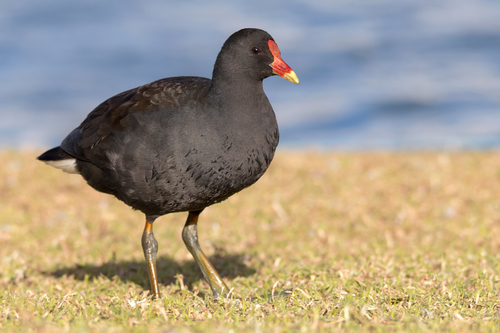
The black-tailed nativehen (Tribonyx ventralis) is a rail native to Australia. The black-tailed nativehen is a large dark bird, reaching about 38 cm in length and weighing around 400 g (0.88 lb). This species possesses an erect tail and is endowed almost entirely with brownish-grey and green feathers. Its long legs and lower jaw are a striking pink-orange colour, as well as its eyes which are more of a bright orange colour. This species is not excessively vocal, its main call is an alarm 'kak' sound. They become noticeable when they are seen in small flocks on the ground. Their erect tails and social behaviour are reminiscent of domestic hens.

This species is nomadic, following seasonal water sources. It is found year-round living near fresh and brackish water. The black-tailed nativehen is common throughout Australia, where it lives by permanent as well as intermittent water sources. It has a large range, with an estimated global extent of occurrence of 1,000,000–10,000,000 km2. It is classified as Least Concern by IUCN. It is a rare vagrant to New Zealand, and occasional to Tasmania.

Breeding generally takes place... Wikipedia →

Global Distribution

Parks Where Found

# Park Country Daily sighting probability
1 Hattah-Kulkyne National Park 🇦🇺 Australia
~20%
2 Fiordland National Park 🇳🇿 New Zealand
<5%
3 Grampians National Park 🇦🇺 Australia
<5%

Cities Where Found

# City Country Daily sighting probability
1 Perth 🇦🇺 Australia
<5%
2 Melbourne 🇦🇺 Australia
<5%
3 Brisbane 🇦🇺 Australia
<5%

Before you go

What are the chances of seeing a Black-tailed Nativehen in Melbourne?

Rare

Under 5% of wildlife watchers report a Black-tailed Nativehen sighting in Melbourne on a given day, based on 307 verified sightings from GBIF citizen-science data. It is the 140th most-seen of the 236 birds we can rate there. Over three days the chance rises to under 5%, and over a week to about 10%, if each day is a fresh chance.

When is the best time to see a Black-tailed Nativehen in Melbourne?

Any time of year

In every month with enough records, under 5% of wildlife watchers report a Black-tailed Nativehen in Melbourne on a given day, so our monthly data shows no clear season.

What time of day is best to see a Black-tailed Nativehen?

Between 9 am and noon

Across all the parks we cover, that three-hour window holds the most Black-tailed Nativehen sightings with a recorded time, and about 9 in 10 of them come between 6 am and 6 pm: it is a daytime animal.

Is Melbourne the best place to see a Black-tailed Nativehen?

Among the best

Of the 3 cities where we can rate Black-tailed Nativehen sightings, Melbourne ranks 2nd at under 5%, level with the leaders once rounded. The best odds are in Perth (Australia, under 5%).

Where does the Black-tailed Nativehen sighting chance come from?

GBIF citizen-science records

It is estimated from how often the Black-tailed Nativehen is recorded against all the birds logged in Melbourne (307 verified sightings), calibrated against known sighting rates. Figures are rounded to the nearest 10% because citizen-science data supports honest approximations, not decimals, and months with records from fewer than five people show "—". How it works.

← Back to Melbourne