Golden Wattle Gall Wasp

Golden Wattle Gall Wasp

Trichilogaster signiventris

Daily sighting probability <5% · Rare
at Melbourne

In 3 days ~10% in a week ~20%

31 Verified sightings at Melbourne
42 In all 3 parks From 2019 to 2026
August Best month
☀️ Diurnal When it's spotted

About the Golden Wattle Gall Wasp

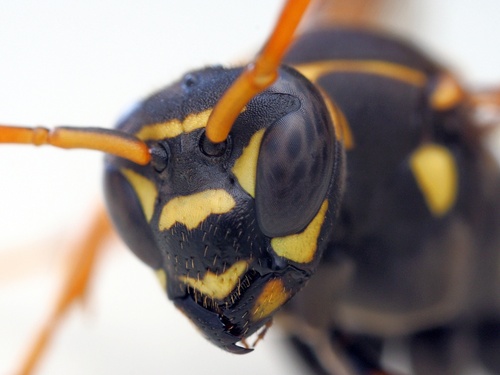
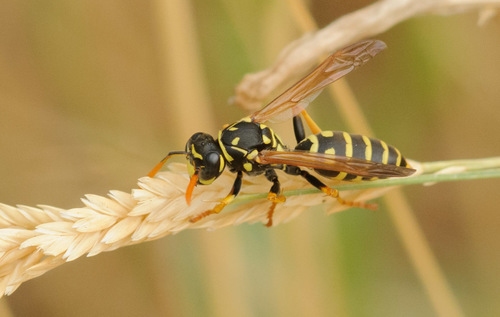
Trichilogaster signiventris, commonly known as the golden wattle bud-galling wasp, is a species of Australian chalcid wasps that parasitises, among others, Acacia pycnantha (golden wattle). It has been introduced into South Africa, where the golden wattle has become an invasive pest.

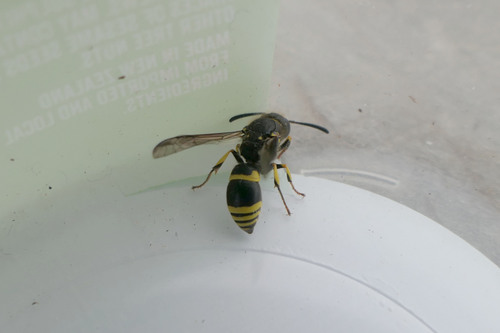
American entomologist Alexandre Arsène Girault described the species as Perilampella signiventris in 1931. The female is yellow and black in colour, though highly variable in colour proportion and pattern. It is 2.3–3.2 mm (23⁄256–1⁄8 in) long. The male is of similar size and almost entirely black with black and yellow legs.

The success of the related species Trichilogaster acaciaelongifoliae in managing Acacia longifolia led scientists to look for another species to control A. pycnantha. T. signiventris was introduced twice and at first thought a failure. Wasps from Lake Natimuk in Victoria were transported and released in Western Cape in 1987 and as no galls were seen the first summer, a second transfer — this time from Mount Compass, South Australia — was made in 1992 as scientists suspected the first cohort might have been incompatible with populations of golden wattle in Africa.

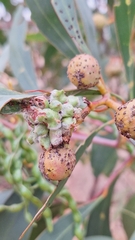
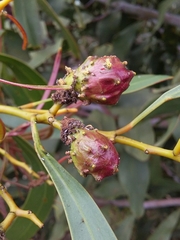
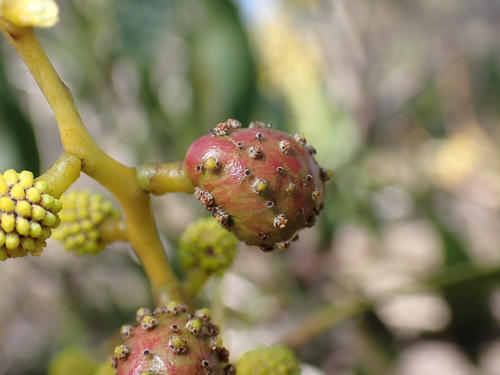
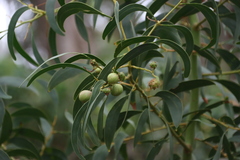
The host species are golden wattle (Acacia pycnantha) and Acacia rivalis. The eggs are laid by short-lived adult wasps into buds of flower heads in the summer, before hatching in May and June when the larvae induce the formation of the grape-like galls and prevent flower development. The galls can be so heavy that branches break under their weight. It has reduced the capacity of trees to reproduce throughout their range. It is possible that the galls also reduce the resilience of the host plants by absorbing nutrients and hence starving them. The galls are up to 3 centimetres (1+1⁄4 inches) in diameter and contain several grubs. Wikipedia →
Global Distribution

Parks Where Found

# Park Country Daily sighting probability
1 De Hoop Nature Reserve 🇿🇦 South Africa
~10%
2 Grampians National Park 🇦🇺 Australia
~10%
3 Table Mountain National Park 🇿🇦 South Africa
<5%

Cities Where Found

# City Country Daily sighting probability
1 Melbourne 🇦🇺 Australia
<5%

Before you go

What are the chances of seeing a Golden Wattle Gall Wasp in Melbourne?

Rare

Under 5% of wildlife watchers report a Golden Wattle Gall Wasp sighting in Melbourne on a given day, based on 31 verified sightings from GBIF citizen-science data. It is the 331st most-seen of the 875 insects we can rate there. Over three days the chance rises to about 10%, and over a week to about 20%, if each day is a fresh chance.

When is the best time to see a Golden Wattle Gall Wasp in Melbourne?

August and November

In those months about 10% of wildlife watchers report a Golden Wattle Gall Wasp in Melbourne on a given day, against under 5% in September–October and December–July, the lowest months.

What time of day is best to see a Golden Wattle Gall Wasp?

Between 1 and 4 pm

Across all the parks we cover, that three-hour window holds the most Golden Wattle Gall Wasp sightings with a recorded time, and nearly all of them come between 6 am and 6 pm: it is a daytime animal.

Where else can you see a Golden Wattle Gall Wasp?

Only Melbourne, in our data

Melbourne is the only city on Wallace's Line with enough records to rate Golden Wattle Gall Wasp sightings: under 5% of wildlife watchers there report one on a given day.

Where does the Golden Wattle Gall Wasp sighting chance come from?

GBIF citizen-science records

It is estimated from how often the Golden Wattle Gall Wasp is recorded against all the insects logged in Melbourne (31 verified sightings), calibrated against known sighting rates. Figures are rounded to the nearest 10% because citizen-science data supports honest approximations, not decimals, and months with records from fewer than five people show "—". How it works.

← Back to Melbourne