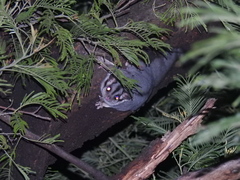
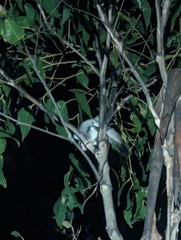
Inland Sugar Glider

Inland Sugar Glider

Petaurus notatus

Silhouette: Steven Traver · PhyloPic

Daily sighting probability ~10% · With luck
at Melbourne

In 3 days ~20% in a week ~50%

170 Verified sightings at Melbourne
41 In all 2 parks From 2019 to 2026
April Best month
☀️🌙 Day & Night When it's spotted

About the Inland Sugar Glider

Krefft's glider (Petaurus notatus) is a species of arboreal nocturnal gliding possum, a type of small marsupial. It is native to most of eastern mainland Australia and has been introduced to Tasmania. Populations of Petaurus from New Guinea and Indonesia previously classified under P. breviceps are also tentatively classified under P. notatus by the American Society of Mammalogists, but likely represent a complex of distinct species. As most captive gliders referred to as "sugar gliders" in at least the United States are thought to originate from West Papua, this likely makes them Krefft's gliders, at least tentatively.

It is closely allied with the sugar glider (P. breviceps), with which it was long taxonomically confused. A 2020 study partially clarified the taxonomy of the sugar glider and split it into three species: the savanna glider (P. ariel), the sugar glider (P. breviceps sensu stricto) and Krefft's glider (P. notatus). The large range throughout eastern Australia once attributed to the sugar glider is now thought to actually be that of Krefft's glider; under the new taxonomy, the sugar glider has a smaller range in the coastal forests of Queensland and New... Wikipedia →

Sounds

Recording0:20

Australia · 2025

© Peter Crowcroft · iNaturalist · CC BY 4.0

Recording0:36

Australia · 2025

© Sally Wilson · iNaturalist · CC BY-NC 4.0

Recording0:35

Australia · 2023

© caliginous · iNaturalist · CC BY-NC 4.0

Global Distribution

Parks Where Found

# Park Country Daily sighting probability
1 Grampians National Park 🇦🇺 Australia
~20%
2 Great Otway National Park 🇦🇺 Australia
~10%

Cities Where Found

# City Country Daily sighting probability
1 Melbourne 🇦🇺 Australia
~10%

Zoos & Centres Where Found

# Zoo / Centre Country
1 East Coast Natureworld 🇦🇺 Australia In captivity
2 Hartley’s Crocodile Adventures 🇦🇺 Australia In captivity
3 Bonorong Wildlife Sanctuary 🇦🇺 Australia In captivity
4 Wing's Wildlife Park 🇦🇺 Australia In captivity

Before you go

What are the chances of seeing an Inland Sugar Glider in Melbourne?

With luck

About 10% of wildlife watchers report an Inland Sugar Glider sighting in Melbourne on a given day, based on 170 verified sightings from GBIF citizen-science data. It is the 8th most-seen of the 22 mammals we can rate there. Over three days the chance rises to about 20%, and over a week to about 50%, if each day is a fresh chance.

When is the best time to see an Inland Sugar Glider in Melbourne?

Any time of year

In every month with enough records, about 10% of wildlife watchers report an Inland Sugar Glider in Melbourne on a given day, so our monthly data shows no clear season.

What time of day is best to see an Inland Sugar Glider?

Between 7 and 10 pm

Across all the parks we cover, that three-hour window holds the most Inland Sugar Glider sightings with a recorded time, and about 7 in 10 of them come between 6 pm and 6 am: it is seen both by day and at night.

Where else can you see an Inland Sugar Glider?

Only Melbourne, in our data

Melbourne is the only city on Wallace's Line with enough records to rate Inland Sugar Glider sightings: about 10% of wildlife watchers there report one on a given day.

Which relatives of the Inland Sugar Glider live in Melbourne?

Same order: Diprotodontia

The closest relatives of the Inland Sugar Glider that you can see in Melbourne (order Diprotodontia, Kangaroos, Possums, Wombats, and Allies) are Common Ringtail Possum (about 40%), Common Brushtail (about 30%) and Eastern Grey Kangaroo (about 20%), with each one's daily chance of a sighting.

Where does the Inland Sugar Glider sighting chance come from?

GBIF citizen-science records

It is estimated from how often the Inland Sugar Glider is recorded against all the mammals logged in Melbourne (170 verified sightings), calibrated against known sighting rates. Figures are rounded to the nearest 10% because citizen-science data supports honest approximations, not decimals, and months with records from fewer than five people show "—". How it works.

← Back to Melbourne