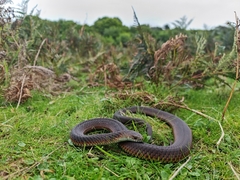
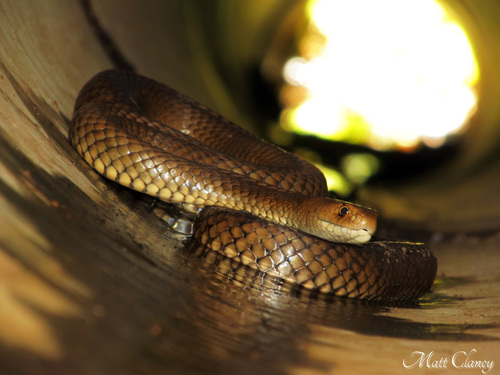
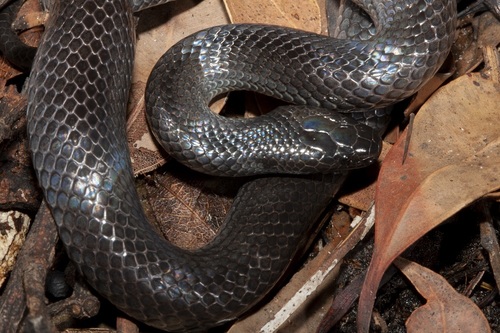
Lowlands Copperhead

Lowlands Copperhead

Austrelaps superbus

Silhouette: SeismicShrimp · PhyloPic

LCLeast ConcernNTVUENCR Endemic
Daily sighting probability ~10% · With luck
at Melbourne

In 3 days ~20% in a week ~40%

97 Verified sightings at Melbourne
108 In all 3 parks From 2019 to 2026
September Best month
☀️ Diurnal When it's spotted

About the Lowlands Copperhead

The lowland copperhead or lowlands copperhead (Austrelaps superbus) is a venomous snake species in the family Elapidae, found in southeastern Australia, including Tasmania. It is commonly referred to as the copperhead, but is not closely related to the American copperhead, Agkistrodon contortrix. If provoked, the lowland copperhead is a dangerous snake with neurotoxic venom, which can kill an adult human if correct first aid is not applied promptly.

The lowland copperhead is generally 1-1.5 m (3–5 feet) long. Their colour varies a great deal, from a coppery mid-brown to yellowish, reddish, grey or black. The copper head colouring that gave rise to the common name is not always present. Its venom has been measured at 0.5 mg/kg subcutaneous.

It is found in southeastern Australia, including Tasmania. A. superbus has a preference for areas of low vegetation near water bodies where it hunts for frogs, lizards and snakes, including smaller specimens of its own species. It has been found in sandstone ridgetop woodland in the Blue Mountains, west of Sydney, where it is becoming rare, due to increasing fires and the spread of urban settlements... Wikipedia →

Global Distribution

Parks Where Found

# Park Country Daily sighting probability
1 Wilsons Promontory National Park 🇦🇺 Australia
~40%
2 Great Otway National Park 🇦🇺 Australia
~20%
3 Grampians National Park 🇦🇺 Australia
~10%

Cities Where Found

# City Country Daily sighting probability
1 Melbourne 🇦🇺 Australia
~10%

Zoos & Centres Where Found

# Zoo / Centre Country
1 Bonorong Wildlife Sanctuary 🇦🇺 Australia In captivity

Before you go

What are the chances of seeing a Lowlands Copperhead in Melbourne?

With luck

About 10% of wildlife watchers report a Lowlands Copperhead sighting in Melbourne on a given day, based on 97 verified sightings from GBIF citizen-science data. It is the 11th most-seen of the 23 reptiles we can rate there. Over three days the chance rises to about 20%, and over a week to about 40%, if each day is a fresh chance.

When is the best time to see a Lowlands Copperhead in Melbourne?

July to April

In those months about 10% of wildlife watchers report a Lowlands Copperhead in Melbourne on a given day, against under 5% in May and June, the lowest months.

What time of day is best to see a Lowlands Copperhead?

Between noon and 3 pm

Across all the parks we cover, that three-hour window holds the most Lowlands Copperhead sightings with a recorded time, and about 9 in 10 of them come between 6 am and 6 pm: it is a daytime animal.

Where else can you see a Lowlands Copperhead?

Only Melbourne, in our data

Melbourne is the only city on Wallace's Line with enough records to rate Lowlands Copperhead sightings: about 10% of wildlife watchers there report one on a given day.

Which relatives of the Lowlands Copperhead live in Melbourne?

Same family: Elapidae

The closest relatives of the Lowlands Copperhead that you can see in Melbourne (family Elapidae, Elapid Snakes) are Eastern Tiger Snake (about 10%) and Eastern Brown Snake (about 10%), with each one's daily chance of a sighting.

Where does the Lowlands Copperhead sighting chance come from?

GBIF citizen-science records

It is estimated from how often the Lowlands Copperhead is recorded against all the reptiles logged in Melbourne (97 verified sightings), calibrated against known sighting rates. Figures are rounded to the nearest 10% because citizen-science data supports honest approximations, not decimals, and months with records from fewer than five people show "—". How it works.

← Back to Melbourne