Daily sighting probability <5% · Rare
at Melbourne

In 3 days ~10%

5 Verified sightings at Melbourne
188 In all 4 parks From 2019 to 2026
January Best month
☀️ Diurnal When it's spotted

About the Redeye Cicada

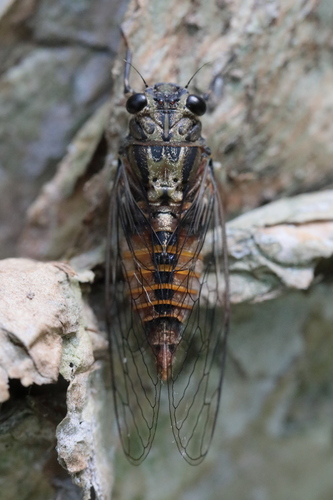
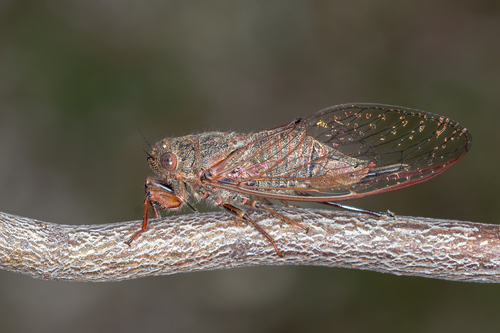
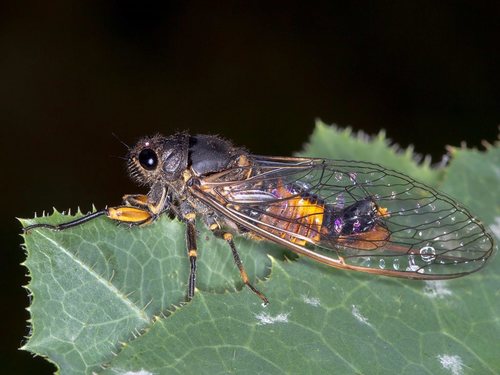
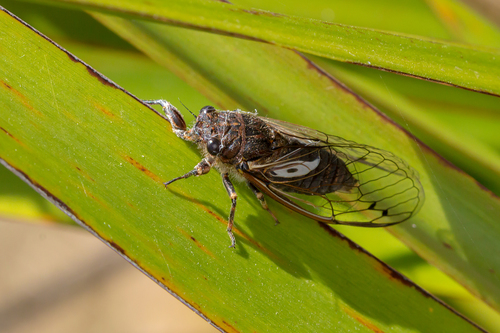
Psaltoda moerens, commonly known as the redeye, is an Australian species of cicada. It is distributed through the south-east of Australia, from southern Queensland to South Australia, as well as Tasmania. Populations can vary greatly between years; one year they may be present in large numbers and the next they may be entirely absent. They feed primarily on eucalyptus but also on Angophora trees. As they feed on tree sap they expel small droplets of clear waste fluid. When numbers are high, this can form a constant stream.

The redeye was originally described by German naturalist Ernst Friedrich Germar in 1834 as Cicada moerens, and later transferred to the new genus Psaltoda, where it was designated the type species by Swedish entomologist Carl Stål.

Walter Wilson Froggatt reported that the common name was used by Sydney children in his 1907 work Australian Insects, referring to the colour of the ocelli. The typical wingspan is around 110–120 mm. The adult is a shiny black above and brown and finely hairy underneath. As the name implies, the eyes are a deep red colour, although pinkish- and brownish-eyed specimens are seen. Heard at any time of day... Wikipedia →

Global Distribution

Parks Where Found

# Park Country Daily sighting probability
1 Royal National Park 🇦🇺 Australia
~20%
2 Blue Mountains National Park 🇦🇺 Australia
~20%
3 Grampians National Park 🇦🇺 Australia
~20%
4 Freycinet National Park 🇦🇺 Australia
~20%

Cities Where Found

# City Country Daily sighting probability
1 Sydney 🇦🇺 Australia
<5%
2 Melbourne 🇦🇺 Australia
<5%

Before you go

What are the chances of seeing a Redeye Cicada in Melbourne?

Rare

Under 5% of wildlife watchers report a Redeye Cicada sighting in Melbourne on a given day, based on 5 verified sightings from GBIF citizen-science data. It is the 808th most-seen of the 875 insects we can rate there. Over three days the chance rises to about 10%, if each day is a fresh chance.

When is the best time to see a Redeye Cicada in Melbourne?

Any time of year

In every month with enough records, under 5% of wildlife watchers report a Redeye Cicada in Melbourne on a given day, so our monthly data shows no clear season.

What time of day is best to see a Redeye Cicada?

Between 10 am and 1 pm

Across all the parks we cover, that three-hour window holds the most Redeye Cicada sightings with a recorded time, and about 8 in 10 of them come between 6 am and 6 pm: it is a daytime animal.

Is Melbourne the best place to see a Redeye Cicada?

Among the best

Of the 2 cities where we can rate Redeye Cicada sightings, Melbourne ranks 2nd at under 5%, level with the leaders once rounded. The best odds are in Sydney (Australia, under 5%).

Which relatives of the Redeye Cicada live in Melbourne?

Same family: Cicadidae

The closest relatives of the Redeye Cicada that you can see in Melbourne (family Cicadidae, Typical Cicadas) are Green Grocer (about 10%) and Silver Princess (about 10%), with each one's daily chance of a sighting.

Where does the Redeye Cicada sighting chance come from?

GBIF citizen-science records

It is estimated from how often the Redeye Cicada is recorded against all the insects logged in Melbourne (5 verified sightings), calibrated against known sighting rates. Figures are rounded to the nearest 10% because citizen-science data supports honest approximations, not decimals, and months with records from fewer than five people show "—". How it works.

← Back to Melbourne