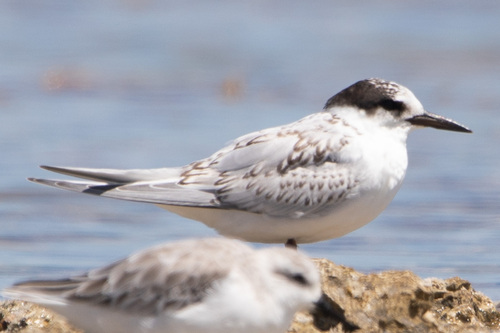
White-fronted Tern

White-fronted Tern

Sterna striata

Silhouette: Sharon Wegner-Larsen · PhyloPic

LCNTNear ThreatenedVUENCR
Daily sighting probability <5% · Rare
at Melbourne

In 3 days <5%

6 Verified sightings at Melbourne
1,720 In all 6 parks From 2019 to 2026
May Best month
☀️ Diurnal When it's spotted

About the White-fronted Tern

The white-fronted tern (Sterna striata), also known as tara, sea swallow, black-billed tern, kahawai bird, southern tern, or swallow tail, was first described by Johann Friedrich Gmelin in 1789. A medium-sized tern with an all-white body including underwing and forked tail, with pale grey hues on the mantle and upper side of the wing. In breeding adults a striking black cap covers the head from forehead to nape, leaving a small white strip above the black bill.

This is the most abundant tern in New Zealand. It can be observed feeding on shoaling fish along the entire coastline and many of the smaller outlying islands. Breeding occurs from October to January on rocky cliffs, offshore islands and along the coast where pairs will nest on shingle, sand, shell or rock. Flocks may contain hundreds of breeding pairs that will nest in close proximity to one another. Large numbers of juveniles and some adults migrate to the south-east coast of Australia and parts of Tasmania in the autumn, with small numbers establishing breeding colonies on Flinders and Cape Barren Islands in the Bass Strait.

Due to mammalian predators introduced to New Zealand, such as ferrets and stoats, the white-fronted tern has recently been given the New Zealand national conservation status of at risk/in decline. Wikipedia →

Sounds

Call1:21

New Zealand · 2023

© Ken George · XC853664 · CC BY-NC-SA 4.0

Flight call0:33

New Zealand · 2025

© David Boyle · XC979738 · CC BY-NC-SA 4.0

Call0:43

New Zealand · 2013

© Fernand DEROUSSEN · XC152985 · CC BY-NC-ND 3.0

Global Distribution

Parks Where Found

# Park Country Daily sighting probability
1 Rakiura National Park 🇳🇿 New Zealand
~60%
2 Fiordland National Park 🇳🇿 New Zealand
~10%
3 Abel Tasman National Park 🇳🇿 New Zealand
~10%
4 Freycinet National Park 🇦🇺 Australia
<5%
5 Egmont National Park 🇳🇿 New Zealand
<5%
6 Royal National Park 🇦🇺 Australia
<5%

Cities Where Found

# City Country Daily sighting probability
1 Auckland 🇳🇿 New Zealand
~10%
2 Sydney 🇦🇺 Australia
<5%
3 Melbourne 🇦🇺 Australia
<5%

Before you go

What are the chances of seeing a White-fronted Tern in Melbourne?

Rare

Under 5% of wildlife watchers report a White-fronted Tern sighting in Melbourne on a given day, based on 6 verified sightings from GBIF citizen-science data. It is the 232nd most-seen of the 236 birds we can rate there. Over three days the chance rises to under 5%, if each day is a fresh chance.

When is the best time to see a White-fronted Tern in Melbourne?

Any time of year

In every month with enough records, under 5% of wildlife watchers report a White-fronted Tern in Melbourne on a given day, so our monthly data shows no clear season.

What time of day is best to see a White-fronted Tern?

Between noon and 3 pm

Across all the parks we cover, that three-hour window holds the most White-fronted Tern sightings with a recorded time, and about 9 in 10 of them come between 6 am and 6 pm: it is a daytime animal.

Is Melbourne the best place to see a White-fronted Tern?

3rd of 3

Of the 3 cities where we can rate White-fronted Tern sightings, Melbourne ranks 3rd at under 5%. The best odds are in Auckland (New Zealand, about 10%) and Sydney (Australia, under 5%).

Where does the White-fronted Tern sighting chance come from?

GBIF citizen-science records

It is estimated from how often the White-fronted Tern is recorded against all the birds logged in Melbourne (6 verified sightings), calibrated against known sighting rates. Figures are rounded to the nearest 10% because citizen-science data supports honest approximations, not decimals, and months with records from fewer than five people show "—". How it works.

← Back to Melbourne