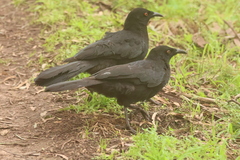
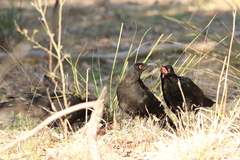
White-winged Chough

White-winged Chough

Corcorax melanoramphos

LCLeast ConcernNTVUENCR Endemic
Daily sighting probability <5% · Rare
at Melbourne

In 3 days <5% in a week ~10%

318 Verified sightings at Melbourne
725 In all 4 parks From 2019 to 2026
July Best month
☀️ Diurnal When it's spotted

About the White-winged Chough

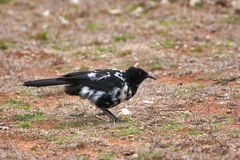
The white-winged chough (Corcorax melanorhamphos) is one of only two surviving species of the Australian mud-nest builders family, Corcoracidae, and is the only member of the genus Corcorax. It is native to southern and eastern Australia and is an example of convergent evolution as it is only distantly related to the European choughs that it closely resembles in shape, and for which it was named.

The white-winged chough was first described by French naturalist Louis Pierre Vieillot in 1817 as Coracia melanorhamphos, other names given include Pyrrhocorax leucopterus by Dutch zoologist Coenraad Jacob Temminck in 1820, and Corcorax australis by French naturalist René Lesson in 1830. before the current name was settled by Gregory Mathews in 1912. The specific epithet is derived from the Ancient Greek words melano- 'black' and rhamphos 'beak'.

It is placed in the family known as the mud-nest builders or Corcoracidae, written as Grallinidae in older books before the removal of the genus Grallina to the family Monarchidae. It is one of two remaining species, with the apostlebird (Struthidea cinerea), which differs in appearance but exhibits many behavioural similarities. The... Wikipedia →

Sounds

Call0:07

Australia · 2026

© Nick Talbot · XC1137103 · CC BY-NC-SA 4.0

Alarm call0:30

Australia · 2020

© Toby Esplin · XC580344 · CC BY-NC-SA 4.0

Call0:15

Australia · 2023

© Romuald Mikusek · XC953369 · CC BY-NC-SA 4.0

Global Distribution

Parks Where Found

# Park Country Daily sighting probability
1 Hattah-Kulkyne National Park 🇦🇺 Australia
~30%
2 Grampians National Park 🇦🇺 Australia
~20%
3 Kosciuszko National Park 🇦🇺 Australia
~10%
4 Blue Mountains National Park 🇦🇺 Australia
<5%

Cities Where Found

# City Country Daily sighting probability
1 Melbourne 🇦🇺 Australia
<5%
2 Sydney 🇦🇺 Australia
<5%

Zoos & Centres Where Found

# Zoo / Centre Country
1 Taronga Zoo 🇦🇺 Australia In captivity
2 Featherdale Sydney Wildlife Park 🇦🇺 Australia In captivity

Before you go

What are the chances of seeing a White-winged Chough in Melbourne?

Rare

Under 5% of wildlife watchers report a White-winged Chough sighting in Melbourne on a given day, based on 318 verified sightings from GBIF citizen-science data. It is the 137th most-seen of the 236 birds we can rate there. Over three days the chance rises to under 5%, and over a week to about 10%, if each day is a fresh chance.

When is the best time to see a White-winged Chough in Melbourne?

Any time of year

In every month with enough records, under 5% of wildlife watchers report a White-winged Chough in Melbourne on a given day, so our monthly data shows no clear season.

What time of day is best to see a White-winged Chough?

Between 11 am and 2 pm

Across all the parks we cover, that three-hour window holds the most White-winged Chough sightings with a recorded time, and nearly all of them come between 6 am and 6 pm: it is a daytime animal.

Is Melbourne the best place to see a White-winged Chough?

Yes

Of the 2 cities where we can rate White-winged Chough sightings, Melbourne has the highest daily chance: under 5%. Next come Sydney (Australia, under 5%).

Which relatives of the White-winged Chough live in Melbourne?

Same order: Passeriformes

The closest relatives of the White-winged Chough that you can see in Melbourne (order Passeriformes, Perching Birds) are Australian Magpie (about 90%), Noisy Miner (about 80%) and Little Raven (about 80%), with each one's daily chance of a sighting.

Where does the White-winged Chough sighting chance come from?

GBIF citizen-science records

It is estimated from how often the White-winged Chough is recorded against all the birds logged in Melbourne (318 verified sightings), calibrated against known sighting rates. Figures are rounded to the nearest 10% because citizen-science data supports honest approximations, not decimals, and months with records from fewer than five people show "—". How it works.

← Back to Melbourne