Black-tailed Gnatcatcher

Black-tailed Gnatcatcher

Polioptila melanura

Silhouette: Sheatherius · PhyloPic

LCLeast ConcernNTVUENCR
Daily sighting probability ~10% · With luck
at Mesa

In 3 days ~20% in a week ~40%

1,094 Verified sightings at Mesa
4,176 In all 6 parks From 2019 to 2026
February Best month
☀️ Diurnal When it's spotted

About the Black-tailed Gnatcatcher

The black-tailed gnatcatcher (Polioptila melanura) is a small, insectivorous bird which ranges throughout the Sonoran and Chihuahuan Deserts of the southwestern United States and northern Mexico. It is nonmigratory and found in arid desert areas year-round.

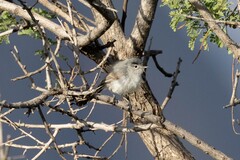
The black-tailed gnatcatcher was described by American ornithologist George Newbold Lawrence in 1857. Meaning 'black-tailed', its specific name is derived from the Ancient Greek melano- 'black' and oura 'tail'. The black-tailed gnatcatcher reaches about 4.5 to 5 inches in length, much of it taken up by a long black tail lined with white outer feathers. The body is blue-grey, with white underparts, and while it is similar to the blue-grey gnatcatcher, the two birds are differentiated by the amount of black in the tail feathers. The male has a black cap during the summer that extends to the eyes. Females and winter males, lacking the black cap, are difficult to distinguish from the blue-grey gnatcatcher. The best way to tell the two apart is the tail; that of the blue-grey is mostly white when viewed from below, and the black-tailed is predominantly black underneath. Like other gnatcatchers, it... Wikipedia →

Sounds

Song0:43

Mexico · 2025

© Barry Edmonston · XC1000843 · CC BY-NC-SA 4.0

Call1:00

Mexico · 2019

© Richard E. Webster · XC503156 · CC BY-NC-SA 4.0

Begging call0:38

United States · 2016

© Bobby Wilcox · XC314498 · CC BY-NC-SA 4.0

Global Distribution

Parks Where Found

# Park Country Daily sighting probability
1 Saguaro National Park 🇺🇸 United States
~30%
2 Big Bend National Park 🇺🇸 United States
~30%
3 Joshua Tree National Park 🇺🇸 United States
~20%
4 Death Valley National Park 🇺🇸 United States
~10%
5 Cumbres de Monterrey National Park 🇲🇽 Mexico
<5%
6 Guadalupe Mountains National Park 🇺🇸 United States
<5%

Cities Where Found

# City Country Daily sighting probability
1 Phoenix 🇺🇸 United States
~10%
2 Mesa 🇺🇸 United States
~10%
3 Las Vegas 🇺🇸 United States
~10%

Before you go

What are the chances of seeing a Black-tailed Gnatcatcher in Mesa?

With luck

About 10% of wildlife watchers report a Black-tailed Gnatcatcher sighting in Mesa on a given day, based on 1,094 verified sightings from GBIF citizen-science data. It is the 88th most-seen of the 268 birds we can rate there. Over three days the chance rises to about 20%, and over a week to about 40%, if each day is a fresh chance.

When is the best time to see a Black-tailed Gnatcatcher in Mesa?

October to June

In those months about 10% of wildlife watchers report a Black-tailed Gnatcatcher in Mesa on a given day, against under 5% in July to September, the lowest months.

What time of day is best to see a Black-tailed Gnatcatcher?

Between 7 and 10 am

Across all the parks we cover, that three-hour window holds the most Black-tailed Gnatcatcher sightings with a recorded time, and about 9 in 10 of them come between 6 am and 6 pm: it is a daytime animal.

Is Mesa the best place to see a Black-tailed Gnatcatcher?

Among the best

Of the 3 cities where we can rate Black-tailed Gnatcatcher sightings, Mesa ranks 2nd at about 10%, level with the leaders once rounded. The best odds are in Phoenix (United States, about 10%).

Where does the Black-tailed Gnatcatcher sighting chance come from?

GBIF citizen-science records

It is estimated from how often the Black-tailed Gnatcatcher is recorded against all the birds logged in Mesa (1,094 verified sightings), calibrated against known sighting rates. Figures are rounded to the nearest 10% because citizen-science data supports honest approximations, not decimals, and months with records from fewer than five people show "—". How it works.

← Back to Mesa