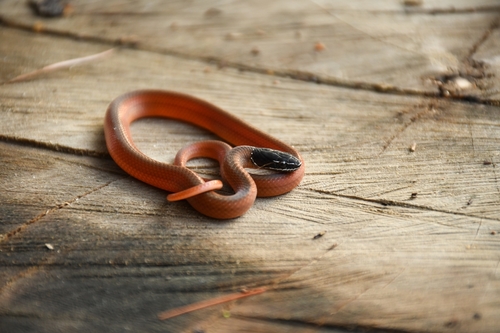
Mexican Bull Snake

Mexican Bull Snake

Pituophis deppei

Silhouette: Alex Slavenko · PhyloPic

LCLeast ConcernNTVUENCR Endemic
Daily sighting probability ~20% · Possible
at Mexico City

In 3 days ~40% in a week ~70%

301 Verified sightings at Mexico City
August Best month
☀️ Diurnal When it's spotted

About the Mexican Bull Snake

Pituophis deppei, commonly known as the Mexican bullsnake and the Mexican pine snake, is a species of nonvenomous colubrid snake endemic to Mexico. There are two recognized subspecies. The specific name, deppei, is in honor of German artist Ferdinand Deppe, who collected natural history specimens in Mexico.

The subspecific name, jani, is in honor of Italian herpetologist Giorgio Jan. P. deppei occurs in the Mexican states of Aguascalientes, Coahuila, Guanajuato, Hidalgo, Jalisco, Mexico, Morelos, Nayarit, Nuevo León, Oaxaca, Puebla, Querétaro, San Luis Potosí, Sinaloa, Sonora, and Tamaulipas. The preferred natural habitats of P. deppei are forest, shrubland, and grassland, but it is also found in agricultural, suburban, and urban areas.

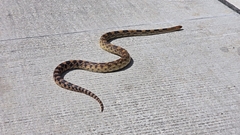
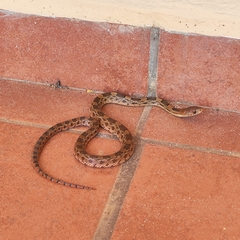
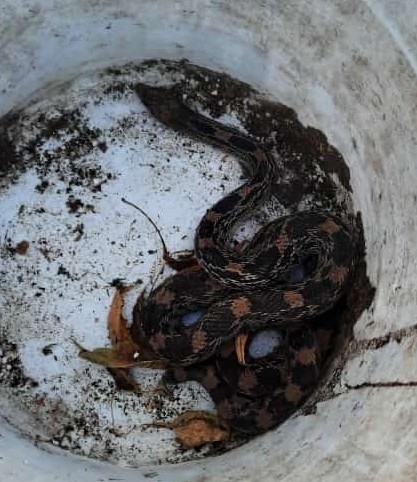
Dorsally, P. deppei is yellowish tan, with a series of large quadrangular blotches, which are dark brown to black. It has smaller dark spots on the sides. Ventrally, it is yellowish, with squarish brown spots. Adults may attain a total length of 1.69 m (5.5 ft), including a tail length of 18 cm (7.1 in).

P. deppei is oviparous. Two subspecies... Wikipedia →
Global Distribution

Parks Where Found

# Park Country Daily sighting probability

More parks will be added in future updates.

Cities Where Found

# City Country Daily sighting probability
1 León 🇲🇽 México
~20%
2 Puebla 🇲🇽 México
~20%
3 Mexico City 🇲🇽 México
~20%
4 San Luis Potosí 🇲🇽 México
~10%
5 Guadalajara 🇲🇽 México
~10%

Zoos & Centres Where Found

# Zoo / Centre Country
1 Cabarceno Natural Park 🇪🇸 Spain In captivity
2 Cape May County Park & Zoo 🇺🇸 United States In captivity
3 Zoológico de San Juan de Aragón 🇲🇽 Mexico In captivity
4 Caldwell Zoo 🇺🇸 United States In captivity
5 Zoológico la pastroa 🇲🇽 Mexico In captivity
6 Chapultepec Zoo 🇲🇽 Mexico In captivity
7 Zoológico Los Coyotes 🇲🇽 Mexico In captivity
8 Parque de las Leyendas 🇵🇪 Peru In captivity
9 Gladys Porter Zoo 🇺🇸 United States In captivity
10 Acuario Inbursa 🇲🇽 Mexico In captivity
11 Reino Animal 🇲🇽 Mexico In captivity
12 Seattle Marine Aquarium 🇺🇸 United States In captivity

Before you go

What are the chances of seeing a Mexican Bull Snake in Mexico City?

Possible

About 20% of wildlife watchers report a Mexican Bull Snake sighting in Mexico City on a given day, based on 301 verified sightings from GBIF citizen-science data. It is the 4th most-seen of the 37 reptiles we can rate there. Over three days the chance rises to about 40%, and over a week to about 70%, if each day is a fresh chance.

When is the best time to see a Mexican Bull Snake in Mexico City?

August

In that month about 30% of wildlife watchers report a Mexican Bull Snake in Mexico City on a given day, against about 10% in November to May, the lowest months. That is one of Mexico City's wettest months, with about 150 mm of rain against 5 mm in December.

What time of day is best to see a Mexican Bull Snake?

Between 10 am and 1 pm

Across all the parks we cover, that three-hour window holds the most Mexican Bull Snake sightings with a recorded time, and about 8 in 10 of them come between 6 am and 6 pm: it is a daytime animal.

Is Mexico City the best place to see a Mexican Bull Snake?

Among the best

Of the 5 cities where we can rate Mexican Bull Snake sightings, Mexico City ranks 3rd at about 20%, level with the leaders once rounded. The best odds are in León (México, about 20%) and Puebla (México, about 20%).

Where does the Mexican Bull Snake sighting chance come from?

GBIF citizen-science records

It is estimated from how often the Mexican Bull Snake is recorded against all the reptiles logged in Mexico City (301 verified sightings), calibrated against known sighting rates. Figures are rounded to the nearest 10% because citizen-science data supports honest approximations, not decimals, and months with records from fewer than five people show "—". How it works.

← Back to Mexico City