The Geometrician

The Geometrician

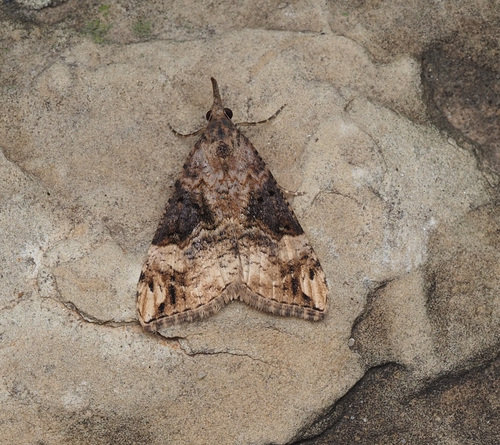
Grammodes stolida

Daily sighting probability <5% · Rare
at Milan

In 3 days ~10% in a week ~30%

9 Verified sightings at Milan
107 In all 7 parks From 2019 to 2026
August Best month
☀️🌙 Day & Night When it's spotted

About the The Geometrician

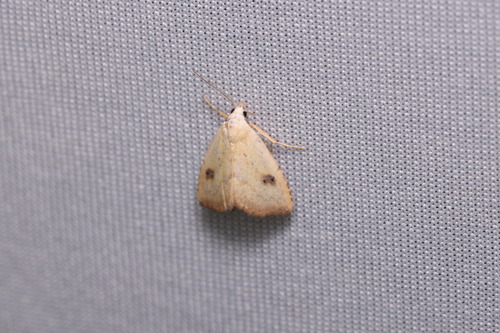
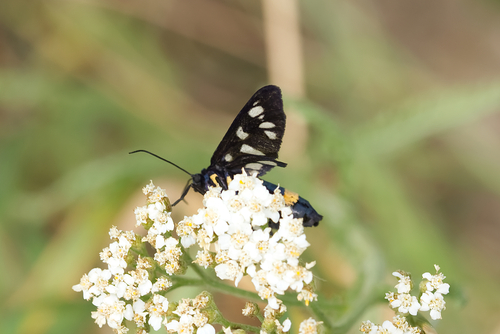
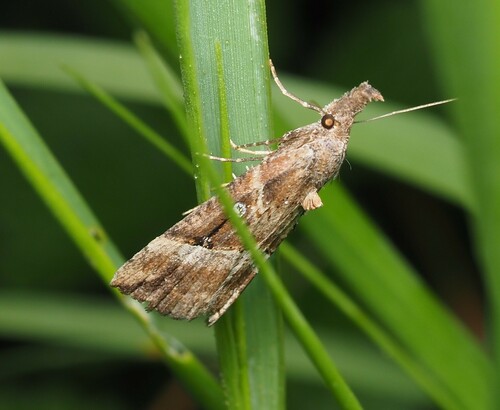
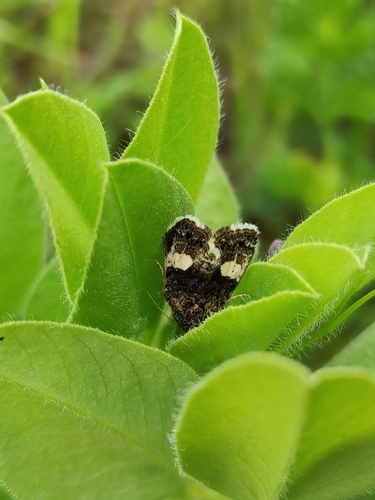
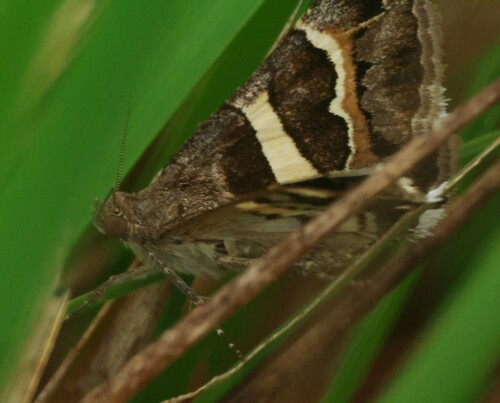
Grammodes stolida, the geometrician, is a moth of the family Erebidae. The species was first described by Johan Christian Fabricius in 1775. It is found in Africa, southern Europe, most of Asia and Australia. It migrates to central and northern Europe as far north as England, Denmark and Finland.

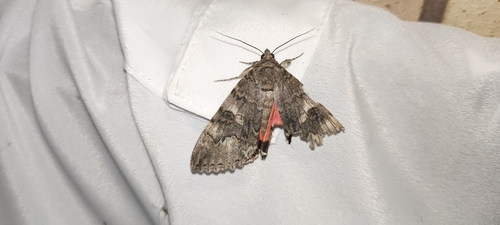
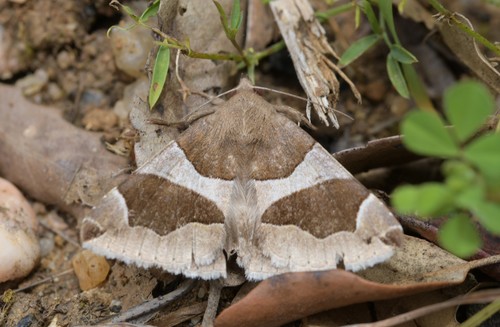
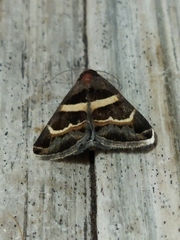
Forewing: basal two-thirds black brown, with basal patch, costal streak, and reniform stigma fuscous grey; crossed at middle by a pale ochreous band oblique from subcostal and widening downwards, its outer half yellowish; limited externally by a biconcave ochreous band, narrower below, followed below vein 6 by a broad brown band, on the outer edge of which are three or four irregular black patches, and above and beyond it on costa a black blotch, sharply angled externally on vein 6, these black marks forming the inner edge of a diffuse submarginal pale line; terminal area shaded with brown and fuscous, with a short black apical streak and a diffuse dark cloud below the middle; fringe grey with white base, altogether whitish round apex: hindwing olive fuscous, becoming blackish towards termen; a white band from costa at one-third to anal angle, and... Wikipedia →
Global Distribution

Parks Where Found

# Park Country Daily sighting probability
1 West Coast National Park 🇿🇦 South Africa
~10%
2 Kgalagadi Transfrontier Park 🇿🇦 South Africa
~10%
3 Namib-Naukluft National Park 🇳🇦 Namibia
~10%
4 Kruger National Park 🇿🇦 South Africa
~10%
5 Addo Elephant National Park 🇿🇦 South Africa
~10%
6 Garden Route National Park 🇿🇦 South Africa
~10%
7 Table Mountain National Park 🇿🇦 South Africa
<5%

Cities Where Found

# City Country Daily sighting probability
1 Naples 🇮🇹 Italy
~10%
2 Pretoria 🇿🇦 South Africa
~10%
3 Johannesburg 🇿🇦 South Africa
~10%
4 Budapest 🇭🇺 Hungary
~10%
5 Athens 🇬🇷 Greece
~10%
6 Bucharest 🇷🇴 Romania
~10%
7 Milan 🇮🇹 Italy
<5%
8 Chennai 🇮🇳 India
<5%
9 Barcelona 🇪🇸 Spain
<5%
10 Cape Town 🇿🇦 South Africa
<5%

Before you go

What are the chances of seeing a The Geometrician in Milan?

Rare

Under 5% of wildlife watchers report a The Geometrician sighting in Milan on a given day, based on 9 verified sightings from GBIF citizen-science data. It is the 221st most-seen of the 351 insects we can rate there. Over three days the chance rises to about 10%, and over a week to about 30%, if each day is a fresh chance.

When is the best time to see a The Geometrician in Milan?

August and September

In those months about 10% of wildlife watchers report a The Geometrician in Milan on a given day, against under 5% in October to July, the lowest months.

What time of day is best to see a The Geometrician?

Between 8 and 11 pm

Across all the parks we cover, that three-hour window holds the most The Geometrician sightings with a recorded time, and about 7 in 10 of them come between 6 pm and 6 am: it is seen both by day and at night.

Is Milan the best place to see a The Geometrician?

7th of 10

Of the 10 cities where we can rate The Geometrician sightings, Milan ranks 7th at under 5%. The best odds are in Naples (Italy, about 10%), Pretoria (South Africa, about 10%) and Johannesburg (South Africa, about 10%).

Which relatives of the The Geometrician live in Milan?

Same family: Erebidae

The closest relatives of the The Geometrician that you can see in Milan (family Erebidae, Underwing, Tiger, Tussock, and Allied Moths) are Fall Webworm Moth (about 20%), Spongy Moth (about 10%) and Red Underwing (about 10%), with each one's daily chance of a sighting.

Where does the The Geometrician sighting chance come from?

GBIF citizen-science records

It is estimated from how often the The Geometrician is recorded against all the insects logged in Milan (9 verified sightings), calibrated against known sighting rates. Figures are rounded to the nearest 10% because citizen-science data supports honest approximations, not decimals, and months with records from fewer than five people show "—". How it works.

← Back to Milan