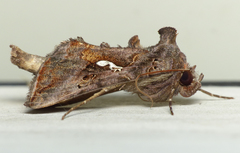
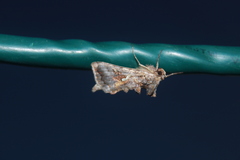
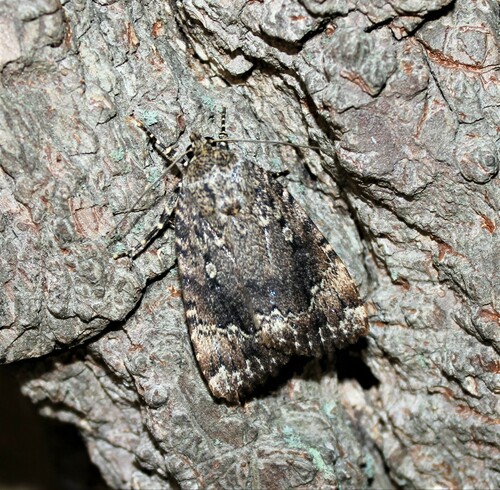
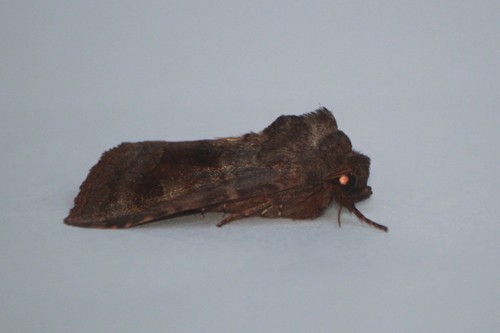
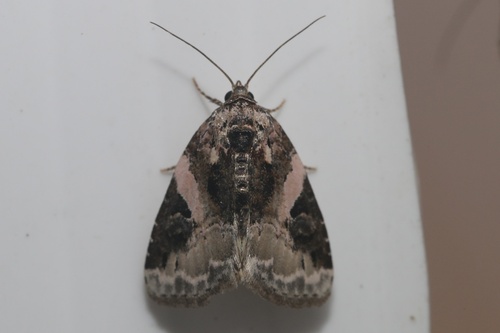
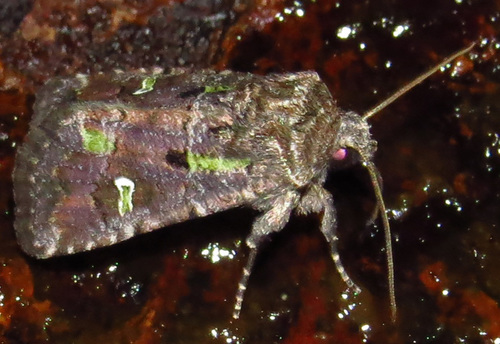
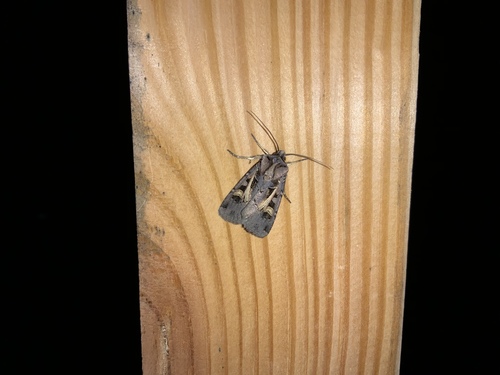
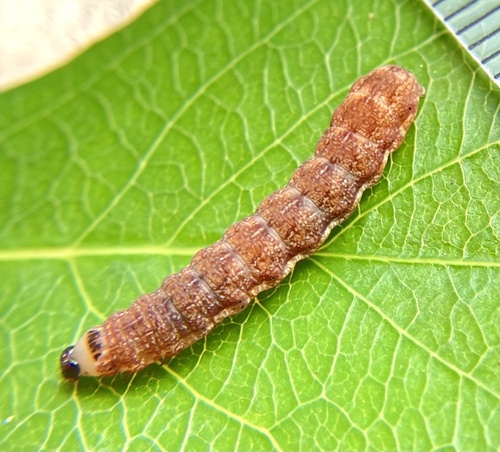
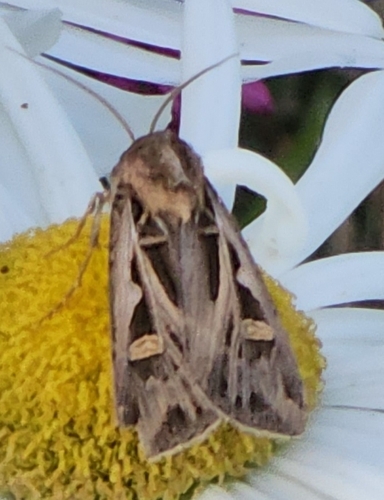
Common Looper Moth

Common Looper Moth

Autographa precationis

Daily sighting probability <5% · Rare
at Minneapolis [Saint Paul]

In 3 days ~10% in a week ~20%

8 Verified sightings at Minneapolis [Saint Paul]
8 In 1 park From 2019 to 2026
October Best month
☀️🌙 Day & Night When it's spotted

About the Common Looper Moth

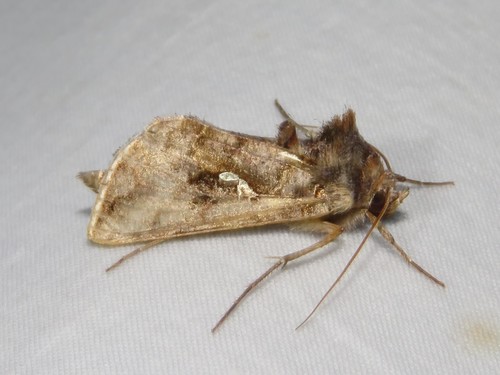
Autographa precationis (common looper moth) is a moth of the family Noctuidae. It is found in eastern and central North America. The wingspan is 30–38 mm. Adults are on wing from April to October depending on the location. There are three or more generations per year.

The larvae feed on various forbs, including Apiaceae, Asteraceae, Brassicaceae, Chenopodiaceae, Convolvulaceae, Fabaceae, Malvaceae, Plantaginaceae and Verbenaceae species. The common looper is thought to have recently moved into the greater niche provided by more soybean planting in its range, with larvae observed in the wild feeding on soybean plants in addition to their usual fare. Notably, their digestibility and efficiency of food utilization for soybeans was not as high as with Pseudoplusia includens, suggesting host plant preference for common loopers is slightly different. Visually, the two species are strikingly similar, so it is easy to confuse the two, but notably the silver spots on the wings of the Common Looper are usually conjoined, while the spots on the wings of P. includens are separated, and their wings are shinier than those of A. precationis. Larvae of this species have 21–23... Wikipedia →
Global Distribution

Parks Where Found

# Park Country Daily sighting probability
1 Point Pelee National Park 🇨🇦 Canada
~10%

More parks will be added in future updates.

Cities Where Found

# City Country Daily sighting probability
1 Chicago 🇺🇸 United States
~10%
2 Boston 🇺🇸 United States
<5%
3 Toronto 🇨🇦 Canada
<5%
4 Philadelphia 🇺🇸 United States
<5%
5 Montreal 🇨🇦 Canada
<5%
6 Washington 🇺🇸 United States
<5%
7 Minneapolis [Saint Paul] 🇺🇸 United States
<5%
8 New York City 🇺🇸 United States
<5%

Before you go

What are the chances of seeing a Common Looper Moth in Minneapolis [Saint Paul]?

Rare

Under 5% of wildlife watchers report a Common Looper Moth sighting in Minneapolis [Saint Paul] on a given day, based on 8 verified sightings from GBIF citizen-science data. It is the 458th most-seen of the 672 insects we can rate there. Over three days the chance rises to about 10%, and over a week to about 20%, if each day is a fresh chance.

When is the best time to see a Common Looper Moth in Minneapolis [Saint Paul]?

Any time of year

In every month with enough records, under 5% of wildlife watchers report a Common Looper Moth in Minneapolis [Saint Paul] on a given day, so our monthly data shows no clear season.

What time of day is best to see a Common Looper Moth?

Between 10 pm and 1 am

Across all the parks we cover, that three-hour window holds the most Common Looper Moth sightings with a recorded time, and about half of them come between 6 am and 6 pm: it is seen both by day and at night.

Is Minneapolis [Saint Paul] the best place to see a Common Looper Moth?

7th of 8

Of the 8 cities where we can rate Common Looper Moth sightings, Minneapolis [Saint Paul] ranks 7th at under 5%. The best odds are in Chicago (United States, about 10%), Boston (United States, under 5%) and Toronto (Canada, under 5%).

Which relatives of the Common Looper Moth live in Minneapolis [Saint Paul]?

Same family: Noctuidae

The closest relatives of the Common Looper Moth that you can see in Minneapolis [Saint Paul] (family Noctuidae, Cutworm Moths and Allies) are American Dagger (about 10%), American Copper Underwing (about 10%) and Celery Looper Moth (about 10%), with each one's daily chance of a sighting.

Where does the Common Looper Moth sighting chance come from?

GBIF citizen-science records

It is estimated from how often the Common Looper Moth is recorded against all the insects logged in Minneapolis [Saint Paul] (8 verified sightings), calibrated against known sighting rates. Figures are rounded to the nearest 10% because citizen-science data supports honest approximations, not decimals, and months with records from fewer than five people show "—". How it works.

← Back to Minneapolis [Saint Paul]