Witch-Hazel Cone Gall Aphid

Witch-Hazel Cone Gall Aphid

Hormaphis hamamelidis

Daily sighting probability <5% · Rare
at Minneapolis [Saint Paul]

In 3 days ~10% in a week ~20%

6 Verified sightings at Minneapolis [Saint Paul]
67 In all 2 parks From 2019 to 2026
December Best month
☀️ Diurnal When it's spotted

About the Witch-Hazel Cone Gall Aphid

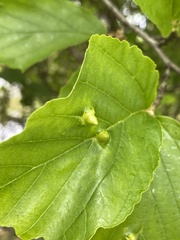
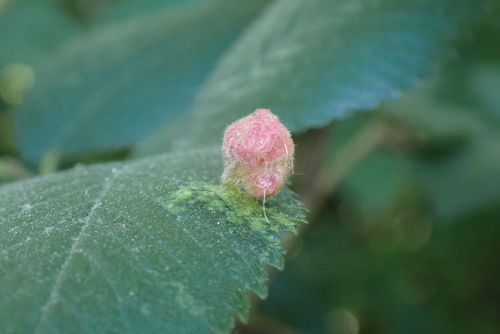
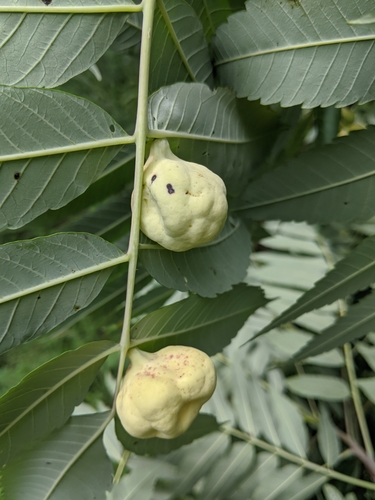
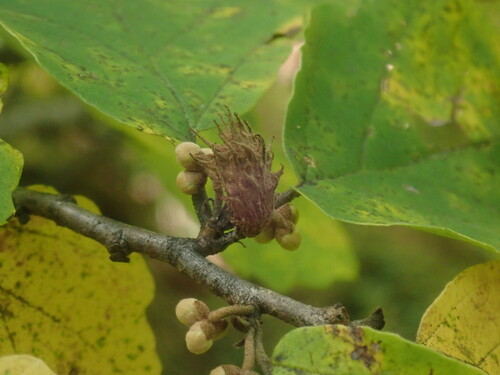
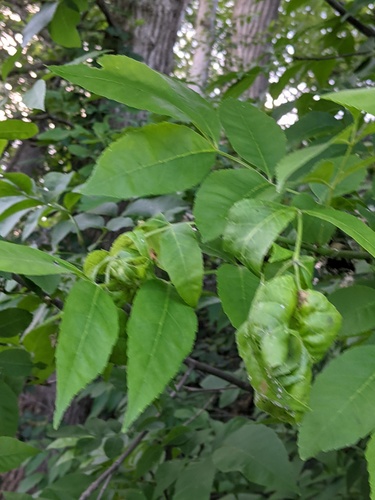
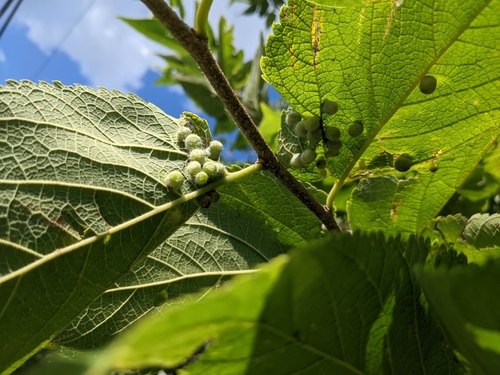
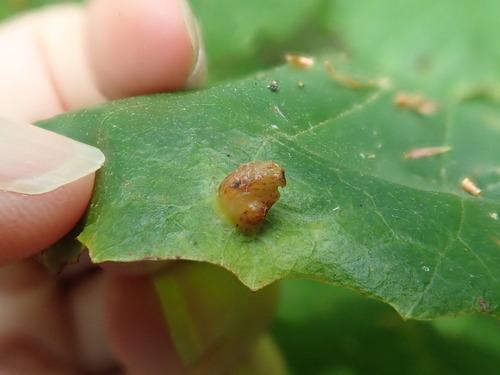
The witch-hazel cone gall aphid (Hormaphis hamamelidis) is a minuscule insect, a member of the aphid superfamily, whose presence on a witch-hazel (Hamamelis virginiana) plant is easily recognizable by a conical gall structure. The gall is green at first, then turns bright red. This gall, rich in nutrients, provides both food and shelter for the female aphid.

H. hamamelidis have three generations per year, each with a different part in the life cycle. At the start of spring, females or stem mothers crawl to witch-hazel leaf buds. As the leaf grows, the aphid injects it with a substance, possibly an enzyme or hormone, that causes that the galls to form around her. Once inside her gall, the stem mother reproduces parthenogenically and fills the gall with 50–70 female offspring. The second generation develops wings and disperses, repeating the process. The third generation includes both males and females. Towards the end of summer, the third generation reproduces sexually and lays eggs on the bark of the witch-hazel. The cycle begins anew in the following spring.

Hormaphis hamamelidis is sometimes mistaken with Hormaphis cornu. The two are closely related, both live in the eastern US, and both form galls on witch-hazel. However, while H. hamamelidis is autoecious and has three generations in a year, H. cornu lays eggs on both witch-hazel and river birch and has seven generations in year. H. hamamelidis is often found at higher elevations, while H. cornu is typically observed at lower elevations. The two species readily interbreed, but hybrids are probably inviable.

Like galls formed by other insects, the galls of H. hamamelidis may deter herbivory. Wikipedia →
Global Distribution

Parks Where Found

# Park Country Daily sighting probability
1 Shenandoah National Park 🇺🇸 United States
~10%
2 Great Smoky Mountains National Park 🇺🇸 United States
~10%

Cities Where Found

# City Country Daily sighting probability
1 Boston 🇺🇸 United States
~10%
2 Washington 🇺🇸 United States
~10%
3 New York City 🇺🇸 United States
~10%
4 Philadelphia 🇺🇸 United States
~10%
5 Baltimore 🇺🇸 United States
<5%
6 Chicago 🇺🇸 United States
<5%
7 Minneapolis [Saint Paul] 🇺🇸 United States
<5%
8 Toronto 🇨🇦 Canada
<5%

Before you go

What are the chances of seeing a Witch-Hazel Cone Gall Aphid in Minneapolis [Saint Paul]?

Rare

Under 5% of wildlife watchers report a Witch-Hazel Cone Gall Aphid sighting in Minneapolis [Saint Paul] on a given day, based on 6 verified sightings from GBIF citizen-science data. It is the 546th most-seen of the 672 insects we can rate there. Over three days the chance rises to about 10%, and over a week to about 20%, if each day is a fresh chance.

When is the best time to see a Witch-Hazel Cone Gall Aphid in Minneapolis [Saint Paul]?

December

In that month about 10% of wildlife watchers report a Witch-Hazel Cone Gall Aphid in Minneapolis [Saint Paul] on a given day, against under 5% in January to November, the lowest months. That is one of Minneapolis [Saint Paul]'s driest months, with about 35 mm of rain against 130 mm in June.

What time of day is best to see a Witch-Hazel Cone Gall Aphid?

Between 11 am and 2 pm

Across all the parks we cover, that three-hour window holds the most Witch-Hazel Cone Gall Aphid sightings with a recorded time, and about 9 in 10 of them come between 6 am and 6 pm: it is a daytime animal.

Is Minneapolis [Saint Paul] the best place to see a Witch-Hazel Cone Gall Aphid?

7th of 8

Of the 8 cities where we can rate Witch-Hazel Cone Gall Aphid sightings, Minneapolis [Saint Paul] ranks 7th at under 5%. The best odds are in Boston (United States, about 10%), Washington (United States, about 10%) and New York City (United States, about 10%).

Where does the Witch-Hazel Cone Gall Aphid sighting chance come from?

GBIF citizen-science records

It is estimated from how often the Witch-Hazel Cone Gall Aphid is recorded against all the insects logged in Minneapolis [Saint Paul] (6 verified sightings), calibrated against known sighting rates. Figures are rounded to the nearest 10% because citizen-science data supports honest approximations, not decimals, and months with records from fewer than five people show "—". How it works.

← Back to Minneapolis [Saint Paul]