Tawny Emperor
Daily sighting probability ~10% · With luck
at Monterrey

In 3 days ~30% in a week ~50%

69 Verified sightings at Monterrey
195 In all 7 parks From 2019 to 2026
October Best month
☀️ Diurnal When it's spotted

About the Tawny Emperor

Asterocampa clyton, the tawny emperor, is a species of brush-footed butterfly. It is native to North America, especially the eastern half from Canada to northern Mexico. The tawny emperor should not be mistaken for a very similar Asterocampa butterfly, the hackberry emperor, which can be distinguished by the white spots near the tip of its forewing and the black eyespot lower along the edge of the forewing.

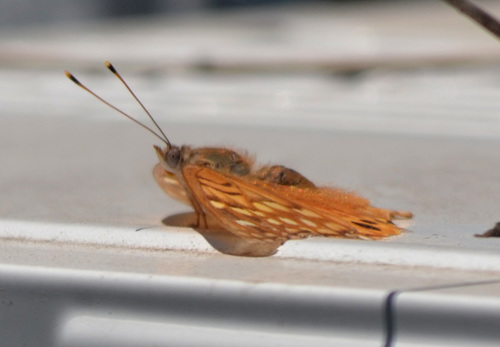
The upperside is mostly dark brown. The forewing is an orange-brown color with pale orange-yellow spots. The underside is mainly gray brown with the forewing having some black and pale yellowish markings. The wingspan measures 2 to 2.6 inches (51 to 66 mm). A dark morph of this species is regionally common with nearly uniformly dark hind wings.

This butterfly may be seen flying near houses, gravel driveways, near water, muddy places, gardens, and woodlands. Its only host plant is hackberry trees. The adult feeds on carrion, plant sap, and dung, and rarely land on flowers.

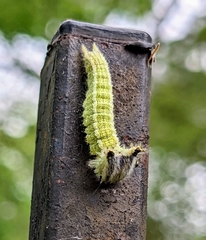
The female lays clusters of green eggs. The larva is green with yellow, white, or greenish stripes. Wikipedia →

Global Distribution

Parks Where Found

# Park Country Daily sighting probability
1 Point Pelee National Park 🇨🇦 Canada
~20%
2 Congaree National Park 🇺🇸 United States
~20%
3 Cumbres de Monterrey National Park 🇲🇽 Mexico
~10%
4 Shenandoah National Park 🇺🇸 United States
~10%
5 Big Bend National Park 🇺🇸 United States
~10%
6 Great Smoky Mountains National Park 🇺🇸 United States
~10%
7 Merritt Island National Wildlife Refuge 🇺🇸 United States
~10%

Cities Where Found

# City Country Daily sighting probability
1 Austin 🇺🇸 United States
~20%
2 San Antonio 🇺🇸 United States
~10%
3 Houston 🇺🇸 United States
~10%
4 Dallas 🇺🇸 United States
~10%
5 Monterrey 🇲🇽 México
~10%
6 Baltimore 🇺🇸 United States
<5%
7 Washington 🇺🇸 United States
<5%
8 New York City 🇺🇸 United States
<5%

Before you go

What are the chances of seeing a Tawny Emperor in Monterrey?

With luck

About 10% of wildlife watchers report a Tawny Emperor sighting in Monterrey on a given day, based on 69 verified sightings from GBIF citizen-science data. It is the 47th most-seen of the 413 insects we can rate there. Over three days the chance rises to about 30%, and over a week to about 50%, if each day is a fresh chance.

When is the best time to see a Tawny Emperor in Monterrey?

August to October

In those months about 20% of wildlife watchers report a Tawny Emperor in Monterrey on a given day, against under 5% in January–March and July, the lowest months. Those are among Monterrey's wettest months, with about 110 mm of rain a month against 20 mm in February.

What time of day is best to see a Tawny Emperor?

Between 11 am and 2 pm

Across all the parks we cover, that three-hour window holds the most Tawny Emperor sightings with a recorded time, and about 9 in 10 of them come between 6 am and 6 pm: it is a daytime animal.

Is Monterrey the best place to see a Tawny Emperor?

5th of 8

Of the 8 cities where we can rate Tawny Emperor sightings, Monterrey ranks 5th at about 10%. The best odds are in Austin (United States, about 20%), San Antonio (United States, about 10%) and Houston (United States, about 10%).

Where does the Tawny Emperor sighting chance come from?

GBIF citizen-science records

It is estimated from how often the Tawny Emperor is recorded against all the insects logged in Monterrey (69 verified sightings), calibrated against known sighting rates. Figures are rounded to the nearest 10% because citizen-science data supports honest approximations, not decimals, and months with records from fewer than five people show "—". How it works.

← Back to Monterrey