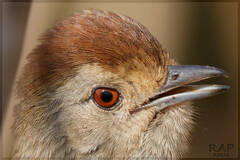
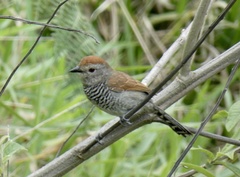
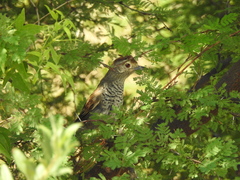
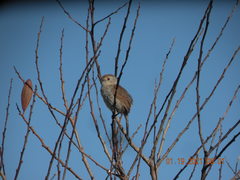
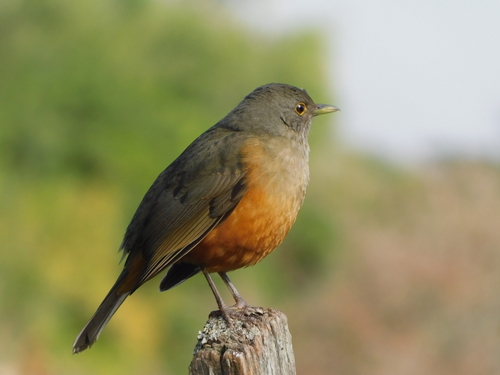
Rufous-capped Antshrike

Rufous-capped Antshrike

Thamnophilus ruficapillus

Silhouette: Sheatherius · PhyloPic

LCLeast ConcernNTVUENCR
Daily sighting probability <5% · Rare
at Montevideo

In 3 days <5%

7 Verified sightings at Montevideo
200 In all 5 parks From 2019 to 2026
March Best month
☀️ Diurnal When it's spotted

About the Rufous-capped Antshrike

The rufous-capped antshrike (Thamnophilus ruficapillus) is a species of bird in subfamily Thamnophilinae of family Thamnophilidae, the "typical antbirds". It is found in Argentina, Bolivia, Brazil, Paraguay, Peru, and Uruguay.

The rufous-capped antshrike was described by the French ornithologist Louis Pierre Vieillot in 1816 and given its current binomial name Thamnophilus ruficapillus. It and the rufous-winged antshrike (T. torquatus) are sister species. The South American Classification Committee of the American Ornithological Society is considering a proposal to lump them as a single species.

In addition to the possibility of the lump, the rufous-capped antshrike's taxonomy is further unsettled. The International Ornithological Committee and the Clements taxonomy assign it these five subspecies: Thamnophilus ruficapillus jaczewskii Domaniewski, 1925

Thamnophilus ruficapillus marcapatae Hellmayr, 1912 Thamnophilus ruficapillus subfasciatus Sclater, PL & Salvin, 1876 Thamnophilus ruficapillus cochabambae (Chapman, 1921) Thamnophilus ruficapillus ruficapillus Vieillot, 1816

However, BirdLife International's Handbook of the Birds of the World (HBW) treats... Wikipedia →

Sounds

Recording0:22

Argentina · 2024

© Sabrina Andrea Rendon Anaya · XC947232 · CC BY-NC-SA 4.0

Song0:47

Brazil · 2020

© Fernando Igor de Godoy · XC706033 · CC BY-NC-SA 4.0

Call0:49

Argentina · 1998

© Rosendo Fraga · XC443170 · CC BY-NC-SA 4.0

Global Distribution

Parks Where Found

# Park Country Daily sighting probability
1 Itatiaia National Park 🇧🇷 Brazil
~10%
2 El Palmar National Park 🇦🇷 Argentina
<5%
3 Serra da Canastra National Park 🇧🇷 Brazil
<5%
4 Iguazú National Park 🇦🇷 Argentina
<5%
5 Iguaçu National Park 🇧🇷 Brazil
<5%

Cities Where Found

# City Country Daily sighting probability
1 Curitiba 🇧🇷 Brazil
~10%
2 Porto Alegre 🇧🇷 Brazil
<5%
3 Buenos Aires 🇦🇷 Argentina
<5%
4 Montevideo 🇺🇾 Uruguay
<5%
5 São Paulo 🇧🇷 Brazil
<5%

Before you go

What are the chances of seeing a Rufous-capped Antshrike in Montevideo?

Rare

Under 5% of wildlife watchers report a Rufous-capped Antshrike sighting in Montevideo on a given day, based on 7 verified sightings from GBIF citizen-science data. It is the 163rd most-seen of the 178 birds we can rate there. Over three days the chance rises to under 5%, if each day is a fresh chance.

When is the best time to see a Rufous-capped Antshrike in Montevideo?

Any time of year

In every month with enough records, under 5% of wildlife watchers report a Rufous-capped Antshrike in Montevideo on a given day, so our monthly data shows no clear season.

What time of day is best to see a Rufous-capped Antshrike?

Between 10 am and 1 pm

Across all the parks we cover, that three-hour window holds the most Rufous-capped Antshrike sightings with a recorded time, and about 8 in 10 of them come between 6 am and 6 pm: it is a daytime animal.

Is Montevideo the best place to see a Rufous-capped Antshrike?

4th of 5

Of the 5 cities where we can rate Rufous-capped Antshrike sightings, Montevideo ranks 4th at under 5%. The best odds are in Curitiba (Brazil, about 10%), Porto Alegre (Brazil, under 5%) and Buenos Aires (Argentina, under 5%).

Which relatives of the Rufous-capped Antshrike live in Montevideo?

Same order: Passeriformes

The closest relatives of the Rufous-capped Antshrike that you can see in Montevideo (order Passeriformes, Perching Birds) are Great Kiskadee (about 90%), Rufous Hornero (about 90%) and House Sparrow (about 80%), with each one's daily chance of a sighting.

Where does the Rufous-capped Antshrike sighting chance come from?

GBIF citizen-science records

It is estimated from how often the Rufous-capped Antshrike is recorded against all the birds logged in Montevideo (7 verified sightings), calibrated against known sighting rates. Figures are rounded to the nearest 10% because citizen-science data supports honest approximations, not decimals, and months with records from fewer than five people show "—". How it works.

← Back to Montevideo